

Key Takeaways
- A storage audit before buying organizers prevents wasted money on solutions that don't fit your kitchen.
- Vertical space — walls, cabinet doors, and high shelves — is the most underused real estate in small kitchens.
- Keeping only daily-use items on countertops dramatically improves both perceived and actual workspace.
- Multi-use tools reduce the total number of items competing for limited storage.
- Proper food storage placement affects shelf life and how efficiently you move through your kitchen.
Start With a Storage Audit
Before buying a single bin or shelf bracket, pull everything out of your cabinets and drawers. This one step consistently reveals the biggest culprits of storage loss: duplicate tools, rarely used gadgets, and mismatched containers without lids. If you haven't used something in six months and it isn't seasonal, it's consuming space that could serve daily cooking.
Sort what remains into three groups: daily use, occasional use, and rarely used. Daily items belong in the most accessible spots — lower cabinets, front-of-drawer positions, and primary counter zones. Occasional items can go higher up or deeper in. Rarely used items, like a specialty roasting pan, can move to a high shelf, a pantry, or even a closet in another room.
If you're starting kitchen organization from scratch, the Kitchen Organization From the Ground Up covers every zone in detail and pairs well with the space-focused strategies here.
Measure Before You Buy Any Organizer
Organizers that are even a half-inch too wide or too tall are useless. Before purchasing any bin, shelf riser, or drawer insert, measure the interior dimensions of the target space — width, depth, and height. Keep a running note on your phone so you have the measurements when you're shopping.
Go Vertical: Walls, Doors, and High Shelves
Vertical space is the most overlooked resource in a small kitchen. Most homeowners organize horizontally — filling lower cabinets and countertops — while the upper two feet of wall space and the backs of cabinet doors sit empty.
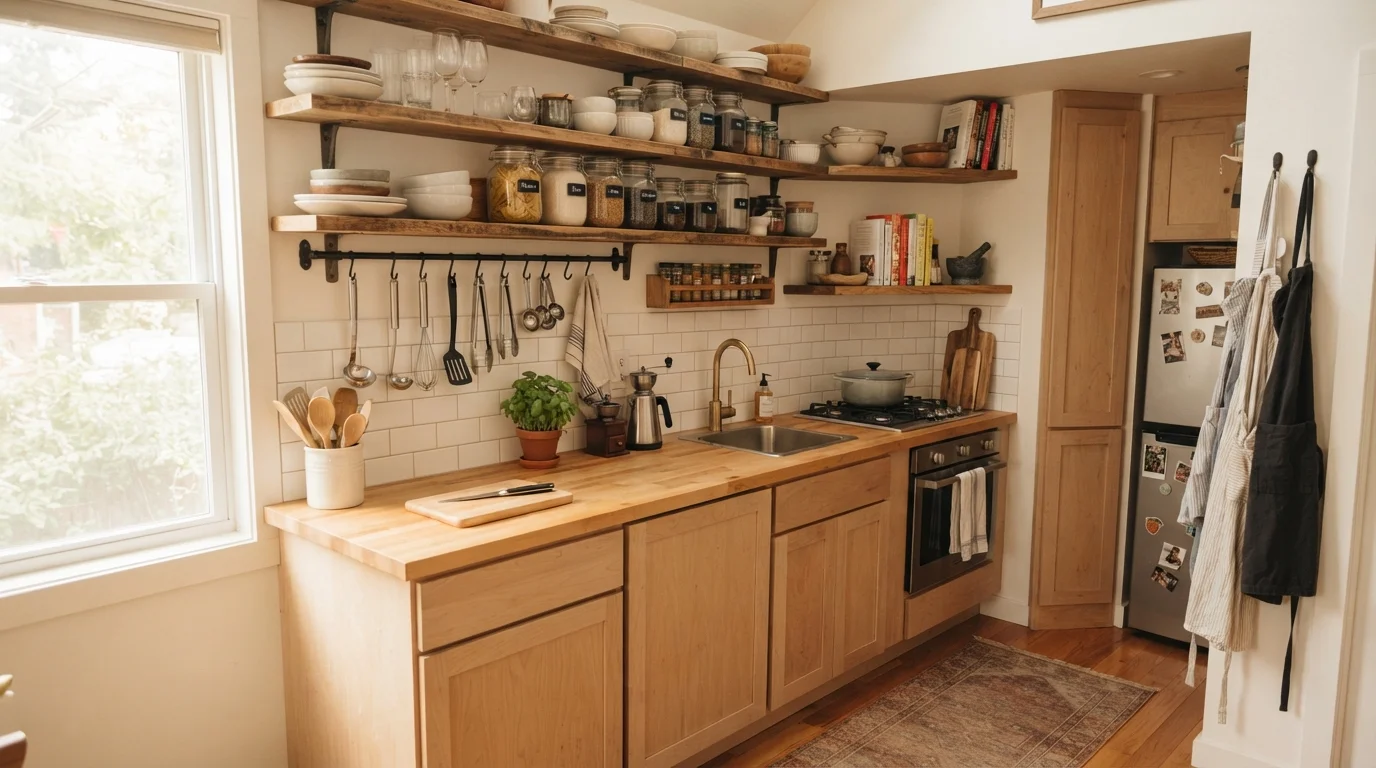
Magnetic knife strips mounted on a wall free up an entire drawer. A pegboard or rail system above or beside the stove keeps frequently used utensils reachable without crowding drawers. Command-hook-compatible rails on the inside of cabinet doors hold cutting boards, pot lids, or cleaning supplies. High shelves above refrigerators or upper cabinets are ideal for infrequently used items in lightweight bins labeled clearly from below.
For a deeper look at wall and door solutions, see our guide on vertical space in the kitchen.
Install hooks or a rail on the inside of your pantry or cabinet door for pot lids — they're the most awkward items to stack and are used almost every day.
Lid storage is one of the most common pain points in small kitchens. Door-mounted storage removes them from the cabinet interior entirely, freeing shelf space for items that stack cleanly.
Group items by task, not by type — keep everything needed for morning coffee in one spot, everything for packed lunches in another.
Task-based grouping reduces the number of steps and cabinet openings needed to complete a routine, which matters more in a small kitchen where movement space is limited.
Make Every Cabinet Work Harder
Standard cabinet shelves are often spaced for tall items even when you're storing short ones, leaving a gap of dead air above your stacked bowls or canned goods. Adjustable shelving or simple shelf risers (sturdy, stackable platforms) can double the usable layers inside a single cabinet.
Drawer-style pull-out organizers inside deep lower cabinets eliminate the need to unstack everything to reach the back. For the notoriously awkward space under the sink, consider tiered organizers that work around the drain pipe — our under-the-sink storage guide covers exactly this challenge.
Turntables (lazy Susans) work particularly well in corner cabinets and deep pantry shelves, making every item at any depth accessible with a single spin. Nest cookware with pan protectors between pieces to reduce stack height and prevent scratches.
50%+
Cabinet space often wasted by poor shelf spacing
Home organization professionals commonly cite poor vertical use of cabinet interiors as the leading cause of perceived storage shortfall in small kitchens.
1 in 3
Kitchen items used less than once a month
Consumer research on household clutter suggests a significant portion of kitchen tools and gadgets are used infrequently, taking up space needed for daily-use items.
Counter Space: What Stays, What Goes
Countertops are premium real estate. The only items that earn a permanent counter spot are those you use almost every day — a coffee maker, a toaster, or a knife block if drawer space is tight. Everything else should have a home elsewhere.
A common mistake is storing fruit bowls, decorative items, or appliances used only on weekends on limited counter space. Moving the occasional-use blender to a lower cabinet takes seconds to retrieve and frees up meaningful prep area. The case for a minimalist kitchen explores how far this principle can be taken and where it has real limitations.
If counter clutter stems partly from improper food storage, check out where food actually belongs — storing food in the right place reduces counter sprawl and extends shelf life simultaneously.
Multi-Use Tools and Smarter Food Storage
In a small kitchen, every item you own needs to justify its footprint. Multi-use tools — a Dutch oven that works as both a stockpot and a braiser, a colander that doubles as a salad spinner — reduce the total headcount of gear you're storing. Before adding anything new, ask whether something you already own can do the job. Our related piece on kitchen equipment worth learning properly makes a strong case for this approach.
For pantry and refrigerator storage, stackable containers in consistent sizes allow you to build upward instead of spreading outward. If you're unsure which container type suits which food, the container types reference guide breaks it down plainly. Reducing food waste is also a direct benefit of organized storage — less forgotten food means less clutter and a lower grocery bill, a point covered in depth in our article on reducing food waste.
Layout Tweaks That Actually Help
Small layout adjustments — without renovation — can meaningfully change how a compact kitchen feels and functions. A rolling cart adds movable prep space and can be tucked away when not in use. A cutting board that fits over the sink expands counter area during prep. Even repositioning the dish drying rack from counter to inside the sink when not in use recovers a surprising amount of workspace.
Consider whether open shelving would serve you better than closed cabinets in specific spots — open shelves can make a kitchen feel less boxed-in and keep frequently grabbed items visible and accessible. The open shelving vs. closed cabinets article walks through the practical pros and cons honestly. And if multiple people share your kitchen, coordination matters as much as storage — keeping a shared kitchen organized addresses how to maintain order when more than one person cooks and stores food in the same space.
Small kitchens reward intentional organization more than large ones. The strategies here don't require a renovation budget — they require a clear-eyed look at what you own, where it lives, and whether that arrangement actually serves how you cook.