

Key Takeaways
- Batch cooking saves weeknight time but requires a dedicated prep session, usually on weekends.
- Cooking fresh each night offers more flexibility but demands daily mental and physical effort.
- Food quality and variety can suffer with batch cooking if storage and reheating aren't handled well.
- A hybrid approach — prepping components, not complete meals — works well for many households.
- Neither method is universally better; the right fit depends on your schedule, household size, and cooking preferences.
Dramatically reduces weeknight cooking time
With meals already prepped, weeknight dinner can be as simple as reheating and plating — often under 10 minutes. This is the core appeal for households with demanding evening schedules.
Cuts decision fatigue across the week
Deciding what's for dinner is a small but daily mental load. Having meals planned and prepped removes that choice entirely, which many cooks find genuinely freeing.
Can reduce grocery spending through bulk prep
Cooking larger quantities of staple ingredients — grains, legumes, roasted vegetables — allows more efficient use of ingredients and reduces mid-week top-up trips to the store.
Minimizes food waste when planned carefully
A well-designed batch cook uses ingredients across multiple meals, reducing the chance that a bunch of herbs or a half-used can of beans gets forgotten in the fridge.
Food quality often declines by mid-week
Many foods — especially proteins, leafy greens, and anything with a crispy element — lose texture and freshness after refrigeration and reheating. This is an inherent limitation, not a fixable technique problem.
Requires a significant upfront time investment
A thorough batch cooking session typically takes two to three hours, which can feel burdensome on a weekend that already has competing demands.
Poor fit for unpredictable or changing schedules
If plans shift mid-week — a last-minute dinner out, unexpected guests, or a changed appetite — pre-cooked food can go to waste rather than deliver its intended convenience.
Variety is harder to maintain across the week
Eating variations of the same core ingredients across five nights can lead to flavor fatigue, particularly for household members who didn't choose the meal plan.
Our Verdict
Batch cooking and nightly cooking each solve a real problem, but neither is a perfect system. Batch cooking earns its place in households with predictable weekly schedules, limited weeknight time, and a tolerance for eating planned meals. Nightly cooking suits those who value spontaneity, cook for one or two, or find that food quality matters more than convenience. For many households, a middle path — prepping grains, proteins, or sauces in advance while leaving final assembly for each evening — delivers the best of both worlds.
Batch cooking is best for busy families or individuals who want dinner largely handled before the week starts; nightly cooking is best for flexible cooks who prioritize fresh results and variety.
Why the Choice Actually Matters
Getting a satisfying dinner on the table after a full workday is one of the most consistent friction points in home cooking. The two dominant strategies — batch cooking a week's worth of food in one session versus cooking fresh each evening — represent fundamentally different relationships with time, effort, and food quality.
Neither approach is objectively superior. Each involves real trade-offs that play out differently depending on your household size, schedule, and what you actually want from a meal. Understanding those trade-offs clearly is more useful than defaulting to whichever sounds more disciplined. If you're also wrestling with how to cut down on daily dinner decisions, see our weekly dinner rotation guide for a complementary framework.
The Case for Batch Cooking
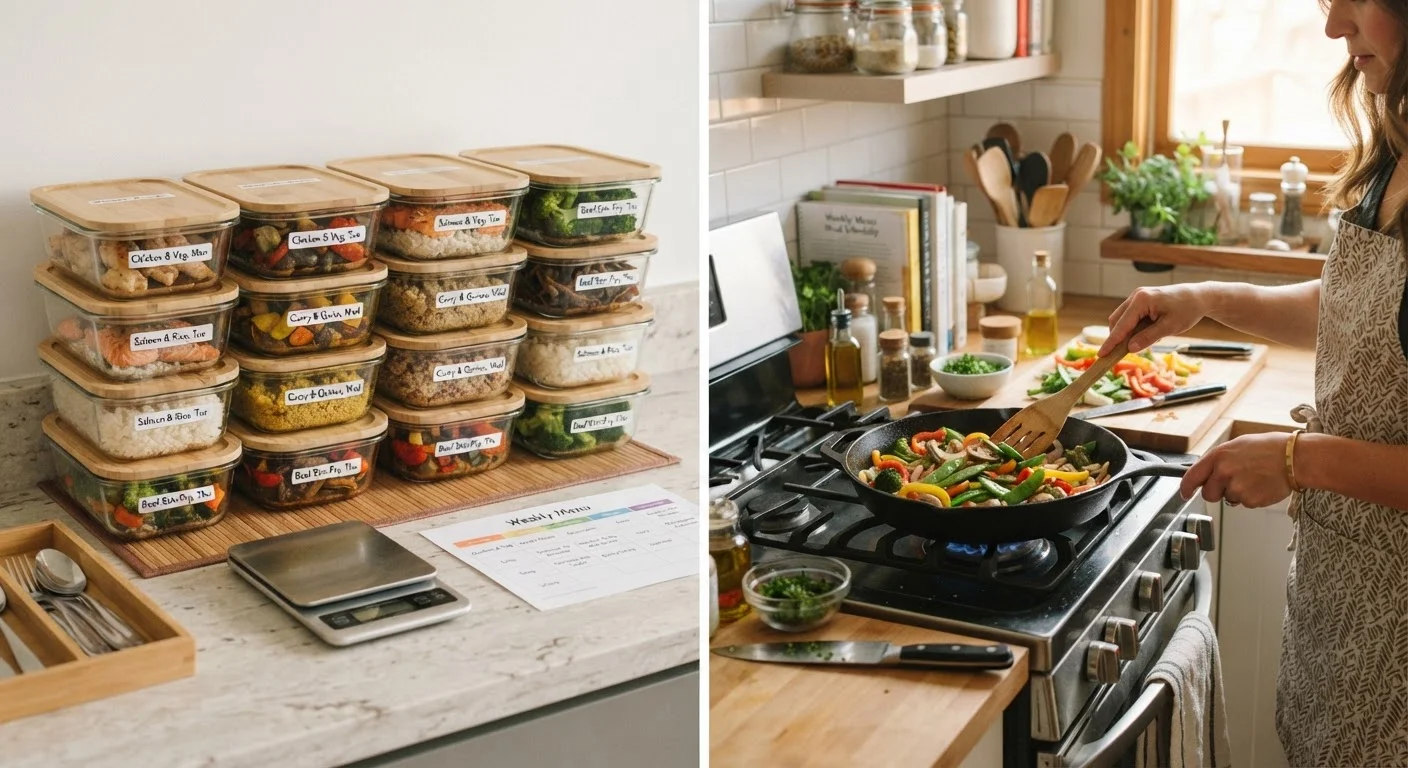
Batch cooking — preparing large quantities of food in a single session, then portioning for the week — appeals most to people who are time-poor on weeknights but have a block of free time on weekends.
Dramatically reduces weeknight cooking time
With meals already prepped, weeknight dinner can be as simple as reheating and plating — often under 10 minutes. This is the core appeal for households with demanding evening schedules.
Cuts decision fatigue across the week
Deciding what's for dinner is a small but daily mental load. Having meals planned and prepped removes that choice entirely, which many cooks find genuinely freeing.
Can reduce grocery spending through bulk prep
Cooking larger quantities of staple ingredients — grains, legumes, roasted vegetables — allows more efficient use of ingredients and reduces mid-week top-up trips to the store.
Minimizes food waste when planned carefully
A well-designed batch cook uses ingredients across multiple meals, reducing the chance that a bunch of herbs or a half-used can of beans gets forgotten in the fridge.
The most practical benefit is decision elimination. When dinner is already cooked, you avoid the daily mental tax of deciding what to make, shopping for missing ingredients, and managing cooking time around other obligations. For households with children, irregular work hours, or both, that reduction in friction is genuinely meaningful.
Batch cooking also tends to support budget-conscious cooking, since buying ingredients in larger quantities and minimizing food waste both contribute to lower per-meal costs. A whole batch of grains, a large pot of beans, or a roasted tray of vegetables stretches further than smaller daily purchases.
Where Batch Cooking Falls Short
The limitations of batch cooking are real and worth naming honestly before committing to the method.
Food quality often declines by mid-week
Many foods — especially proteins, leafy greens, and anything with a crispy element — lose texture and freshness after refrigeration and reheating. This is an inherent limitation, not a fixable technique problem.
Requires a significant upfront time investment
A thorough batch cooking session typically takes two to three hours, which can feel burdensome on a weekend that already has competing demands.
Poor fit for unpredictable or changing schedules
If plans shift mid-week — a last-minute dinner out, unexpected guests, or a changed appetite — pre-cooked food can go to waste rather than deliver its intended convenience.
Variety is harder to maintain across the week
Eating variations of the same core ingredients across five nights can lead to flavor fatigue, particularly for household members who didn't choose the meal plan.
Texture and freshness are the biggest casualties. Many foods — leafy greens, delicate fish, anything crispy — degrade noticeably after a day or two in the refrigerator. Reheated proteins can turn dry, and sauces may separate. This isn't a failure of technique; it's simply what happens to many foods over time.
Batch cooking also demands accurate forecasting. If your plans change mid-week — a dinner out, a sick day, an unexpected guest — prepped food can go to waste rather than save effort. And the upfront time cost is real: a thorough batch session can run two to three hours, which is a significant ask on a weekend day that may already feel crowded.
For a deeper look at when large-quantity cooking helps and when it doesn't, this balanced breakdown covers the honest limitations in more detail.
The Case for Cooking Fresh Each Night
Cooking a meal from scratch each evening has real advantages that batch cooking cannot replicate — and they're often undervalued in conversations about weeknight efficiency.
~43%
U.S. adults who say lack of time is their top cooking barrier
According to survey data from the International Food Information Council's Food and Health Survey, time pressure consistently ranks as a leading obstacle to home cooking.
30–40%
Estimated share of food wasted at the household level
The USDA estimates that a substantial portion of food purchased for home use is discarded — a figure that both batch cooking and better nightly planning can help reduce.
Freshly cooked food simply tastes better in most cases. Proteins cooked to order retain their intended texture. Vegetables stay bright and have better bite. You can adjust seasoning, portion size, and ingredients based on what the evening calls for, rather than what you committed to on Sunday.
Nightly cooking is also inherently more flexible. If you're cooking for one or two people, the economies of scale that benefit batch cooking shrink considerably — smaller households often find that batch-cooked portions go stale before they're consumed. Balancing from-scratch cooking with semi-homemade shortcuts can make nightly cooking significantly faster without sacrificing much freshness.
The Hybrid Middle Ground
Most experienced home cooks land somewhere between full batch cooking and fully fresh nightly cooking. The practical middle path is component prep: cooking foundational elements in advance — a pot of grains, a batch of roasted vegetables, a seasoned protein — while leaving final assembly and seasoning for each evening.
Component Prep vs. Full Meal Prep
There's an important distinction between prepping complete meals — portioned containers of finished dishes — and prepping components like cooked grains, roasted vegetables, or marinated proteins. Component prep gives you more flexibility to mix and match throughout the week, and ingredients stay fresher when they haven't been fully assembled. If you're new to batch cooking, starting with components rather than complete meals is a lower-risk entry point.
This approach captures most of batch cooking's time savings while preserving much of nightly cooking's freshness and flexibility. A cooked grain base, for instance, can go in a grain bowl one night, fried rice the next, and a soup base by midweek — with each meal tasting distinct rather than like leftovers.
Getting your prep sequence right matters a lot here. The mise en place principle for home cooks explains how arranging what you prep — and in what order — changes how smoothly the rest of the week flows. If you want a full walkthrough of planning and executing a weekly prep session, building a week of meals in one session offers a step-by-step guide.