

Key Takeaways
- Vertical storage solves most problems with flat, rigid items like cutting boards and baking sheets.
- Pot lids are among the most space-wasting items in any kitchen — a simple rack fixes that.
- Cabinet doors and drawer dividers unlock storage you're probably already ignoring.
- Bulky small appliances stay accessible without cluttering counters when given dedicated shelf zones.
- Consistent placement — not perfection — is what makes kitchen organization stick long-term.
Why Awkward Items Need Their Own Strategy
Most kitchen storage systems are designed around standard-sized dishes and pantry goods. The outliers — tall cutting boards, slippery pot lids, oversized baking sheets, bulky stand mixers — resist the usual cabinet layouts and end up wedged wherever they technically fit. The result is wasted space, constant reshuffling, and items that never quite have a home.
The fix isn't buying more cabinets. It's rethinking how specific categories of items are stored. Flat things should stand upright. Round things need containment. Bulky things need zones, not shelves they share with everything else. The strategies below address each of these pain points directly, using approaches that work across kitchen sizes and budgets. If your kitchen is especially tight, these space-maximizing strategies pair well with the ideas here.
Stand cutting boards upright with a file organizer or tension rods
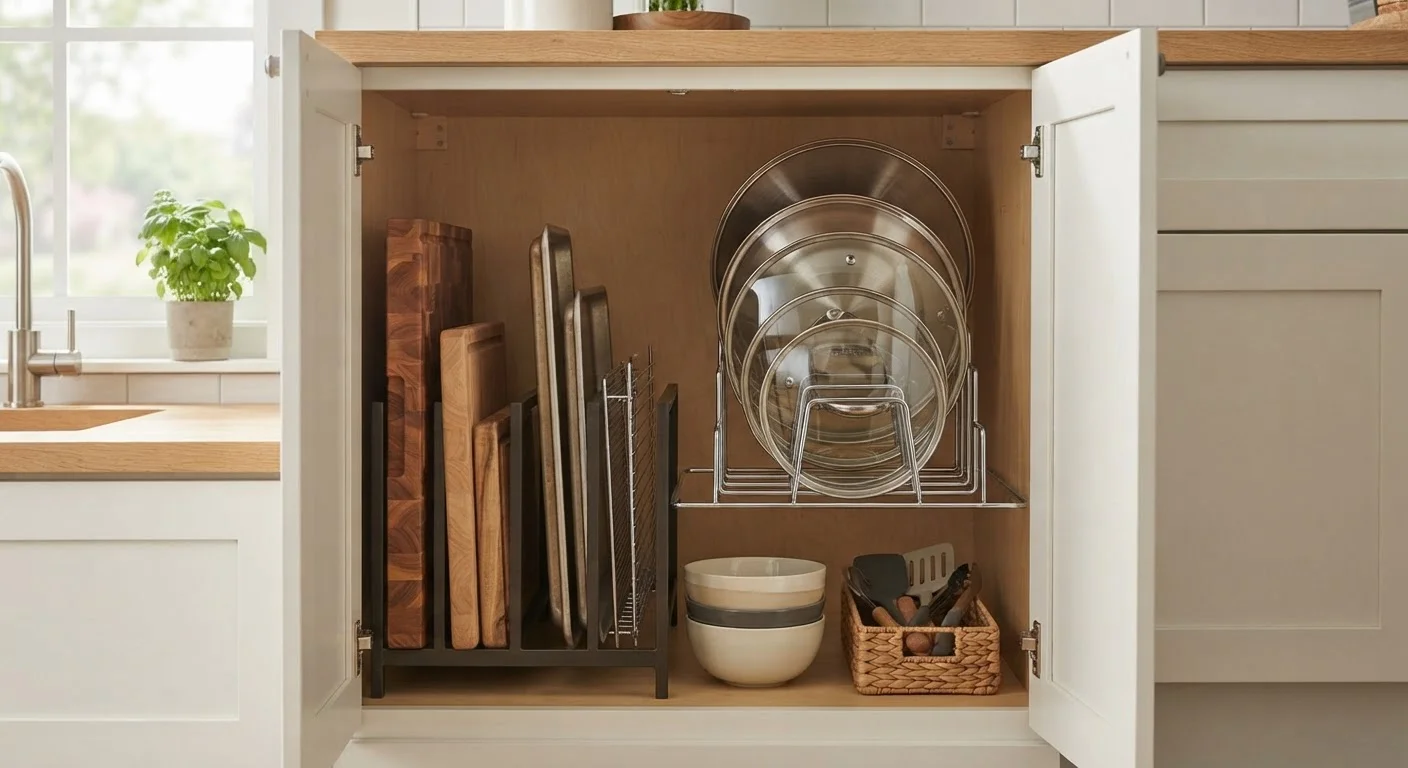
Cutting boards stacked flat in a cabinet become an unstable pile that requires unpacking to reach the one you need. Standing them vertically — using a metal file organizer, a dish rack insert, or a few tension rods mounted inside a cabinet — makes each board immediately accessible and keeps them from trapping moisture between surfaces.
This works equally well for plastic and wood boards of different thicknesses. If you have multiple boards, grouping them by size within the same vertical holder makes retrieval even faster.
Standing boards vertically eliminates the stack problem and keeps moisture from getting trapped underneath.
Corral pot lids in a dedicated rack or on a cabinet door
Pot lids are structurally awkward: round, smooth, and prone to sliding. Nesting them inside the pot they belong to works for one or two, but breaks down quickly when you have multiple sizes. A wire lid rack — either freestanding inside a cabinet or mounted on the inside of a cabinet door — keeps lids organized and upright without them touching each other.
Cabinet door mounting is especially efficient because it uses space that's almost always empty. Just confirm the door closes fully with the rack in place before committing to the placement.
Mounting a lid rack on the inside of a cabinet door uses space that's almost always wasted.
Store baking sheets and trays vertically using dividers
Sheet pans, muffin tins, and cooling racks are wide, flat, and heavy when stacked. Storing them on their edges in a cabinet fitted with adjustable dividers — similar to a filing system — makes it easy to pull out exactly what you need without lifting everything on top of it.
Adjustable wire dividers that sit on a cabinet shelf are inexpensive and require no installation. Fixed built-in dividers provide a cleaner look but are less flexible if your collection changes. Either approach is far more functional than a flat stack.
Treating baking sheets like files in a cabinet makes them easy to grab without disturbing the rest.
Give bulky appliances a dedicated shelf zone
Stand mixers, food processors, and blenders are heavy and awkward to move repeatedly, which is why they tend to stay wherever they were last used. If counter space is limited, consider a lower cabinet shelf with enough clearance for the appliance's full height — and nothing else stacked on top of it.
A small piece of non-slip mat under each appliance makes it easier to slide out without lifting. Keeping frequently used appliances at the front of the shelf and occasional-use items toward the back creates a natural priority system. Using vertical space creatively can also free up the lower cabinet room these items need.
A dedicated low-shelf zone with non-slip matting makes heavy appliances easy to access without lifting.
Use deep drawer inserts for wraps, foils, and oddly shaped tools
Plastic wrap, aluminum foil, parchment paper, and large kitchen tools like ladles or slotted spoons tend to clutter drawers because they don't fit standard cutlery organizers. A deep drawer fitted with adjustable pegboard inserts or compartmentalized inserts designed for taller items keeps these upright and easy to locate.
For drawers that are too shallow for this, a mounted dispenser on the inside of a cabinet door handles foil and wrap rolls cleanly, freeing up the drawer for tools. The same logic that works under the sink — working around fixed obstacles with targeted organizers — applies equally well to problem drawers.
Adjustable drawer inserts designed for taller items solve the jumbled wrap-and-tool drawer immediately.
Handle mixing bowls with nesting plus a single anchor point
Mixing bowls nest well in theory, but the stack becomes unwieldy once you have more than three or four. The most practical approach is to choose one anchor point — a lower cabinet shelf or a deep drawer — and commit to keeping the full nested set there. Add a non-slip liner underneath the bottom bowl to prevent the stack from shifting when you pull one out.
If cabinet space is tight, hanging a few bowls on a wall-mounted rack or storing them inside the largest pot you own can reduce the footprint significantly without scattering them across multiple locations.
Choosing a single anchor point for your bowl stack prevents them from migrating across the kitchen.
Making It All Hold Up Over Time
Storage solutions only work when they're easy to maintain. If putting something away requires more effort than just setting it down, the system will break down within a week. The goal is to make the right spot the easiest spot.
Test before you commit
Before mounting anything or buying additional organizers, do a one-week trial by simply rearranging how you store the problem item. Use a rubber band, a piece of tape, or a temporary container to simulate the new system. If it works in practice, then invest in the more permanent solution. This prevents spending money on organizers that don't actually match how you use your kitchen.
Start with just one or two problem items rather than reorganizing everything at once. Nail the cutting board situation, then tackle lids, then move to appliances. Incremental changes are easier to sustain. For ideas on expanding these habits to your pantry, see pantry organization principles that hold up over time.
Also worth exploring: your kitchen's vertical surfaces are almost certainly underused. Walls, cabinet doors, and the space above the refrigerator can all absorb items that are currently competing for drawer or shelf space. Vertical storage solutions can make a real difference without requiring any structural changes.