

Key Takeaways
- Cooking from scratch generally costs less but demands more active time and planning.
- Semi-homemade cooking uses prepared ingredients to cut weeknight effort without abandoning home cooking entirely.
- The smartest weeknight strategy usually blends both approaches depending on the day and dish.
- Factors like available time, household size, and skill level should drive your choice each night.
- Neither approach is inherently superior — consistency and flexibility matter most.
Our Verdict
Cooking entirely from scratch every weeknight is an admirable goal but an unrealistic daily standard for most busy households. Semi-homemade cooking — leaning on quality prepared components — is a practical, legitimate tool rather than a shortcut to feel guilty about. The most effective approach is a flexible hybrid: default to semi-homemade on the most hectic nights and invest in scratch cooking when time and energy allow.
| Best for | Recommended |
|---|---|
| Budget-conscious households with some prep time | From scratch |
| Households with very limited weeknight time | Semi-homemade |
| Most families navigating an unpredictable week | A flexible blend of both |
| New or less confident cooks building skills gradually | Semi-homemade as a starting point |
What We Mean by Each Approach
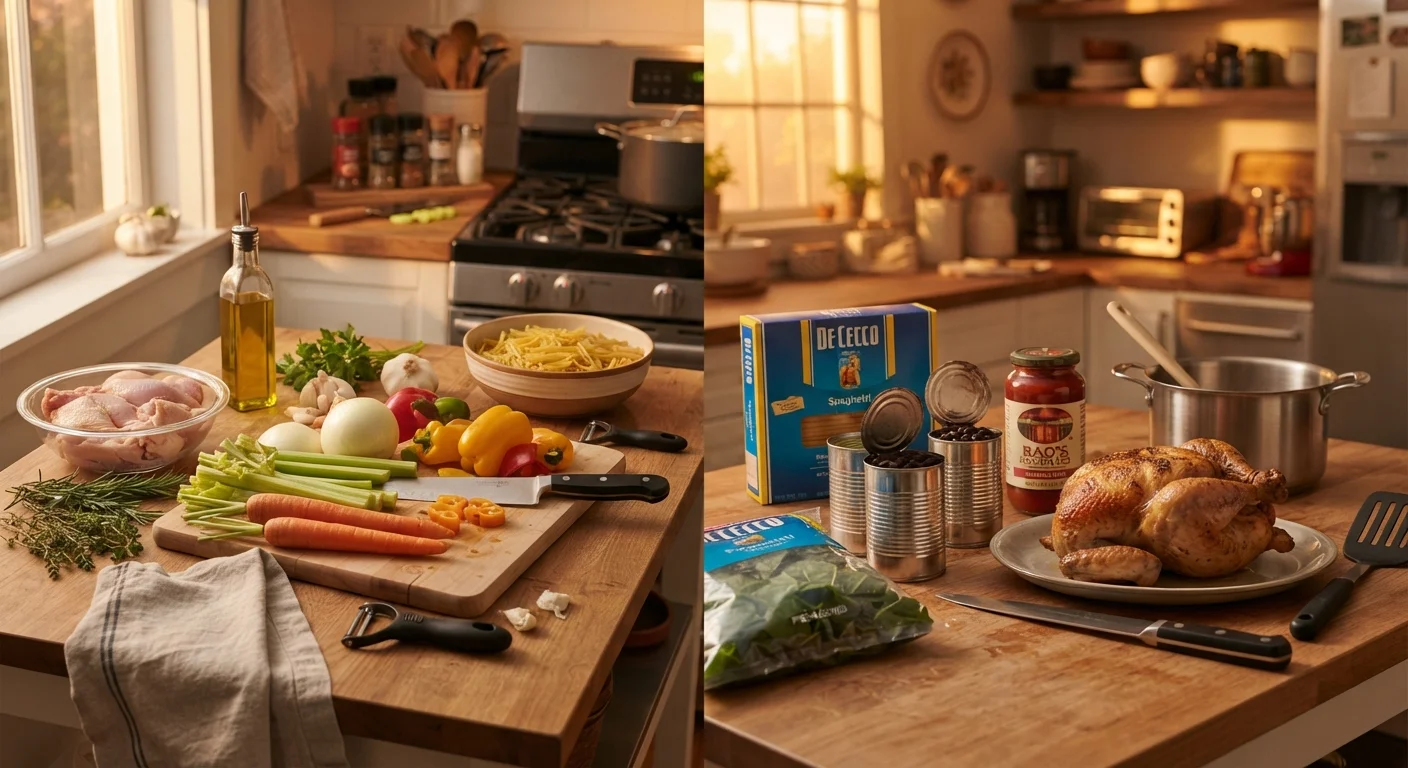
Cooking from scratch means starting with whole, raw ingredients — dried beans, uncooked grains, raw proteins, fresh produce — and building a meal without leaning on pre-processed shortcuts. Semi-homemade cooking means intentionally incorporating prepared components — canned beans, store-bought broth, rotisserie chicken, pre-washed salad greens, jarred pasta sauce — to reduce hands-on time while still assembling and seasoning the final dish yourself.
Neither definition requires perfection. Most weeknight cooking lands somewhere on a spectrum between the two, and that's exactly the point. If you're new to building a consistent dinner routine, see our weeknight cooking playbook for a grounding in the foundational habits that make both approaches more manageable.
Where From-Scratch Cooking Has a Real Edge
From-scratch meals tend to win on cost, sodium control, and flavor depth. A pot of dried lentils or beans costs a fraction of canned equivalents. A homemade tomato sauce using crushed canned tomatoes, garlic, and olive oil lets you control seasoning entirely. Soups, braises, and grain dishes built from raw ingredients often taste noticeably more layered because you're building flavor at each stage.
From scratch also pays off when you're cooking in volume. If you're investing a Sunday afternoon, the time cost per meal drops significantly — see our batch cooking from scratch guide for a practical walkthrough. The real trade-off is active time on weeknights: soaking beans, simmering stock, or breaking down a whole chicken aren't realistic at 6 p.m. on a Tuesday for most households.
Make Scratch Cooking Faster with Micro-Prep
You don't have to choose between a full Sunday prep session and starting from zero every night. Spending 10–15 minutes on a weekday morning — rinsing and draining canned beans, washing greens, or marinating protein — can cut your active evening cooking time substantially. Small prep actions compound across the week without requiring a dedicated cooking block.
Where Semi-Homemade Earns Its Place
Semi-homemade cooking is not about laziness — it's about making strategic trade-offs. A rotisserie chicken over roasted sheet-pan vegetables with jarred salsa verde is a legitimate, nourishing dinner assembled in under 20 minutes. Canned chickpeas sautéed with canned tomatoes, spinach, and spices over quick-cook couscous is fast, affordable, and genuinely satisfying.
Prepared components also lower the barrier for less experienced cooks. When you don't have to worry about cooking raw chicken safely from scratch or building a sauce from nothing, you can focus on seasoning and timing — skills that build confidence over time. For more on where friction really comes from in weeknight cooking, our piece on why weeknight cooking feels harder than it should is worth a read.
| From Scratch | Semi-Homemade | |
|---|---|---|
| Typical weeknight time | 45–90 minutes | 15–30 minutes |
| Ingredient cost | Generally lower | Moderate — convenience carries a premium |
| Sodium & additive control | Full control | Limited — varies by product |
| Skill required | More technique involved | Lower barrier to entry |
| Flavor depth | Higher potential with time | Depends on product quality and seasoning |
| Planning needed | Significant — ingredient prep matters | Minimal — pantry staples carry you |
| Best use case | Weekends, batch sessions, lower-stress nights | Busy weeknights, low-energy evenings |
Building a Practical Hybrid Strategy
The most durable weeknight system isn't a commitment to one camp — it's a flexible framework. Consider mapping your week by energy level and available time rather than by principle. A Monday with a long commute calls for a 20-minute semi-homemade meal; a relaxed Wednesday might be the right moment to simmer a from-scratch soup that doubles as Thursday's lunch.
A few practical anchors help:
- Keep a semi-homemade pantry stocked — canned beans, good-quality broth, jarred tomatoes, and pre-cooked grains give you fast building blocks without much planning.
- Identify two or three from-scratch recipes you genuinely enjoy and rotate them when you have margin. Familiarity makes them faster over time.
- Use prepared proteins strategically — a store-bought rotisserie chicken, canned fish, or pre-cooked sausage can anchor a from-scratch vegetable dish, giving you the best of both worlds.
For more structure on building a repeatable dinner system, our guide on building a weekly dinner rotation offers a step-by-step approach to cutting decision fatigue throughout the week. And if you're weighing whether to prep ahead rather than cook nightly, batch cooking vs. cooking fresh each night lays out the honest pros and cons.