

Key Takeaways
- Weeknight cooking difficulty is usually a planning problem, not a skill problem.
- Decision fatigue at dinnertime is one of the most overlooked obstacles for home cooks.
- A reliable protein and a few pantry staples can carry most weeknight meals.
- Reducing choices ahead of time — not adding more recipes — is what builds consistency.
- Small weekend prep habits have an outsized impact on how weeknights feel.
Weeknight Cooking Friction
Weeknight cooking friction refers to the accumulated small obstacles — missing ingredients, unclear plans, decision fatigue — that make getting dinner on the table feel harder than it should. It's rarely about lacking cooking skill. Instead, it's the gap between the energy you have at 6 p.m. and the mental load that dinner still demands. Identifying where friction enters your routine is the first step to reducing it.
In behavioral research, 'friction' describes any environmental or cognitive barrier that interrupts a desired behavior. Applied to home cooking, even minor planning gaps can be enough to trigger takeout over a home-cooked meal.
The Real Problem Isn't Cooking — It's Deciding
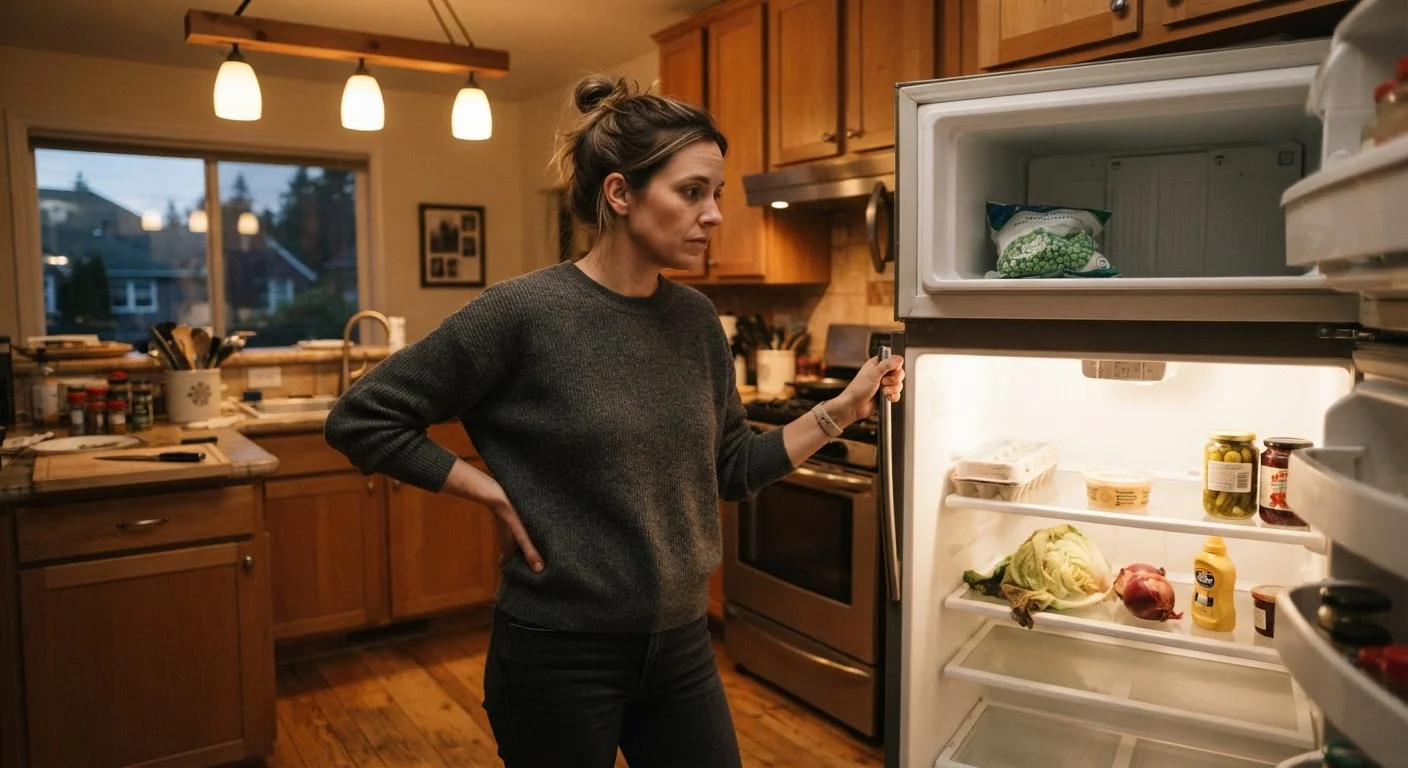
Most people assume weeknight cooking is hard because they lack skill, time, or the right recipes. In practice, the bigger obstacle is much earlier in the process: the moment you arrive home hungry, tired, and without a clear plan. That moment — not the actual cooking — is where most dinners fall apart.
Decision fatigue is a well-documented phenomenon in behavioral science. After a full day of choices at work, in traffic, and managing household logistics, the mental bandwidth available for something as open-ended as "what should we have for dinner?" is genuinely depleted. It's not weakness or laziness — it's how human cognition works under accumulated load.
The solution isn't more inspiration or a longer recipe collection. It's fewer decisions at dinnertime, made by a version of you that had more energy — ideally sometime over the weekend. See our before-the-week-starts checklist for a straightforward way to do exactly that.
Decide Dinners Before You're Hungry
The single highest-leverage habit in weeknight cooking is making meal decisions when you're not yet tired or hungry — ideally on Sunday afternoon. Even a loose plan like "pasta Monday, tacos Wednesday, stir-fry Friday" removes the hardest part of weeknight cooking before it begins. You don't need a rigid schedule; you just need to avoid making the decision at the worst possible time.
Where Friction Actually Lives in a Weeknight Kitchen
Once you start looking for friction points, they appear in predictable places. The most common ones are:
- No protein thawed or ready. Dinner stalls before it starts if your main ingredient needs an hour to defrost.
- A pantry that doesn't match your planned meals. Running to the store mid-week is a reliable way to abandon cooking altogether.
- Recipes that assume more prep time than they state. A "30-minute meal" that assumes pre-chopped vegetables and a preheated oven isn't actually 30 minutes. Our guide to what 30-minute meals actually require unpacks this honestly.
- An unclear kitchen setup. When tools aren't where you expect them, small inefficiencies stack up fast. Good kitchen organization matters more than most cooks realize.
None of these require a skill upgrade to fix. They require a small systems upgrade.
~57%
Americans who say they don't have enough time to cook
A recurring finding in food industry surveys, including data from the International Food Information Council, shows perceived time scarcity is the top barrier to home cooking — ahead of skill or cost.
35,000+
Decisions the average adult makes each day
Behavioral researchers estimate adults make tens of thousands of micro-decisions daily, which helps explain why open-ended dinner planning at day's end feels disproportionately hard.
6–8
Meals in a functional weeknight rotation
Meal planning practitioners and registered dietitians commonly recommend a rotation of six to eight familiar meals as the sweet spot between variety and decision simplicity.
What a Low-Friction Weeknight Routine Actually Looks Like
The households that consistently cook on weeknights without stress share a few habits — and they're simpler than they look from the outside.
They cook from a rotation, not a fresh search. A set of six to eight familiar meals, loosely rotated, means dinner is already half-decided before the week begins. This isn't monotony — it's the same way restaurants use a menu. Our guide to building a dinner rotation walks through how to build one that holds up over time.
They stock fast-cooking proteins. Eggs, canned beans, thin-sliced chicken, and canned fish are weeknight workhorses. Understanding how each one behaves in the pan — and how long each actually takes — turns a bare fridge into a real meal. The weeknight protein guide covers this in practical detail.
They use semi-homemade shortcuts without apology. Rotisserie chicken, canned tomatoes, pre-washed greens, and frozen vegetables aren't shortcuts to feel guilty about — they're tools. Knowing when to cook from scratch and when not to is itself a skill worth developing.
“The key to getting dinner on the table consistently isn't cooking faster — it's thinking about dinner earlier in the day, or better yet, earlier in the week.”
— Food & Cooking Editorial Team, Weeknight Meal Strategy Editors
The Mindset Shift That Changes Everything
Many home cooks hold themselves to an implicit standard — that a real weeknight dinner means cooking everything fresh, from scratch, with variety every night. That standard, applied to the actual conditions of a full-time household on a Tuesday at 6:30 p.m., is nearly impossible to sustain.
Letting go of that standard isn't lowering the bar. It's adjusting expectations to match reality, which is what actually produces consistent home-cooked meals over months and years.
A bowl of eggs and roasted vegetables over rice isn't a lesser dinner — it's a competent one. Repeated weekly, it becomes a reliable anchor that makes the rest of the week easier. For cooks building this kind of consistency from the ground up, The Weeknight Cooking Playbook offers a structured path from uncertainty to confidence.
The friction you feel on weeknights is real — but its source is almost always fixable. The fix rarely involves learning new techniques. It involves setting up simpler conditions before the week begins.