

Key Takeaways
- Minimalist kitchens reduce visual clutter and can make cleaning significantly faster.
- Fewer items on counters doesn't always mean a more functional cooking space.
- Households that cook frequently or have multiple cooks may find minimalism limiting.
- A hybrid approach — minimal surfaces with smart hidden storage — often works best.
- Decluttering before adopting any style is the most reliable first step.
Faster daily cleaning with fewer surfaces to wipe
Clear countertops eliminate the step of moving objects before cleaning, which makes wiping down surfaces quicker and more likely to happen consistently.
Reduces visual stress in a high-activity room
Research in environmental psychology suggests cluttered spaces can increase cognitive load. A calmer visual field in the kitchen may support a more relaxed cooking experience.
Easier to spot what needs restocking
When fewer items are stored, inventory becomes more visible and manageable — reducing the chance of buying duplicates or missing essentials.
Encourages deliberate purchasing habits
Committing to a minimal kitchen creates a natural filter against impulse buys and single-use gadgets that rarely earn their keep in a drawer.
Can make a small kitchen feel larger
Clearing countertops opens sightlines and can make compact kitchens feel more spacious without any structural change.
Inconvenient if storage space is already limited
Moving items off countertops only works if there's somewhere logical to store them. In kitchens with insufficient cabinet or drawer space, minimalism can create clutter in less visible but still problematic places.
Frequent cooks may find it slows prep down
If everyday tools — a cutting board, an oil bottle, a colander — have to be retrieved from storage before every meal, the kitchen becomes less efficient rather than more.
Requires consistent habits from all household members
A minimalist kitchen only stays that way if everyone using it buys into the system. In multi-person households, that alignment can be difficult to maintain.
Can feel cold or unwelcoming to some households
A kitchen that's purely functional with no visible personality may not reflect how a family actually lives in and uses the space — particularly if cooking is a social, communal activity.
Risk of over-purging useful items
Taken too far, minimalism can lead to getting rid of tools you do need — only to replace them later at additional cost. Utility should drive decisions, not aesthetics alone.
Our Verdict
A minimalist kitchen delivers real benefits in cleanliness, visual calm, and easier maintenance — but those gains depend on your household having the right storage infrastructure to hide what gets cleared off surfaces. For light cooks or smaller households, it can be a genuinely practical setup. For busy, high-volume cooking households, strict minimalism can create friction rather than ease.
Best suited to smaller households, infrequent cooks, or homeowners who have adequate cabinet and drawer space to store everyday essentials out of sight without inconvenience.
What a Minimalist Kitchen Actually Means
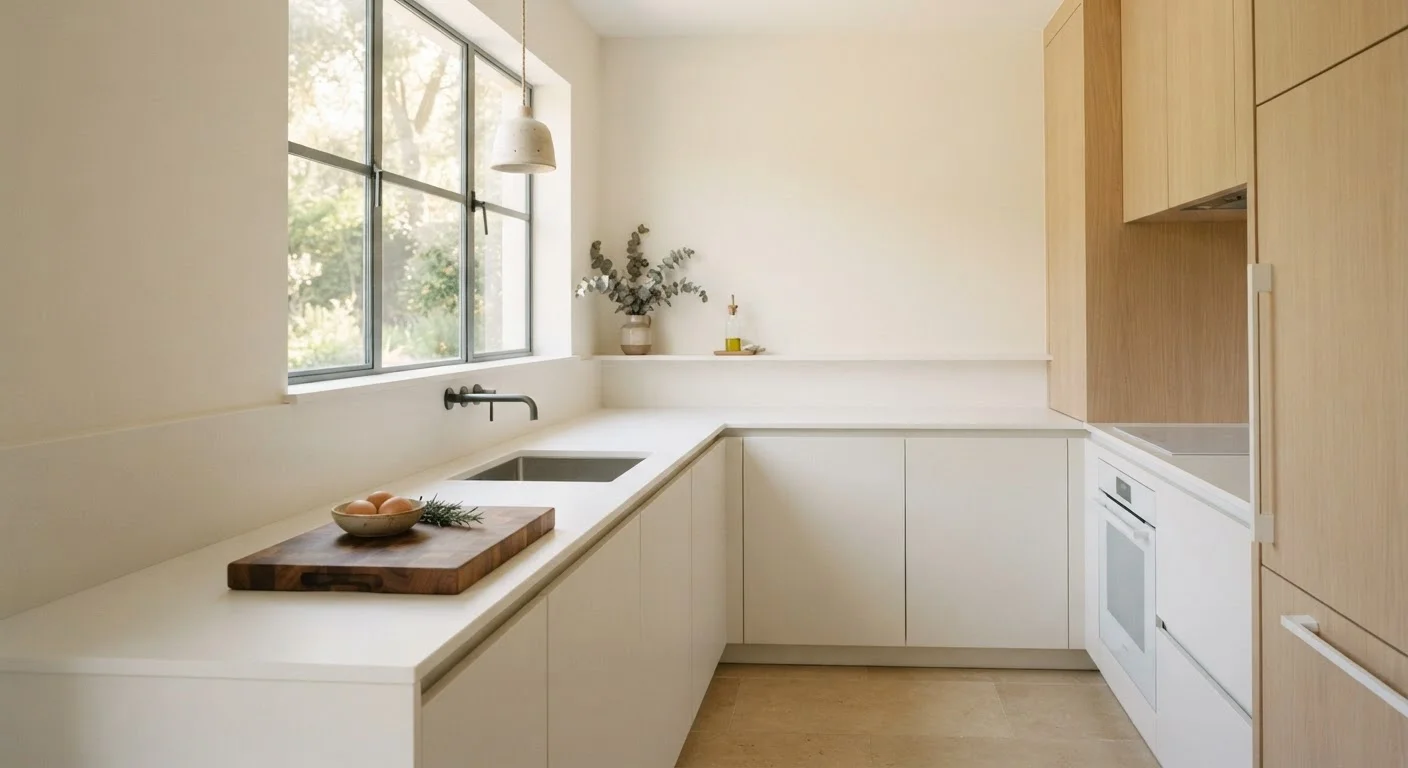
A minimalist kitchen isn't simply a tidy kitchen. It's a deliberate approach to keeping only what you regularly use, storing everything out of sight, and designing the space so that surfaces remain clear by default — not just after a cleaning session.
In practice, this often means countertops with one or two appliances at most, closed cabinet storage that handles the bulk of daily tools, and a willingness to put things away after every use. It's a system as much as an aesthetic. Before deciding whether it suits your home, it helps to weigh both sides honestly.
If you're starting from scratch with how you organize your space, the Kitchen Organization From the Ground Up guide is a useful reference for thinking through zones and storage before committing to any particular style.
The Real Advantages of Going Minimal
There are legitimate, practical reasons homeowners gravitate toward a stripped-back kitchen — and they go beyond aesthetics.
Faster daily cleaning with fewer surfaces to wipe
Clear countertops eliminate the step of moving objects before cleaning, which makes wiping down surfaces quicker and more likely to happen consistently.
Reduces visual stress in a high-activity room
Research in environmental psychology suggests cluttered spaces can increase cognitive load. A calmer visual field in the kitchen may support a more relaxed cooking experience.
Easier to spot what needs restocking
When fewer items are stored, inventory becomes more visible and manageable — reducing the chance of buying duplicates or missing essentials.
Encourages deliberate purchasing habits
Committing to a minimal kitchen creates a natural filter against impulse buys and single-use gadgets that rarely earn their keep in a drawer.
Can make a small kitchen feel larger
Clearing countertops opens sightlines and can make compact kitchens feel more spacious without any structural change.
30%
Of kitchen items used regularly
Home organization professionals commonly estimate that roughly 30% of kitchen tools see regular use — with the remainder occupying storage space infrequently or not at all.
~8 min
Average daily time spent tidying kitchen
Household surveys suggest Americans spend several minutes per day on kitchen tidying; minimalist setups are often cited by organizers as reducing this time meaningfully.
Fewer items on display also means fewer decisions about where things live. When every tool has a fixed home inside a drawer or cabinet, the kitchen tends to stay organized more reliably than in spaces where items accumulate wherever there's room.
Where Minimalism Creates Friction
The limitations of a minimalist kitchen become apparent quickly in households with heavier cooking demands or limited storage infrastructure.
Inconvenient if storage space is already limited
Moving items off countertops only works if there's somewhere logical to store them. In kitchens with insufficient cabinet or drawer space, minimalism can create clutter in less visible but still problematic places.
Frequent cooks may find it slows prep down
If everyday tools — a cutting board, an oil bottle, a colander — have to be retrieved from storage before every meal, the kitchen becomes less efficient rather than more.
Requires consistent habits from all household members
A minimalist kitchen only stays that way if everyone using it buys into the system. In multi-person households, that alignment can be difficult to maintain.
Can feel cold or unwelcoming to some households
A kitchen that's purely functional with no visible personality may not reflect how a family actually lives in and uses the space — particularly if cooking is a social, communal activity.
Risk of over-purging useful items
Taken too far, minimalism can lead to getting rid of tools you do need — only to replace them later at additional cost. Utility should drive decisions, not aesthetics alone.
The biggest practical tension is that minimalism assumes adequate storage. If your cabinets are already full, clearing countertops simply means putting things somewhere inconvenient — which defeats the purpose. Before adopting a minimal approach, a kitchen declutter audit can reveal whether you have the underlying storage capacity to make it work.
A Hybrid Approach Worth Considering
Most functional kitchens land somewhere between fully minimalist and maximally stocked. A sensible middle ground keeps surfaces clear of seldom-used items while keeping daily-use tools accessible — whether that's a coffee maker that stays out or a knife block that earns its counter space.
Open Shelving Changes the Calculus
If your kitchen has open shelving rather than closed cabinets, minimalism becomes even more demanding — everything stored is still visible, so the discipline required is higher. Closed storage makes a minimal countertop look coherent without requiring perfectly arranged shelves. If you're weighing storage types, the open shelving vs. closed cabinets breakdown covers the practical tradeoffs in detail.
If you're working with a small kitchen, the strategies outlined in Small Kitchen, Smart Storage show how vertical space and multi-use tools can support a leaner setup without sacrificing function. The same principles apply to kitchens of any size.
The question isn't whether minimalism is objectively better — it's whether the tradeoffs fit how your household actually cooks. See how your current layout holds up against an efficient kitchen workflow checklist to get a clearer picture of what's genuinely working and what's just taking up space.