

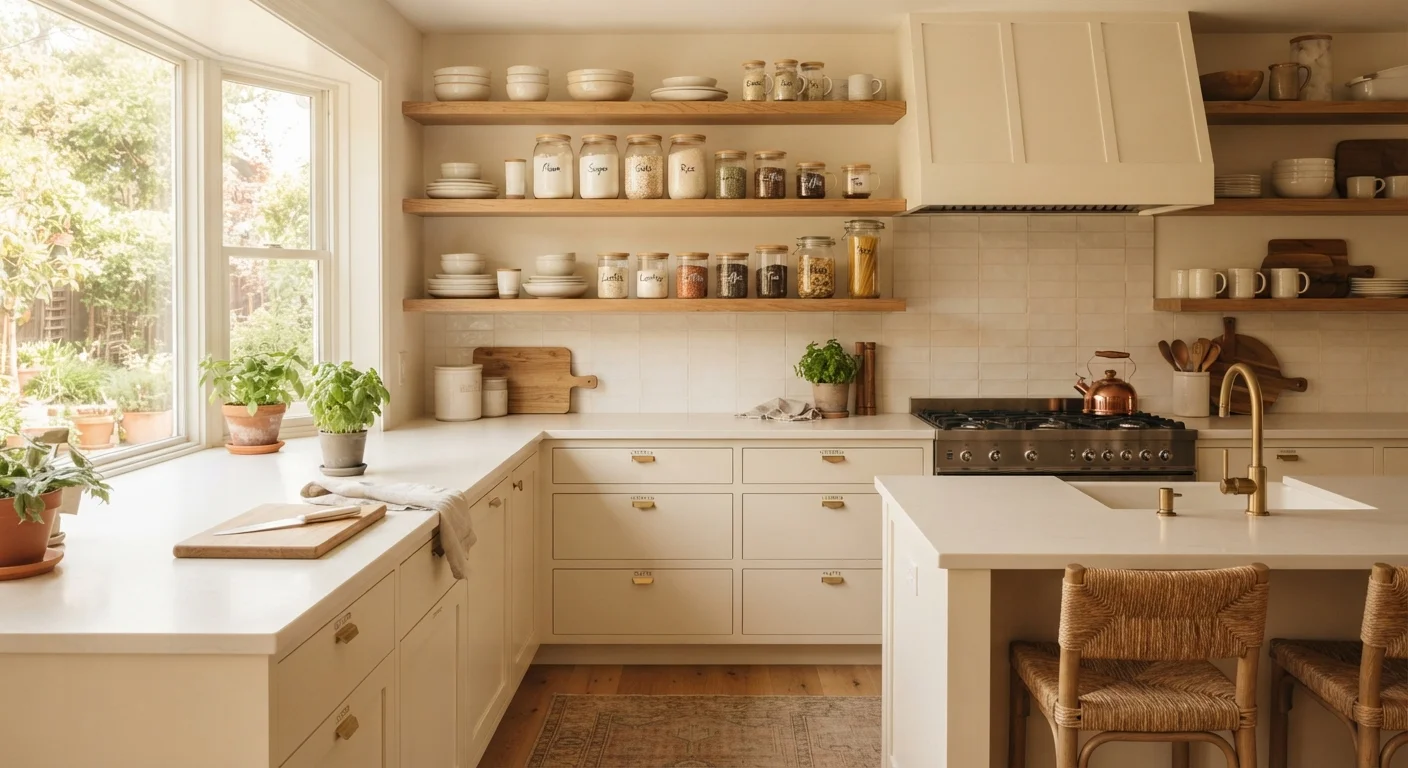
Key Takeaways
- Decluttering before organizing prevents wasted effort on items you don't actually use.
- Dividing your kitchen into activity-based zones cuts prep time and reduces daily friction.
- Most items should be stored closest to where you use them, not where they happen to fit.
- Countertops work best when reserved only for daily-use items.
- Consistency — not perfection — is what keeps a kitchen organized over time.
Start here
Why Kitchen Organization Feels Overwhelming (And How to Start)
First step
Declutter Before You Organize
Build your system
Mapping Your Kitchen Into Zones
Go deeper
Drawers, Shelves, and Cabinets: Where Things Actually Belong
Final touches
Countertop Rules: What Earns Its Spot
Maintain it
Keeping It Organized Long-Term
Why Kitchen Organization Feels Overwhelming (And How to Start)
Most people don't struggle with organization because they lack discipline — they struggle because they try to organize everything at once without a clear plan. A kitchen touches nearly every daily habit, from morning coffee to late-night snacks, which means disorder compounds fast.
The key shift is treating kitchen organization as a project with phases, not a single afternoon task. You'll declutter first, then assign zones, then address specific storage areas one at a time. This guide walks through that sequence so you can build a system that actually holds up under daily use.
If you also want to understand how workflow fits into the picture, this kitchen workflow checklist pairs well with the organizational steps here.
Kitchen zone
A defined area of your kitchen dedicated to a specific task or activity, such as food prep or cooking, where related tools and supplies are stored nearby.
Shelf riser
A small elevated platform placed inside a cabinet or on a shelf to create a second tier of storage, effectively doubling usable vertical space.
Drawer divider
An insert or adjustable partition that separates a drawer into sections, keeping utensils and small items from shifting and mixing together.
Decluttering
The process of removing items you no longer use, need, or want before reorganizing what remains — distinct from simply tidying or rearranging.
Vertical storage
Using the height of a cabinet, wall, or pantry to store items stacked or hung upward, rather than spread out horizontally across a surface.
Declutter Before You Organize
Organizing items you don't need is just tidying clutter into neater piles. Before touching a single bin or drawer insert, pull everything out of your cabinets and evaluate it honestly. The test is simple: do you use it, does it work, and does it earn its space?
Common offenders include duplicate utensils, appliances used fewer than a handful of times per year, and mismatched food storage containers missing their lids. Set aside anything expired, broken, or genuinely redundant.
For a structured approach to this step, a room-by-room kitchen audit checklist can help you work through every surface methodically without missing anything.
Don't Skip the Declutter Step
Jumping straight to buying organizers without first removing what you don't need is one of the most common — and costly — mistakes. You'll spend money on storage solutions that end up holding things you'd have been better off donating or discarding. Give yourself permission to reduce before you organize.
Mapping Your Kitchen Into Zones
Zones are the backbone of any functional kitchen. Rather than storing things by category (all baking supplies together, wherever they fit), you store them by where you use them. The four core zones in most home kitchens are: prep, cooking, cleaning, and pantry/storage.
- Prep zone: Near your primary cutting surface — knives, cutting boards, mixing bowls, peelers, and measuring tools.
- Cooking zone: Adjacent to the stove — pots, pans, cooking utensils, oil, and commonly used spices.
- Cleaning zone: Around the sink — dish soap, scrubbers, drying rack, and cleaning supplies stored below.
- Pantry/storage zone: Away from heat sources — dry goods, canned items, and less-used appliances.
Zones overlap in smaller kitchens, and that's fine. The goal is proximity, not perfection. The kitchen zones method explained in full covers how to adapt this approach to different kitchen layouts.
Drawers, Shelves, and Cabinets: Where Things Actually Belong
Once you have your zones mapped, placement within each zone becomes more intuitive. Apply a simple rule: frequent use means easy reach, infrequent use means high shelf or back of cabinet.
- Top drawers: Everyday flatware, frequently grabbed utensils, and small tools you reach for daily.
- Lower drawers: Larger utensils, kitchen towels, wraps and bags, or bulkier tools.
- Eye-level cabinet shelves: Everyday dishes, glasses, and the spices you cook with most.
- Lower cabinets: Heavy items like cast iron, large pots, stand mixer, or baking sheets (use vertical dividers for trays).
- Upper or hard-to-reach cabinets: Seasonal items, entertaining pieces, and appliances used a few times a year.
Inside cabinets, shelf risers can effectively double your usable storage without any installation. Drawer dividers — even simple ones — prevent the slow drift where everything migrates into one tangled layer.
Buy Organizers After You Declutter
It's tempting to pick up bins and drawer inserts before you start, but you'll often end up with the wrong sizes or more than you need. Finish your declutter first, measure your spaces, and shop only for what actually fits your remaining items.
Countertop Rules: What Earns Its Spot
Countertops are premium real estate. Every item sitting on yours takes up prep space and adds visual noise. The standard worth applying: if you don't use it daily, it doesn't live on the counter.
Most households find that only a few items genuinely belong on the counter — a coffee maker, a knife block or magnetic strip, a dish drying rack if space allows, and perhaps a fruit bowl. Everything else should have a cabinet or drawer home.
If your counters are chronically cluttered, understanding why kitchen clutter keeps returning can help you address the root habit rather than just tidying the symptom repeatedly.
Keeping It Organized Long-Term
The hardest part of kitchen organization isn't setting it up — it's maintaining it when daily life picks up speed. The systems most likely to hold are the ones with the lowest friction: items stored where they're actually used, containers that are easy to open and close, and labels where multiple people share the space.
Build two simple habits: a daily one-minute reset (return anything out of place before bed) and a brief monthly check to catch pantry items that have expired or spaces that have drifted. Households with multiple people cooking will benefit especially from clear labeling and agreed-upon zones — shared kitchen organization strategies addresses the specific dynamics that come with multiple users.
For those drawn to a more stripped-back approach, it's worth reading a balanced take on minimalist kitchen organization to see whether that philosophy fits your household's actual habits.