

Key Takeaways
- Open shelves offer faster access to frequently used items but require consistent tidying to look presentable.
- Closed cabinets conceal clutter and protect items from grease and dust, at the cost of some accessibility.
- Open shelving is generally less expensive to install upfront; cabinets involve higher materials and labor costs.
- Dust and grease accumulation is a significant ongoing maintenance factor unique to open shelves.
- Many kitchens benefit from a hybrid approach — open shelves for daily-use items, cabinets for everything else.
- Your household habits and clutter tolerance matter more than aesthetics when choosing between the two.
Option A
Open Shelving
The accessible, visually open approach to kitchen storage.
Best for: Homeowners who keep tidy, curated kitchen items and want quick grab-and-go access to everyday essentials.
Option B
Closed Cabinets
The practical, clutter-concealing standard for most kitchens.
Best for: Households with varied, mismatched kitchenware who want protected storage with minimal daily upkeep.
If you have a small kitchen and want it to feel more open
Open Shelving
Removing upper cabinet doors creates visual breathing room and makes compact kitchens feel less boxed in — particularly effective with lighter wall colors.
If your household generates a lot of kitchen clutter
Closed Cabinets
Closed doors contain the visual chaos of mismatched containers, half-used pantry goods, and everyday items that don't photograph well.
If you cook frequently and want fast access to tools
Open Shelving
Frequently used pots, pans, and prep tools are instantly visible and reachable without opening and closing cabinet doors repeatedly.
If you live in a high-humidity or high-grease cooking environment
Closed Cabinets
Steam and airborne grease settle on open shelves quickly, requiring regular cleaning of every exposed surface and item stored there.
If you want a budget-friendly kitchen refresh without full remodeling
Open Shelving
Floating shelves can be installed for a fraction of the cost of full cabinet runs, making them an accessible option for renters and budget-conscious owners.
What You're Actually Deciding
The choice between open shelving and closed cabinets isn't purely aesthetic — it's a decision about how you actually use your kitchen day to day. Both approaches manage the same challenge: storing dishes, food, tools, and supplies in a practical, organized way. Where they diverge is in how much maintenance you're willing to do, how tidy your household naturally runs, and what trade-offs you're prepared to live with.
Before comparing specifics, it helps to think honestly about your habits. If your shelves would realistically hold a rotating mix of cereal boxes, mismatched mugs, and half-open bags of chips, open shelving will likely frustrate rather than impress. If every item in your kitchen has a dedicated place and you enjoy the visual of curated dishware, open shelves can genuinely work. For a broader look at evaluating what belongs in your kitchen at all, see our kitchen decluttering checklist.
| Criterion | Open Shelving | Closed Cabinets |
|---|---|---|
| Dust & grease exposure | High — items fully exposed | Low — contents protected |
| Accessibility | Immediate — everything visible | Requires opening doors |
| Clutter tolerance | Low — mess always visible | High — doors conceal clutter |
| Upfront install cost | Generally lower | Generally higher |
| Visual spaciousness | Opens up the kitchen | Can feel more enclosed |
| Maintenance frequency | More frequent wiping needed | Less frequent cleaning |
| Storage flexibility | Limited to display-worthy items | Accommodates anything |
The Real Trade-Offs: Dust, Access, and Cost
Open shelves have one unavoidable downside: everything on them is exposed to kitchen air. Cooking produces grease vapor and steam that settles on surfaces — including your dishes, glassware, and the shelves themselves. In a kitchen used daily for frying or high-heat cooking, open shelves require wiping down weekly rather than seasonally. This isn't a dealbreaker, but it is a recurring chore that closed cabinets simply don't create.
Closed cabinets, by contrast, protect contents from dust, grease, and light — which matters for items you don't use daily. They also reduce the visual obligation to keep everything looking curated. The trade-off is accessibility: finding a specific item in a deep cabinet requires more searching, especially without interior organizers.
~30%
Of US kitchen remodels include open shelving
Houzz kitchen trends surveys have consistently found open shelving appearing in roughly a quarter to a third of kitchen renovation projects in recent years.
2–3x
More frequent cleaning required for open shelves
Kitchen design professionals generally note that open shelves in active cooking kitchens need wiping down at least two to three times more often than cabinet interiors.
On cost, open shelving tends to be less expensive upfront. Floating wood or metal shelves can be installed for far less than a full cabinet run, which involves box construction, door hardware, and finishing. That said, structural walls, weight-bearing anchors, and professional installation can add up regardless of which style you choose. Both options vary widely in price depending on materials and scope.
For smaller kitchens where every inch matters, smart storage strategies can work effectively with either shelving type — the key is using vertical space well, which we cover separately in our guide to vertical kitchen storage.
Style, Flexibility, and the Hybrid Middle Ground
Open shelves have earned their popularity partly because they make kitchens feel larger and less enclosed. Removing upper cabinet boxes opens up wall space and creates sightlines that closed cabinetry blocks. That visual openness is real — but it depends on what's sitting on those shelves. A well-edited collection of matching bowls and a few plants reads as intentional design. A jumble of mismatched items reads as disorganization with no door to hide it.
Closed cabinets offer more flexibility in what you store. They accommodate items that don't look good on display — cleaning supplies, excess pantry stock, rarely used appliances — without requiring any visual management. For households with children, closed cabinets also provide a layer of access control for storing items out of reach.
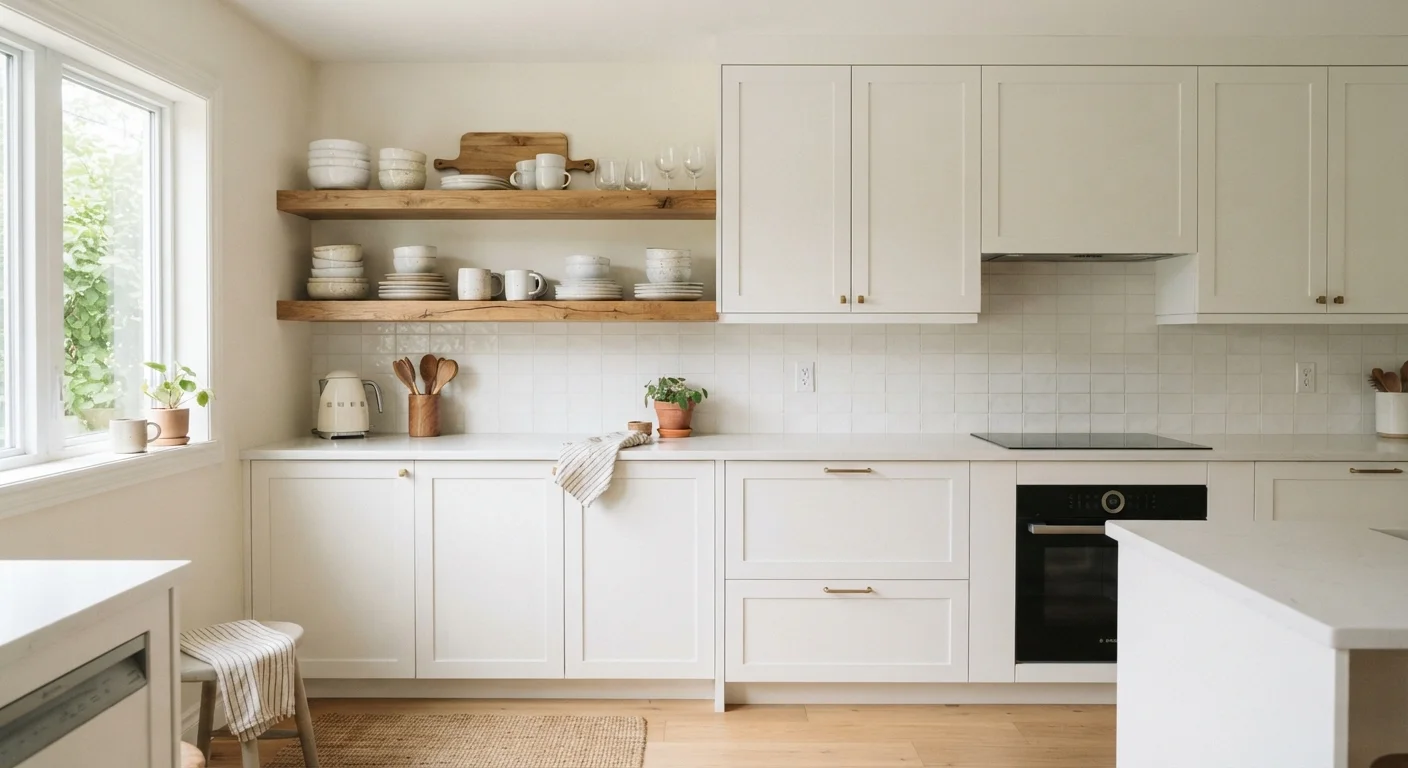
The most practical solution for many kitchens is a deliberate hybrid: closed lower cabinets for bulk storage and heavy items, open upper shelves for daily-use dishes and glassware. This approach captures the accessibility benefits of open shelving while keeping clutter-prone zones behind doors. It also allows you to test open shelving in a limited area before committing to a full conversion. If you're weighing a similar decision in other rooms, the same logic applies — see how built-in vs. freestanding storage compares in living spaces. And if the minimalist appeal of open shelves is part of what's drawing you in, it's worth reading the case for and against a minimalist kitchen before committing.
Renter Considerations for Open Shelving
If you're renting, check your lease before installing floating shelves — wall anchors and bracket holes may require landlord approval or could affect your security deposit. Some renters use freestanding shelving units as a reversible alternative that provides similar open-storage aesthetics without permanent wall modifications. Always patch and repaint anchor holes to the original condition when vacating.