

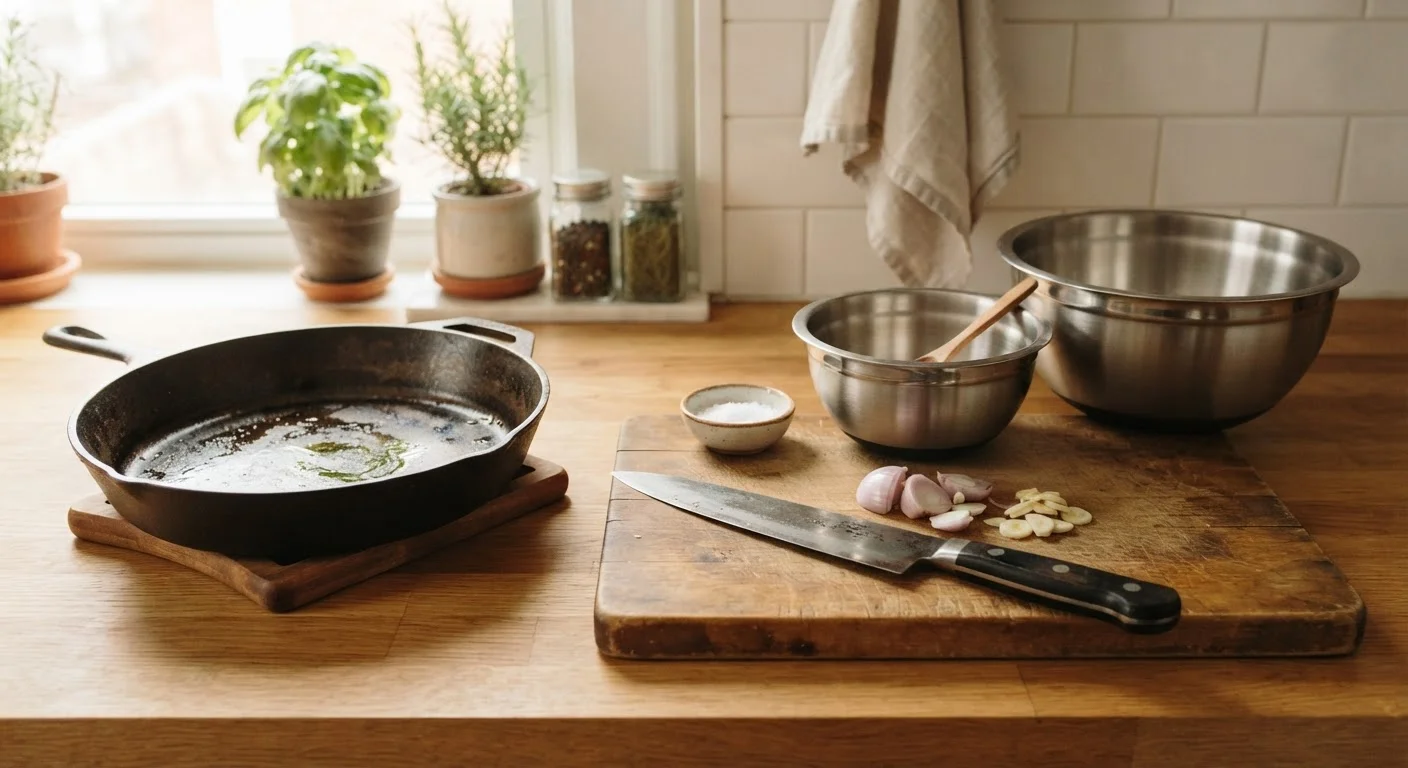
Key Takeaways
- Mastering core kitchen equipment consistently produces better results than accumulating new gadgets.
- A chef's knife, cast iron skillet, and sheet pan can handle the majority of everyday cooking tasks.
- Understanding heat control and proper technique unlocks far more from familiar tools.
- Most under-performing kitchen equipment is under-used, not under-powered.
Your Kitchen Is Already Better Equipped Than You Think
The impulse to buy a new kitchen tool before mastering the ones already on hand is nearly universal. A new gadget feels like progress, but more often the bottleneck is technique, not equipment. Most home kitchens have everything needed to cook well — what's missing is familiarity with what those tools can actually do.
This list focuses on the equipment that rewards genuine investment of time and attention. Learn these properly and you'll likely find yourself reaching for new purchases far less often. For a broader look at how kitchen habits stack up, see our efficient kitchen workflow checklist.
The chef's knife
A single well-maintained chef's knife — typically 8 inches — handles more prep tasks than any other tool in the kitchen. Chopping, slicing, mincing, breaking down whole chickens: most of it flows from this one blade. The problem isn't the knife; it's that most home cooks never learn to use it properly.
Safe grip technique, consistent cutting motion, and keeping an edge sharp are skills that compound over time. Our knife skills guide breaks down the fundamentals that actually speed up prep and reduce accidents. A sharp knife on a stable cutting board is the foundation everything else is built on.
One well-maintained chef's knife handles more prep tasks than any other kitchen tool.
The cast iron skillet
Cast iron holds heat more evenly and retains it longer than most other cookware, making it well-suited for searing, pan-frying, baking cornbread, and even finishing dishes in the oven. Its reputation for being difficult is mostly undeserved — it simply requires a different kind of care than non-stick pans.
Learning how to preheat it correctly, manage seasoning, and clean it without stripping the surface takes a few uses, not months of effort. Once that click happens, cast iron becomes one of the most versatile and long-lasting pieces in the kitchen. It also avoids several common cooking myths around non-stick coatings and high-heat cooking.
Cast iron's reputation for difficulty is largely undeserved — it just requires slightly different care.
The rimmed sheet pan
Sheet pans are among the most underestimated pieces of equipment in a home kitchen. Roasting vegetables, baking, broiling fish, toasting breadcrumbs, cooking sheet-pan dinners — a heavy-gauge rimmed pan handles all of it with no fuss and easy cleanup.
The key variables to understand are pan weight (thin pans warp and cook unevenly), rack position in the oven, and how crowding affects browning. Once you understand that steam is the enemy of crispness on a sheet pan, results improve immediately. No special technique required — just a bit of spatial awareness about how food is arranged.
Crowding a sheet pan creates steam rather than browning — spacing food properly transforms results.
The wooden or plastic cutting board
A large, stable cutting board does more to improve kitchen efficiency than almost any appliance. It gives you genuine working space, protects knife edges, and keeps prep contained. Many home cooks use boards that are too small, which forces awkward cutting angles and slows everything down.
Understanding board hygiene — particularly when switching between proteins and produce — is the most important thing to learn here. Knife care also connects directly: hard surfaces like glass or ceramic damage edges quickly. Paired with proper cutting technique, a good board changes the feel of prep work noticeably.
Most home cooks use cutting boards that are too small, which slows prep and creates awkward technique.
The heavy-bottomed saucepan
A 3- or 4-quart saucepan with a thick base is the workhorse for sauces, grains, soups, custards, and reductions. The thickness matters because it distributes heat more evenly and reduces scorching — a common problem with thin pans on higher heat settings.
Learning to control temperature in a saucepan — knowing when to reduce to the lowest setting, when to pull off the burner entirely, and how to recognize the visual cues of a proper simmer — builds a skill that transfers across many recipes. See our guide to tasting as you cook for how these technique habits work together.
Controlling temperature in a saucepan is a learnable skill that transfers across dozens of recipes.
The box grater
Few tools are as overlooked as the humble box grater. Beyond shredding cheese, it grates citrus zest, garlic, ginger, and hard vegetables like carrots or zucchini quickly and without the cleanup burden of a food processor. Knowing which side of the grater to use for which task — and how to hold food safely as it gets small — makes a real difference in both speed and safety.
It also plays into smarter seasoning: freshly grated Parmesan or lemon zest added at the right moment changes a dish's profile considerably. For a deeper look at building flavour throughout cooking, our guide to seasoning at every stage is worth reading alongside this.
A box grater handles zest, garlic, ginger, and hard vegetables quickly — no food processor needed.
Skill Pays Dividends That New Equipment Often Can't Match
Every piece of equipment on this list shares one characteristic: the gap between a beginner's results and an experienced cook's results is enormous, and it closes with practice rather than upgrades. Understanding how heat levels actually affect food will do more for your cooking than most appliances you could add to your counter.
Try a Week Without Buying Anything New
Before adding any new tool to your kitchen, cook deliberately with what you have for one week. Notice which tasks feel awkward or slow — those are genuine gaps. Often, the friction turns out to be technique rather than a missing piece of equipment, and the fix costs nothing.
If counter space or storage is already a pressure point, the calculus shifts even further toward skill over stuff. Our guide to small kitchen storage strategies covers practical ways to keep what you use and clear out what you don't. The goal isn't a minimalist kitchen for its own sake — it's a kitchen where everything earns its place.