

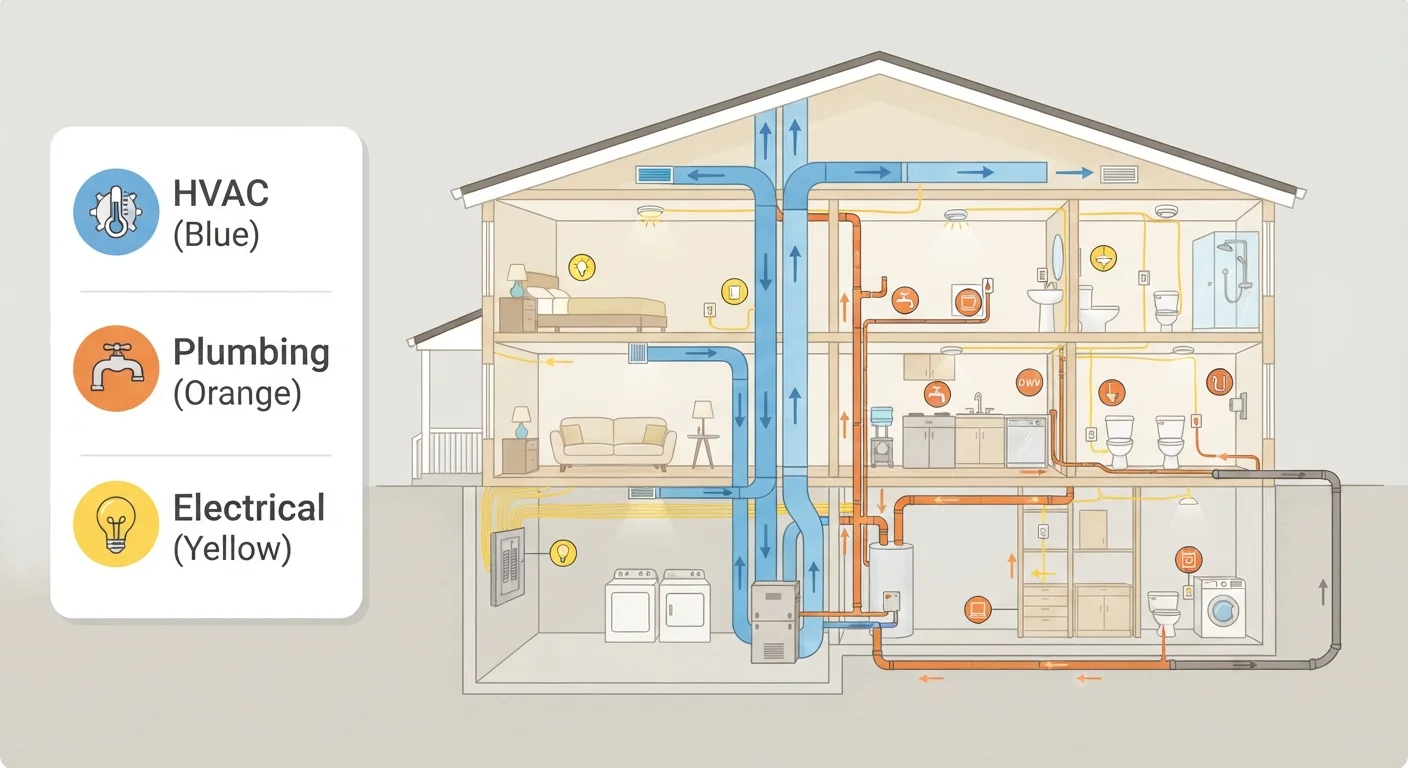
Key Takeaways
- Every home depends on three core systems: HVAC, plumbing, and electrical.
- Each system has distinct components, but all three interact and affect one another.
- Understanding how they work helps you spot problems before they become expensive.
- Most routine maintenance tasks are safe for homeowners to handle without a professional.
- Hazardous or permitted work — such as electrical panel upgrades or gas lines — always requires a licensed contractor.
Start here
Why These Three Systems Matter
Learn each system
HVAC: Heating, Ventilation, and Air Conditioning
Go deeper
How the Three Systems Interact
Take action
Building a Maintenance Mindset
Why These Three Systems Matter
Behind every comfortable home are three systems you almost never see: HVAC, plumbing, and electrical. They run through your walls, floors, and ceilings, and they work around the clock. Most homeowners only think about them when something stops working — but a basic understanding of what each system does, and how they relate to each other, puts you in a much stronger position to prevent problems and respond wisely when they arise.
This guide is designed for homeowners who are starting from scratch. No technical background is required. By the end, you'll know what each system is responsible for, where its key components are located, and how to keep it running reliably. For a broader look at how maintenance fits into the calendar year, see our seasonal maintenance overview.
HVAC
Stands for Heating, Ventilation, and Air Conditioning — the combined system that controls indoor temperature, humidity, and air quality in your home.
Circuit breaker
A safety switch inside your electrical panel that automatically cuts power to a circuit when it detects an overload, protecting your wiring from damage.
Drain-Waste-Vent (DWV)
The plumbing sub-system that carries used water and waste out of the home by gravity and uses vent pipes to maintain proper pressure in drain lines.
Condensate drain line
A small pipe on your air conditioner or heat pump that removes the moisture (condensate) collected during the cooling process. Blockages can cause leaks.
GFCI outlet
A ground fault circuit interrupter outlet that cuts power in milliseconds if it detects an imbalance in electrical current, protecting against shock in wet areas.
Main water shutoff
The valve that stops all water flow into your home from the municipal supply line. Knowing its location lets you quickly stop a leak in an emergency.
HVAC: Heating, Ventilation, and Air Conditioning
Your HVAC system controls indoor temperature, humidity, and air quality. In most US homes it includes a furnace or heat pump, a central air conditioner or cooling coil, an air handler or blower, and a network of ducts that distribute conditioned air room to room. A thermostat acts as the brain, telling the system when to turn on and off.
The system works in a loop: the blower pulls air from your living spaces through return vents, passes it over a heat exchanger or cooling coil, and pushes the conditioned air back out through supply vents. A filter sits at the return air side and catches dust, pet dander, and other particles before they can coat internal components.
What owners can do: Replace air filters on schedule (typically every 1–3 months for standard filters), keep supply and return vents unobstructed, and clear a 2-foot perimeter around your outdoor condenser unit. Inspect the condensate drain line — the small tube that removes moisture — every few months. A clogged drain can overflow and cause water damage.
For anything involving refrigerant, gas connections, or electrical wiring inside the unit, contact a licensed HVAC technician. For a plain-language breakdown of HVAC terminology, visit our HVAC glossary for homeowners.
Plumbing: Supply, Drainage, and Venting
Home plumbing is actually two separate systems that work side by side. The supply system delivers pressurized cold and hot water to every fixture — sinks, toilets, showers, appliances. The drain-waste-vent (DWV) system carries used water and waste away by gravity, routing it to a municipal sewer or private septic tank.
A third component — the vent stack — is easy to overlook. Vent pipes run up through your walls and exit through the roof. They equalize pressure in the drain lines so water flows freely and prevent sewer gases from entering your living space. If you've ever heard a gurgling sound when a toilet flushes, a blocked vent is a common cause.
What owners can do: Know the location of your main water shutoff valve — usually near where the supply line enters the home. Test it once a year to confirm it operates smoothly. Clean fixture aerators and showerheads periodically to remove mineral buildup. Avoid putting fats, oils, or fibrous foods down drains.
Find Your Shutoff Before You Need It
Locate and test your main water shutoff valve now, not during a plumbing emergency. Turn it off and back on once a year to prevent it from seizing. If it's difficult to turn or shows signs of corrosion, have a plumber inspect it — a stuck valve during a burst pipe is a costly problem.
For a detailed breakdown of how supply lines, traps, and shutoff valves fit together, see The Anatomy of a Home Plumbing System.
Electrical: Power Distribution and Safety
Electricity enters your home through a utility connection and flows to the main service panel — often called the breaker box. Inside the panel, individual circuit breakers divide power into separate circuits, each serving a specific area or appliance. Breakers are safety devices: when a circuit draws more current than it can safely handle, the breaker trips and cuts power, preventing overheated wiring and potential fires.
From the panel, wiring runs through your walls to outlets, switches, and hardwired appliances. Modern homes also include ground fault circuit interrupters (GFCIs) — outlets with test and reset buttons — in wet areas like kitchens and bathrooms, and arc fault circuit interrupters (AFCIs) in bedrooms and living areas. Both add extra layers of protection against shock and fire.
What owners can do: Test GFCI outlets monthly using the test and reset buttons. Know which breaker controls which area of your home — label the panel if it isn't already. Replace any outlet or switch cover that is cracked or missing.
Electrical Panel Work Requires a Licensed Electrician
Never attempt to add circuits, replace a breaker, or make any modifications inside your electrical panel yourself. Panel work involves live wires that can cause fatal electrocution and typically requires a permit and inspection. Always hire a licensed electrician for panel-level repairs or upgrades, and check your local code requirements before any electrical project.
How the Three Systems Interact
These systems share physical space and often depend on each other in ways that aren't obvious until something goes wrong. Your HVAC system needs electrical power to run its blower, thermostat, and controls. The water heater — part of plumbing — is powered by either electricity or gas, and a tripped breaker or pilot outage shuts off hot water entirely. A clogged HVAC condensate drain can leak onto nearby wiring, creating a hazard that spans two systems at once.
Understanding these connections helps you diagnose problems more accurately. If multiple things fail at the same time, look for a shared cause — a tripped breaker, a water leak near equipment, or a clogged drain affecting pressure — rather than assuming you have multiple unrelated issues.
For a guide to what common warning signs across all three systems usually indicate, see Warning Signs Your Home's Systems Are Telling You Something Is Wrong.
Building a Maintenance Mindset
The most effective maintenance strategy is simple: learn your systems before there's a crisis. Walk through your home and locate the main water shutoff, the electrical panel, and the HVAC filter slot. Label what you find. That twenty minutes of preparation can save hours of scrambling during an emergency.
From there, build a routine. Most system-level failures don't happen suddenly — they develop from neglected small tasks: a filter that never got changed, a slow drain that was never cleared, a GFCI that was never tested. A consistent, low-effort schedule prevents the majority of expensive repairs.
Our whole-house maintenance schedule provides a month-by-month framework for keeping all three systems in good shape throughout the year. Use it alongside Your Home's Year at a Glance to build a complete, year-round routine that keeps upkeep manageable and affordable.
Whole-House Systems Maintenance Schedule
A month-by-month maintenance framework covering HVAC, plumbing, and electrical tasks so routine upkeep never falls through the cracks.
HVAC Terminology Glossary
Plain-language definitions for the HVAC terms you'll encounter when servicing or replacing your heating and cooling equipment.
Home Plumbing Anatomy Guide
A detailed look at supply lines, DWV pipes, traps, and shutoff valves — everything you need to understand how your plumbing is structured.