

| Minimum SEER for new central AC units (U.S. federal standard) | 14–15 SEER (U.S. Department of Energy regional efficiency standards) |
| Typical AFUE for a high-efficiency gas furnace | 90–98% (U.S. Department of Energy) |
| Recommended MERV rating for most homes | MERV 8–11 (American Society of Heating, Refrigerating and Air-Conditioning Engineers (ASHRAE)) |
| Standard filter change interval (basic 1-inch filters) | Every 1–3 months (General industry guidance; varies by household conditions) |
| Average lifespan of a central AC system | 15–20 years (U.S. Department of Energy) |
Why HVAC Vocabulary Matters
When a technician tells you your system has a low SEER rating or that your refrigerant is low, it helps to know what those words actually mean. Familiarity with HVAC terminology lets you ask better questions, evaluate service recommendations honestly, and avoid paying for work you don't need.
Your heating and cooling system is one of the most complex — and most expensive — systems in your home. See our overview of your home's core systems for context on how HVAC fits alongside plumbing and electrical. This reference guide covers the terms you're most likely to encounter as an everyday homeowner.
HVAC
Stands for Heating, Ventilation, and Air Conditioning. It refers collectively to the systems that control temperature, humidity, and air quality inside a home.
BTU
British Thermal Unit — a measure of heat energy. In HVAC, it describes how much heating or cooling capacity a system can deliver. A higher BTU rating means the unit can handle more square footage.
SEER Rating
Seasonal Energy Efficiency Ratio. It measures how efficiently a central air conditioner or heat pump cools your home over an entire season. Higher numbers indicate greater efficiency.
AFUE
Annual Fuel Utilization Efficiency. Used for furnaces and boilers, it expresses what percentage of fuel is converted into usable heat. An 80% AFUE means 80 cents of every dollar spent on fuel becomes heat.
MERV Rating
Minimum Efficiency Reporting Value. It rates how effectively an air filter captures particles. Ratings typically range from 1 to 16 for residential use; a higher number captures smaller particles but may restrict airflow.
Refrigerant
A chemical compound that absorbs and releases heat as it cycles through the HVAC system. It is what actually moves heat out of your home during cooling. Handling refrigerant requires EPA certification.
Heat Pump
A system that moves heat rather than generating it, providing both heating and cooling from a single unit. It extracts heat from outdoor air (even in cold temperatures) to warm your home in winter.
Zoning System
A setup that divides a home into separate areas, each with independent temperature control. Dampers inside the ductwork regulate airflow to different zones, which can improve comfort and efficiency.
Key Performance and Efficiency Terms
Efficiency ratings appear on equipment labels, in contractor proposals, and in utility rebate programs. Understanding what the numbers mean helps you evaluate your current system and make sense of any replacement discussions.
| Minimum SEER for new central AC units (U.S. federal standard) | 14–15 SEER (U.S. Department of Energy regional efficiency standards) |
| Typical AFUE for a high-efficiency gas furnace | 90–98% (U.S. Department of Energy) |
| Recommended MERV rating for most homes | MERV 8–11 (American Society of Heating, Refrigerating and Air-Conditioning Engineers (ASHRAE)) |
| Standard filter change interval (basic 1-inch filters) | Every 1–3 months (General industry guidance; varies by household conditions) |
| Average lifespan of a central AC system | 15–20 years (U.S. Department of Energy) |
When a contractor recommends upgrading to a higher SEER unit, they're saying the newer equipment will use less electricity to produce the same amount of cooling. A higher rating typically means lower monthly energy use, though actual savings depend on your climate, home size, and usage habits — no specific outcome can be guaranteed.
For practical steps tied to these performance metrics, the seasonal HVAC maintenance checklist walks through filter changes, drain cleaning, and outdoor unit care on a schedule that aligns with how your system actually works.
Components You Should Be Able to Name
Knowing the names of physical parts helps you describe a problem accurately — whether you're calling a technician or doing basic upkeep yourself.
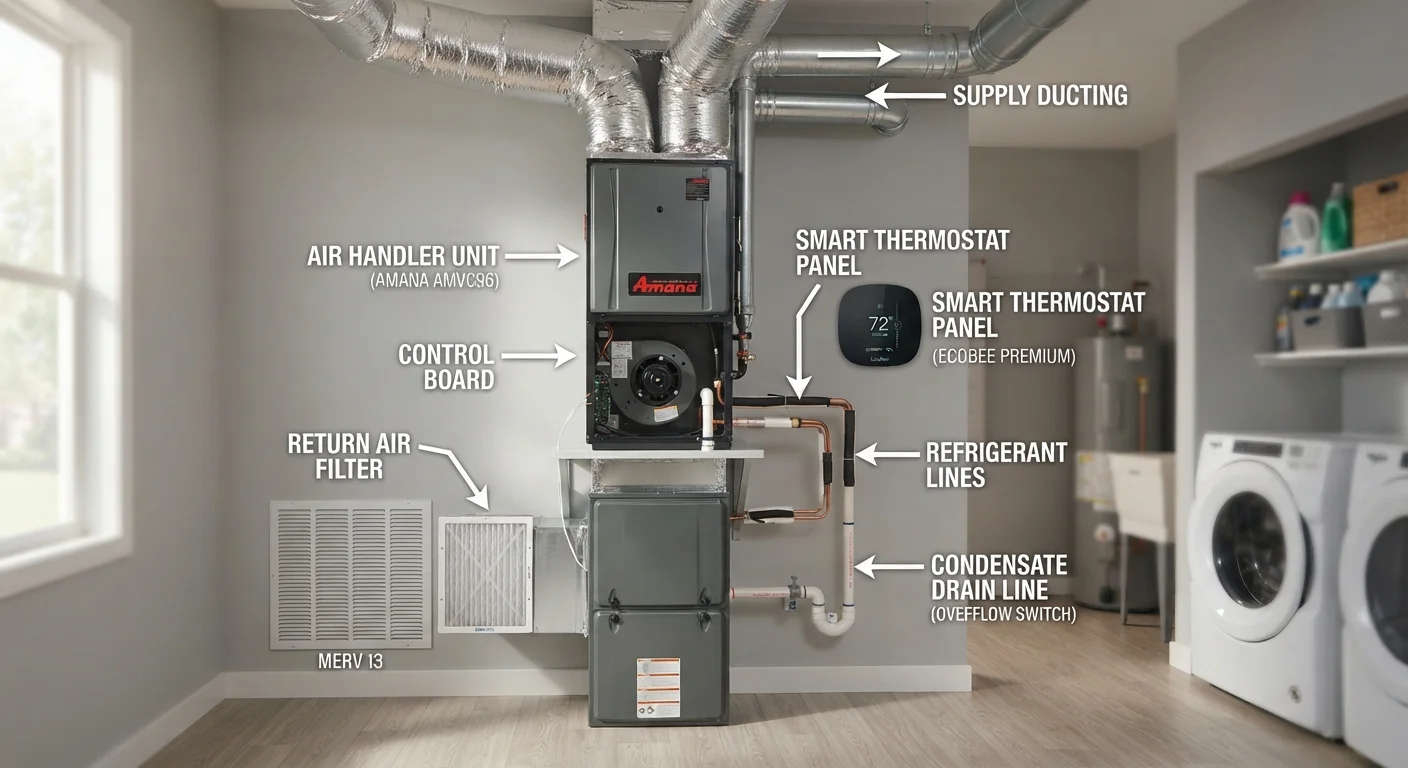
- Air handler: The indoor unit that moves air across the coils and through the ductwork. It houses the blower motor and filter.
- Condenser unit: The outdoor cabinet that releases heat removed from your home. It contains the compressor and condenser coil.
- Evaporator coil: Located inside the air handler, this coil absorbs heat from indoor air. A frozen or dirty coil is a common cause of poor cooling.
- Blower motor: The fan that circulates air through the duct system. If airflow seems weak, the motor or filter is often the first place to check.
- Condensate drain line: A small pipe that carries moisture removed from indoor air to a floor drain or outside. Algae can clog it, causing water backup — a common DIY maintenance item.
- Thermostat: The control interface that signals the system to heat or cool. Programmable and smart thermostats can improve efficiency by adjusting temperatures on a schedule.
- Ductwork: The network of metal or flexible channels that distribute conditioned air through your home and return it to the air handler.
If you're planning any modifications to these components — especially work involving electrical connections, refrigerant lines, or structural ductwork — check first whether permits or inspections are required. Our article on when permits are required for home system work explains what typically triggers those requirements and how to verify local rules.
Keeping track of all these components as part of a larger maintenance routine is easier with a structured plan. The year-round home systems maintenance schedule provides a month-by-month framework so HVAC upkeep doesn't get overlooked.