

| Recommended pendant height above counters | 30–36 inches (General interior design practice) |
| Warm white color temperature range | 2700–3000K (Lighting industry standard) |
| Layers in a complete lighting plan | 3 (ambient, task, accent) (Standard residential lighting design framework) |
| Ideal task lamp position for reading | Shoulder height when seated (General ergonomic guidance) |
| Kitchen undercabinet lighting benefit | Eliminates counter shadow from overhead source (Practical kitchen design principle) |
Why Lighting Layers Matter in Every Room
Most homeowners treat lighting as an afterthought — a ceiling fixture here, a lamp there — and then wonder why a room never quite feels right. Effective residential lighting depends on layering: combining ambient, task, and accent sources so each zone in a room can be adjusted independently. This reference walks through the core terminology and practical placement principles room by room.
Ambient lighting
The base layer of illumination that fills a room broadly without strong directional focus. Ceiling fixtures, recessed downlights, and chandeliers typically serve this role.
Task lighting
Focused light aimed at a specific work surface or activity zone — reading, cooking, or desk work. It supplements ambient light rather than replacing it.
Accent lighting
Directional light used to highlight architectural features, artwork, or decorative elements. It adds visual depth and contrast without significantly raising room brightness.
Color temperature (Kelvin)
A measure of how warm or cool a light source appears, expressed in Kelvin (K). Lower values (2700–3000K) appear warm and amber-toned; higher values (4000K+) appear cooler and more blue-white.
Lumens
The unit measuring total light output from a source. Higher lumens means more light; wattage measures energy use, not brightness.
Dimmer switch
A control device that adjusts the brightness of compatible fixtures by reducing the electrical current supplied to them. Requires compatible bulbs — not all LEDs are dimmable.
Before diving into specific spaces, it helps to understand how color temperature and lumens affect the mood a fixture creates. Warm white light (roughly 2700–3000K) reads as relaxed and residential; cool white (3500–4100K) feels alert and crisp. Matching color temperature across fixtures in one room prevents the jarring patchwork effect that makes spaces feel unfinished. See how light interacts with your wall colors in our guide to colour, tone, and light interaction.
Living Room Lighting Principles
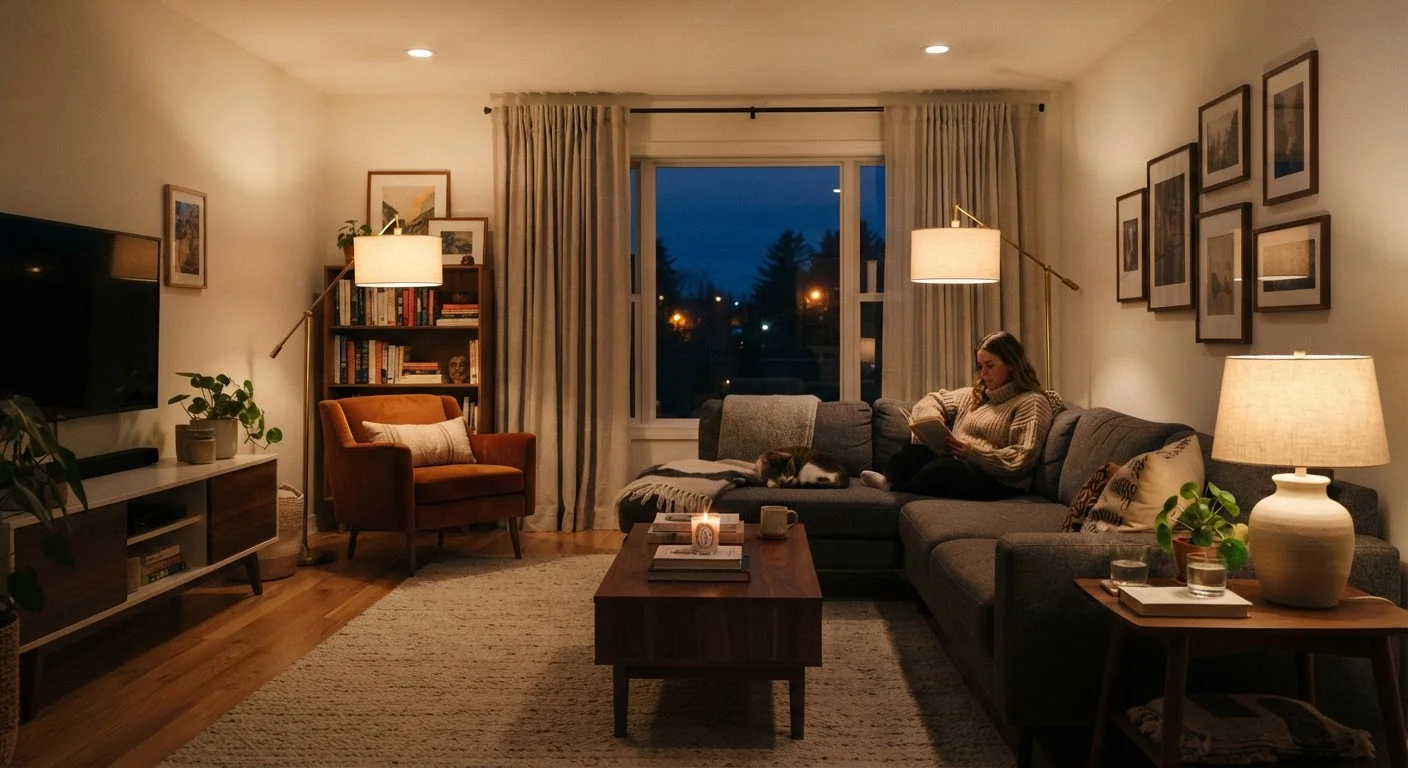
The living room carries the widest range of functions — conversation, reading, media viewing, and occasionally working — so it demands the most deliberate layering. A practical baseline:
- Ambient layer: A central overhead fixture or recessed downlights on a dimmer provides baseline illumination. Aim for even coverage without harsh shadows across the seating area.
- Task layer: Floor lamps positioned behind or beside reading chairs; table lamps flanking a sofa. The light source should sit at shoulder height when the user is seated so it falls directly onto the page or work surface.
- Accent layer: Wall sconces, picture lights, or uplighters directed at artwork or architectural features add visual depth without raising overall brightness.
Dimmers on at least the ambient circuit give you a single control point that shifts the room from daytime utility to evening comfort. Combining this approach with intentional furniture placement amplifies the effect — see living room layout principles for spatial context. Lighting also functions as an effective room divider; our piece on zoning without walls explains how pendant clusters and floor lamps define activity areas.
| Recommended pendant height above counters | 30–36 inches (General interior design practice) |
| Warm white color temperature range | 2700–3000K (Lighting industry standard) |
| Layers in a complete lighting plan | 3 (ambient, task, accent) (Standard residential lighting design framework) |
| Ideal task lamp position for reading | Shoulder height when seated (General ergonomic guidance) |
| Kitchen undercabinet lighting benefit | Eliminates counter shadow from overhead source (Practical kitchen design principle) |
Bedroom and Kitchen: Targeted Approaches
Bedroom: Prioritize controllability. Overhead ambient light is rarely flattering at full brightness; pair it with dimmers and add bedside reading lamps on each side of the bed. Swing-arm wall-mounted lamps free up nightstand space and keep light directed downward rather than across the room. Avoid cool-white bulbs in this space — warmer temperatures (2700K) support winding down.
Kitchen: Kitchens need both broad ambient coverage and focused task illumination over counters and the cooktop. Under-cabinet lighting is one of the most practical upgrades for any kitchen — it eliminates the shadow your body casts when working at the counter under a ceiling fixture alone. Island pendants should hang roughly 30–36 inches above the counter surface for adequate coverage without obstructing sightlines. Dimming the overhead layer lets the kitchen transition from meal-prep brightness to a softer atmosphere for informal dining.
Keep color temperature consistent between ambient and undercabinet fixtures in the kitchen — a warm overhead paired with a stark cool-white strip light under cabinets creates a visually disjointed workspace. For a broader look at how natural light factors into these decisions, check natural light myths before finalizing a plan.
Common Mistakes and Quick Fixes
Even well-intentioned lighting plans fall short for predictable reasons:
- Single-source rooms: One overhead fixture creates a flat, institutional feel. Adding even one floor lamp changes the perceived warmth of a space significantly.
- Wrong bulb height in pendants: Pendants hung too high lose their task effectiveness; too low, they become a visual obstruction. Measure from the surface up, not from the ceiling down.
- Ignoring wall reflectance: Dark wall colors absorb light and require higher lumen output from fixtures to maintain the same perceived brightness. Paint finish also matters — paint sheen and light reflectance explains this in detail.
- No dimming on accent circuits: Accent lighting that can't be dimmed competes with the ambient layer rather than complementing it.
For a full room rethink that incorporates lighting as part of a larger plan, the complete living room transformation guide covers the end-to-end process.