

| Ideal pantry staple count | 40–60 items (General culinary guidance for functional home kitchens) |
| Typical dried pasta shelf life | 1–2 years (USDA food storage guidelines) |
| Canned goods safe storage window | 2–5 years (low-acid); 12–18 months (high-acid) (USDA food safety recommendations) |
| Whole spices vs. ground | Whole: up to 4 years; Ground: 2–3 years (General food science consensus) |
| Most versatile pantry oil | Extra-virgin olive oil (Standard culinary reference) |
| Storage temperature for dry goods | Below 70°F (21°C), away from heat and light (USDA food safety guidelines) |
Why Your Pantry Is the Real Meal-Planning Tool
Most weeknight cooking friction doesn't happen at the stove — it happens when you open the fridge and realize you're missing three key ingredients. As we cover in why weeknight cooking feels harder than it should, planning gaps are the real culprit behind dinner stress. A well-stocked pantry closes those gaps before they open.
The pantry works as a buffer. Fresh ingredients vary week to week, but room-temperature staples stay consistent. When your pantry is stocked strategically, a bare fridge becomes a starting point rather than a dead end. The goal isn't quantity — it's having the right building blocks on hand at all times.
| Ideal pantry staple count | 40–60 items (General culinary guidance for functional home kitchens) |
| Typical dried pasta shelf life | 1–2 years (USDA food storage guidelines) |
| Canned goods safe storage window | 2–5 years (low-acid); 12–18 months (high-acid) (USDA food safety recommendations) |
| Whole spices vs. ground | Whole: up to 4 years; Ground: 2–3 years (General food science consensus) |
| Most versatile pantry oil | Extra-virgin olive oil (Standard culinary reference) |
| Storage temperature for dry goods | Below 70°F (21°C), away from heat and light (USDA food safety guidelines) |
Core Pantry Categories to Maintain
Grains and Starches
Dried pasta, white and brown rice, quick-cooking farro, rolled oats, and dried lentils cover a wide range of meals. These items have long shelf lives and form the caloric backbone of most weeknight dinners. Aim to keep at least two or three varieties on hand so you're not locked into one meal type.
Canned and Jarred Proteins
Canned beans (black, chickpea, cannellini), canned tuna or salmon, and canned tomatoes with a jar of anchovies give you substantial protein without refrigeration. These pair naturally with fast-cooking fresh proteins and extend any meal when portions are short.
Aromatics and Flavor Builders
Garlic, onions, and shallots store well at room temperature for weeks. Soy sauce, fish sauce, apple cider vinegar, hot sauce, and Worcestershire sauce add depth without prep time. A small collection of whole and ground spices — cumin, smoked paprika, coriander, red pepper flakes, dried oregano — handles most global flavor profiles.
Fats and Acids
Olive oil, a neutral cooking oil, and a few vinegars (red wine, balsamic, rice) round out your pantry. These are the elements that make food taste finished rather than flat. Without them, even well-cooked ingredients can feel one-dimensional.
Baking and Thickening Agents
All-purpose flour, cornstarch, baking powder, and baking soda take up minimal space and expand what you can make quickly — from simple pan sauces to last-minute flatbreads.
Aromatics
Vegetables, herbs, or spices — such as onion, garlic, and celery — cooked at the start of a recipe to build a flavor base for the dish.
First-in, first-out (FIFO)
A stock rotation method where older items are placed at the front so they get used before newer purchases. Widely used in food storage to reduce waste.
Pantry staples
Room-temperature, shelf-stable ingredients kept on hand consistently to enable meal preparation without frequent grocery trips.
Shelf life
The period during which a packaged food maintains acceptable quality when stored under recommended conditions. After this window, quality — but not necessarily safety — may decline.
Acid (in cooking)
Ingredients like vinegar, citrus juice, or fermented condiments that add brightness, balance richness, and lift the overall flavor of a finished dish.
Organising Your Pantry So You Actually Use It
Stocking a pantry is only half the equation. If items get buried, they stop being useful — and eventually go to waste. The principles behind systems that reduce waste and keep food accessible apply directly here.
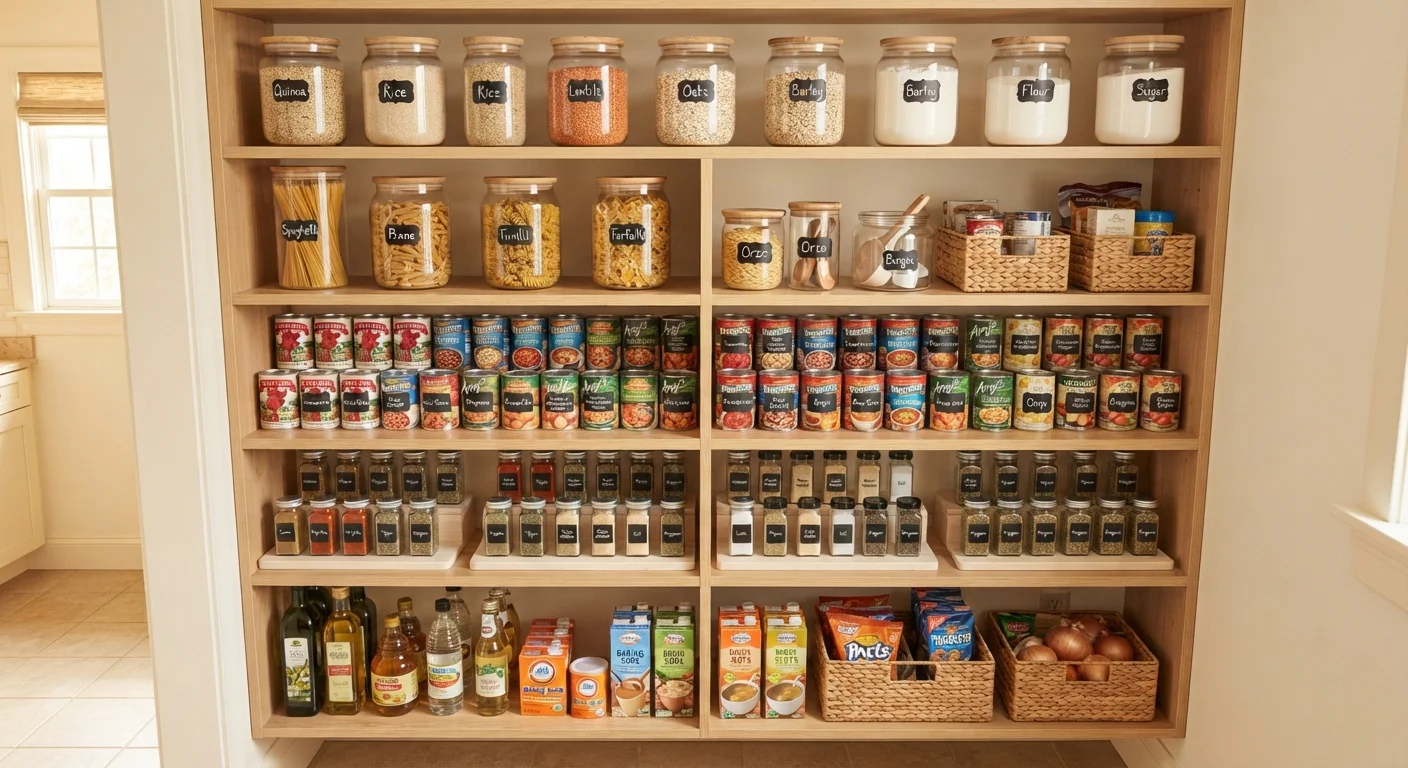
- Group by category, not by size. Keep all grains together, all canned goods together, all spices in one zone. This speeds up grabbing ingredients mid-cook.
- Use first-in, first-out rotation. When restocking, move older items to the front. This naturally reduces waste without extra effort.
- Decant selectively. Clear containers for frequently used grains and flours make quantities visible at a glance. Don't decant everything — it creates more work than it saves.
- Label with purchase dates. A piece of masking tape and a marker on jars and bags tells you which items need using soon.
Before your next grocery run, do a quick pantry audit to avoid duplicating items you already own and to spot genuine gaps. Pair this with an efficient kitchen workflow and the time savings compound quickly.
For a deeper look at turning these staples into actual meals on hectic nights, see how a pantry framework converts to real weeknight dinners. And if kitchen organisation overall is where you want to focus next, the kitchen organisation hub is a practical starting point.