

Key Takeaways
- Your electrical panel distributes power from the utility to every circuit in your home.
- Circuit breakers protect your wiring by tripping when a circuit is overloaded.
- Most modern homes have 100A to 200A service panels; older homes may have less.
- A well-labeled panel makes troubleshooting faster and safer.
- Certain panel issues — burning smells, warm covers, or frequent tripping — require a licensed electrician.
Electrical Panel
An electrical panel — also called a breaker box, load center, or service panel — is the metal enclosure that receives electricity from the utility company and distributes it to every circuit in your home. It contains circuit breakers (or, in older homes, fuses) that automatically cut power if a circuit draws more current than it can safely handle. Think of it as a traffic director for your home's electricity.
Panels are rated by amperage capacity — commonly 100A, 150A, or 200A in residential settings — which determines the maximum electrical load the home can safely draw at one time.
How Your Panel Receives and Distributes Power
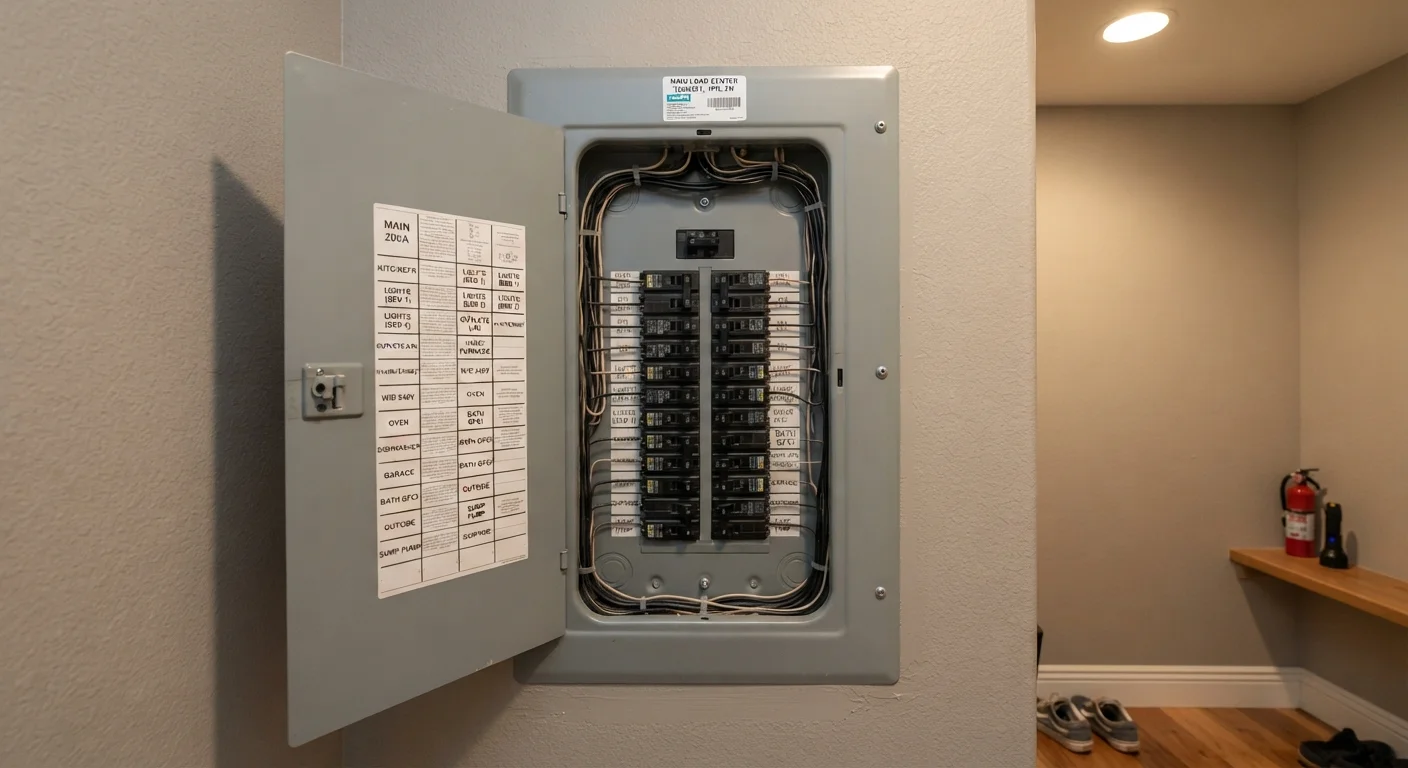
Electricity enters your home through two insulated service wires (plus a neutral) that connect to your panel's main breaker — a large double-pole switch at the top of the box. The main breaker controls all power to the panel and is rated at your home's total service amperage, such as 100A or 200A.
Below the main breaker, a bus bar (a metal strip that carries current) feeds the individual circuit breakers arranged in two columns. Each breaker connects to a single circuit — a dedicated loop of wiring that powers a specific area or appliance in your home. Understanding this flow helps you see why the panel is described as the hub in our guide to your home's three core systems.
Single-pole breakers handle 120V circuits (lights, outlets, small appliances), while double-pole breakers take up two slots and supply 240V to high-demand appliances like dryers, electric ranges, and central air conditioners.
Reading the Breakers and Understanding Amperage
Every breaker is stamped with an amperage rating — typically 15A or 20A for standard circuits. This rating is the maximum sustained current that circuit's wiring can safely carry. If demand exceeds that threshold, the breaker trips, cutting power and preventing overheated wiring.
200A
Standard service for new construction homes
Most newly built single-family homes in the U.S. are wired with 200-amp service panels to accommodate modern electrical loads, according to general residential construction standards.
60A–100A
Typical service in pre-1970s homes
Many homes built before 1970 were originally wired for 60 to 100 amps, which can fall short of the demand created by today's appliances and electronics.
15A or 20A
Rating of most standard household circuits
General-purpose circuits throughout a home are almost universally rated at 15 or 20 amps, matching the wire gauge installed in the walls for that circuit.
Each breaker should correspond to a label on the panel directory — a small card inside the door. Labels like "Kitchen outlets," "Master bedroom," or "HVAC" identify which breaker controls which part of your home. If your directory is blank or inaccurate, mapping your circuits is a worthwhile afternoon project: plug a lamp into each outlet in one room, then flip breakers until the lamp goes off. A helper makes this much faster.
For a deeper look at what happens when a breaker trips versus when an older fuse blows, see our explanation of tripped breakers vs. blown fuses.
Common Panel Configurations and What They Mean for Older Homes
Homes built before roughly 1960 may still have fuse boxes rather than breaker panels, or panels with fewer than 100 amps of service. These systems were designed when household electrical demand was a fraction of what it is today — before personal computers, multiple refrigerators, EV chargers, and central air became common.
Some older panels have known reliability concerns that home inspectors and electricians frequently flag; if your home is more than 40 years old and the panel has never been updated, a professional evaluation is a reasonable step. Flickering lights, outlets that don't work, or circuits that trip under modest loads can all point to a system under strain — symptoms also covered in our article on warning signs your home's systems send.
Label Your Panel While You Have the Chance
If your panel directory is blank, partially filled, or inaccurate, take an hour to map and label every circuit. Accurate labels make troubleshooting faster, help contractors work more safely, and are genuinely useful in an emergency. Use a pencil first — you may need to revise as you go.
What Homeowners Can — and Cannot — Safely Do
There is a meaningful difference between interacting with your panel during normal operation and performing work inside it. Homeowners can safely reset a tripped breaker, read the directory, and verify that the panel cover is undamaged and not warm to the touch.
Opening the panel cover, touching wiring, or adding or replacing breakers crosses into territory governed by the National Electrical Code (NEC) and most local permit requirements. Even with the main breaker switched off, the wires entering from the utility — called service entrance conductors — remain energized. That distinction matters: it means there is no fully safe way for an untrained person to work inside an energized service panel.
For a clear breakdown of which tasks fall within safe DIY limits, see electrical work homeowners can safely handle vs. what requires a licensed electrician. And if you're considering any panel upgrade or new circuit, check whether your municipality requires permits — a topic covered in our guide to permits and inspections for home system work.