
The Difference Between a Tripped Breaker and a Blown Fuse — and What to Do Next

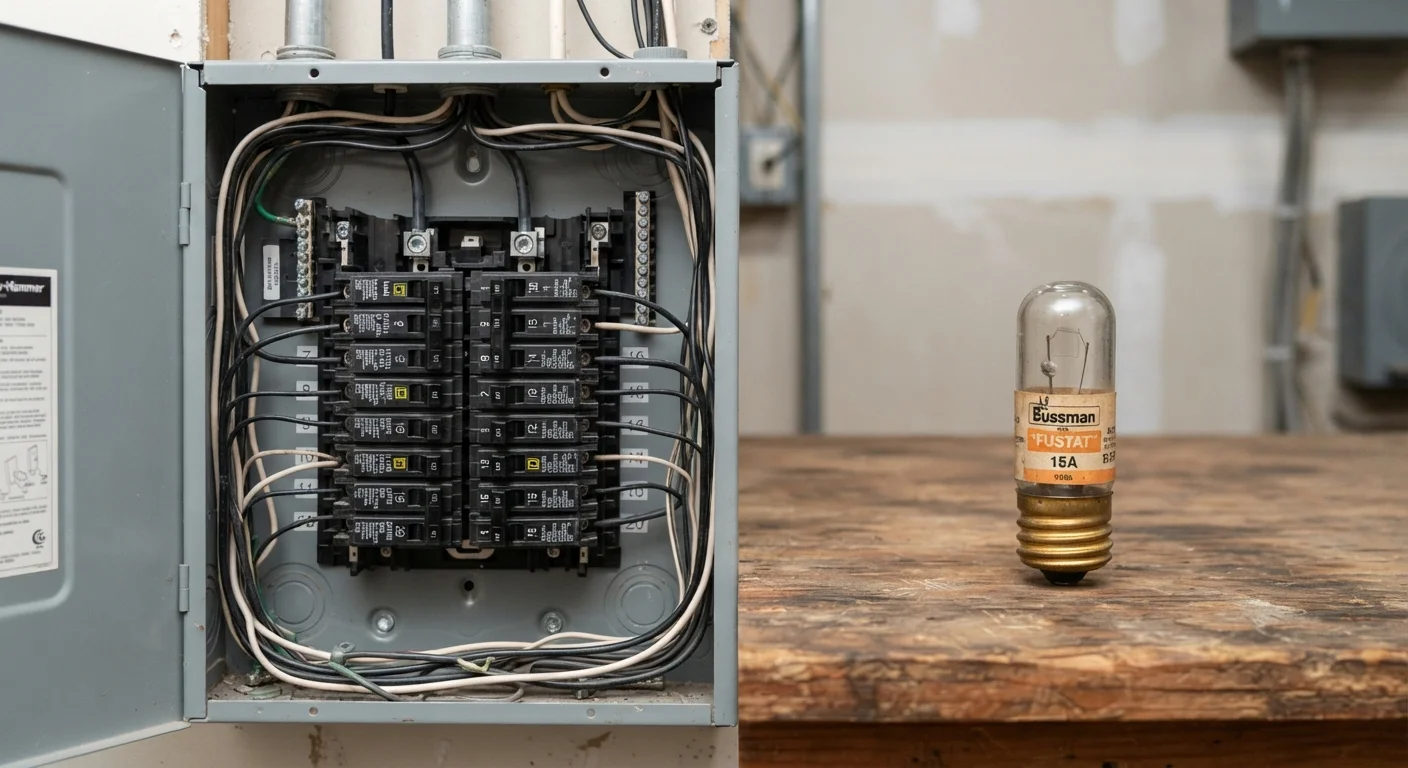
Key Takeaways
- A tripped breaker can be reset by hand; a blown fuse must be physically replaced.
- Both devices exist to protect wiring from overheating due to excess current.
- Identifying which system your home uses is the essential first step before troubleshooting.
- Repeatedly tripping breakers or blowing fuses signals an underlying circuit problem worth investigating.
- Always turn off loads on a circuit before resetting a breaker or replacing a fuse.
- Call a licensed electrician when the root cause of the trip or blown fuse is not obvious.
Option A
Tripped Circuit Breaker
The resettable, modern overcurrent protection device.
Best for: Homes built or rewired in recent decades with a standard electrical panel.
Option B
Blown Fuse
The one-time protection element found in older fuse boxes.
Best for: Older homes that still have an original fuse panel rather than a breaker box.
If your home has a modern electrical panel with switches
Tripped Circuit Breaker
Your panel uses breakers. Locate the tripped switch, reduce the load on that circuit, and reset it — no parts needed.
If your home has an older fuse box with glass or ceramic fuses
Blown Fuse
Check for a discolored or broken element inside the fuse, then replace it with one of the exact same amperage rating.
If power outages on a circuit are happening repeatedly
Tripped Circuit Breaker
Repeated tripping points to a persistent overload or short circuit. Stop resetting and have a licensed electrician diagnose the cause.
If you are unsure of the cause or smell burning near the panel
Tripped Circuit Breaker
Burning smells near any electrical panel — breaker or fuse — are a safety emergency. Do not reset or replace anything; call an electrician immediately.
How Each Device Works
Both circuit breakers and fuses serve the same fundamental purpose: they interrupt the flow of electricity when current on a circuit exceeds a safe level, protecting your home's wiring from overheating and reducing the risk of fire. The key difference is how each one does it.
A circuit breaker is an electromechanical switch. When current surges beyond the breaker's rated amperage, an internal mechanism trips the switch to the off position, cutting power to that circuit instantly. Because it is mechanical, you can reset it by hand once the underlying problem is addressed.
A fuse contains a thin metal element — usually a wire or strip — calibrated to melt at a specific current level. When excess current flows through it, the element melts and breaks the circuit permanently. The fuse itself is destroyed in the process and must be replaced before power is restored.
Before going further, make sure you understand which system your home has. See Understanding Your Home's Electrical Panel for a plain-language walkthrough of what your panel contains and how to read it safely.
| Criterion | Circuit Breaker | Fuse |
|---|---|---|
| How it stops current | Mechanical switch trips to off | Metal element melts and breaks |
| Reusable after activation | Yes — reset by hand | No — must be replaced |
| Typical home age | Homes wired from mid-20th century on | Older homes, pre-1960s construction |
| How to identify a fault | Switch in middle or OFF position | Discolored or broken element visible |
| Cost to restore power | No cost — reset manually | Cost of replacement fuse |
| Key safety risk | Repeated tripping without diagnosis | Installing a higher-amperage fuse |
How to Tell Them Apart and What to Do Next
If you have a breaker panel: Open the panel door and scan the rows of switches. A tripped breaker will usually sit in a middle position between ON and OFF, or it may have flipped fully to OFF. Some panels include a red or orange indicator window that appears when a breaker trips. To reset it, first unplug or switch off any appliances on the affected circuit. Push the breaker firmly to the OFF position, then back to ON. If it holds, power is restored. If it trips again immediately, stop — there is a larger problem requiring professional attention.
If you have a fuse box: Locate the fuse that corresponds to the dead circuit. With older glass screw-in fuses (called Edison-base fuses), look through the glass window. A blown fuse will show a melted or broken element, or the glass may be discolored or cloudy. Before touching any fuse, turn off the main power switch if your panel has one, or at minimum switch off all loads on that circuit. Replace the blown fuse with a new one of identical amperage — using a higher-rated fuse is dangerous and against electrical code.
~1960s
When circuit breakers largely replaced fuses in U.S. homes
Most residential construction in the U.S. shifted from fuse panels to circuit breaker panels during the 1960s, though many older homes still retain their original fuse boxes.
15–20 A
Typical household circuit breaker amperage range
Most general-purpose home circuits are rated at 15 or 20 amperes; major appliance circuits may run higher, which is why matching fuse or breaker ratings to the circuit is critical.
If you notice flickering lights, outlets that spark, or other unusual symptoms elsewhere in your home, those could be related warning signs. Warning Signs Your Home's Systems Are Telling You Something Is Wrong covers what common electrical symptoms usually indicate.
When to Stop and Call a Professional
Resetting a breaker or replacing a fuse once is a normal maintenance task for most homeowners. Doing it repeatedly on the same circuit is not — it signals an underlying issue such as a persistent overload, a short circuit, or a failing device. Continuing to reset without diagnosing the cause can damage wiring or appliances over time.
Call a licensed electrician if you observe any of the following:
- A breaker trips again within minutes of being reset
- You smell burning or see scorch marks near the panel or outlets
- A breaker feels warm or hot to the touch
- You cannot identify what caused the trip or blown fuse
- Your home still has an older fuse panel and you are unsure whether it meets current load demands
For a broader look at where the DIY boundary lies with electrical work, see Electrical Work Homeowners Can Safely Handle vs. What Requires a Licensed Electrician. And if you ever question whether a repair is in your wheelhouse at all, DIY Repairs vs. Calling a Tradesperson: Where the Line Really Is is a helpful starting point.
This article is for general informational purposes only and does not constitute electrical or safety advice. Electrical work may be subject to local codes and permit requirements. Always consult a licensed electrician before performing any electrical work beyond basic troubleshooting.