
Electrical Work Homeowners Can Safely Handle vs. What Requires a Licensed Electrician

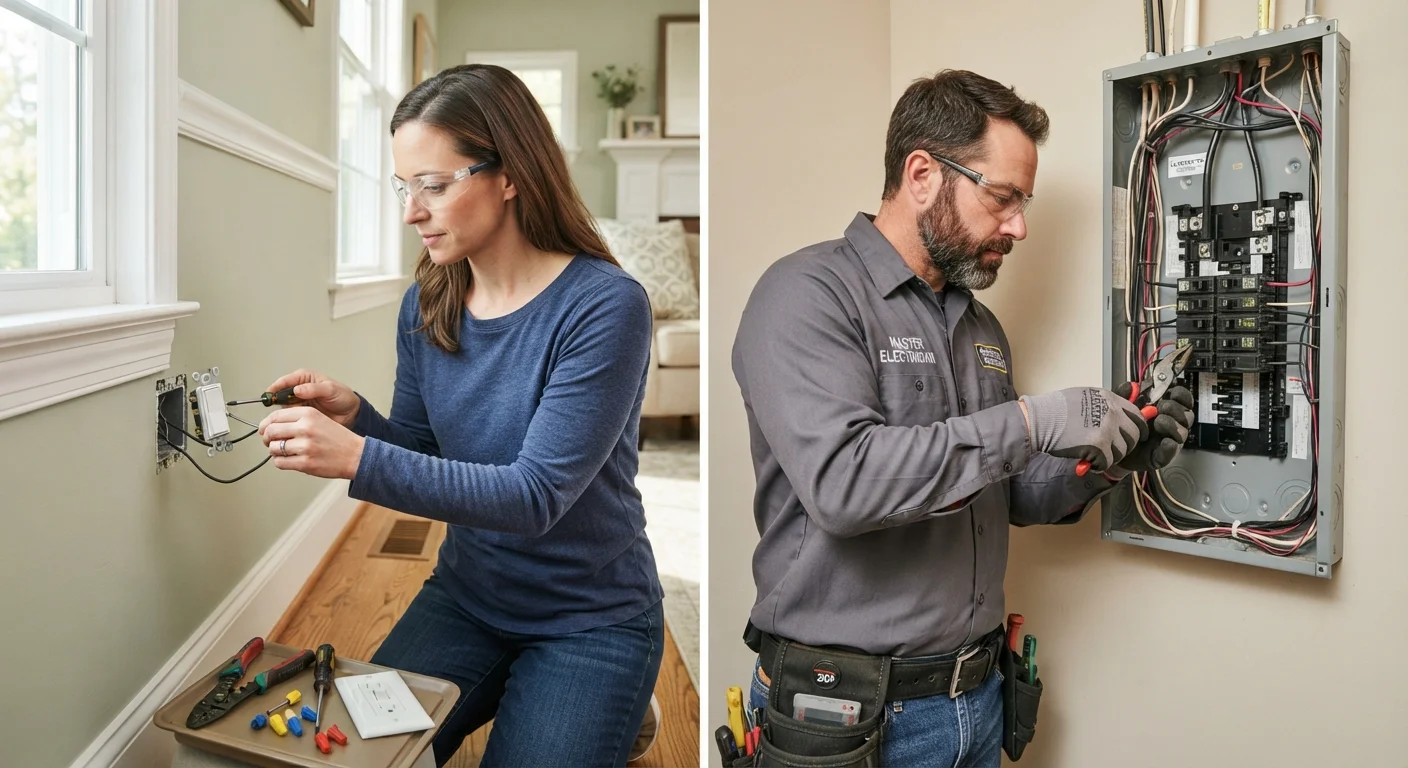
Key Takeaways
- Replacing a light switch or outlet on an existing, properly wired circuit is generally safe for careful DIYers.
- Any work involving your electrical panel, new circuits, or service entrance must be done by a licensed electrician.
- Most significant electrical work requires a permit and inspection — skipping these steps can affect your home insurance.
- Always shut off the correct circuit breaker and verify power is off with a non-contact voltage tester before touching any wiring.
- When in doubt, the cost of hiring an electrician is far lower than the cost of a wiring fire or failed home inspection.
Our Verdict
Simple like-for-like swaps on existing, functioning circuits — such as replacing a switch, outlet, or light fixture — fall within reach of a careful, informed homeowner. Anything that involves your electrical panel, new wiring runs, added circuits, or service upgrades belongs with a licensed electrician. The dividing line is not just about skill; it's about safety codes that exist to protect your household and your home's value.
| Best for | Recommended |
|---|---|
| Homeowners comfortable with basic tools and safety steps | DIY electrical tasks |
| Any work involving panels, new circuits, or permitted work | Licensed electrician |
| Older homes with aluminum wiring or ungrounded systems | Licensed electrician |
| Seasonal upkeep and general home system awareness | DIY electrical tasks |
The Core Principle: Existing vs. New Electrical Work
The clearest way to think about DIY electrical limits is this: working within an existing, properly functioning circuit is very different from creating, extending, or modifying one. Most electrical codes in the U.S. allow homeowners to perform certain repairs on their own property, but regulated work — anything that changes the capacity, routing, or protection of your electrical system — typically requires a licensed electrician and a permit.
Before anything else, make sure you understand your home's electrical panel. Understanding your home's electrical panel helps you identify which breaker controls each circuit, what your home's amperage capacity is, and how to safely de-energize a circuit before touching any wiring. That knowledge is the foundation of every DIY electrical task described here.
For a broader look at where DIY ends and professional help begins across home systems, see our guide on DIY repairs vs. calling a tradesperson.
What Homeowners Can Generally Handle Safely
The following tasks involve swapping out existing devices on circuits that are already correctly wired and protected. They require no new wiring runs, no changes to the panel, and no permits in most U.S. jurisdictions — though always verify with your local building department.
- Replacing a light switch: Swapping a standard single-pole switch for a new one of the same type. Take a photo of the existing wiring before disconnecting anything, and match the connections exactly.
- Replacing an electrical outlet (receptacle): Like-for-like replacement of a standard outlet. If your home has ungrounded two-prong outlets, upgrading to three-prong receptacles is more complex and may require an electrician or GFCI-protected approach.
- Installing a GFCI outlet: Ground Fault Circuit Interrupter outlets protect against shock in wet areas. Replacing a standard outlet with a GFCI outlet on an existing circuit is manageable, but verify local code first.
- Replacing a light fixture: Swapping a ceiling fixture for another of compatible wattage on an existing box. Confirm the electrical box is rated for the fixture's weight.
- Resetting a tripped breaker or replacing a fuse: Straightforward, but if a breaker trips repeatedly, that signals an underlying problem requiring a professional evaluation.
Never Assume Power Is Off Without Testing
Labeling errors in electrical panels are common, especially in older homes. A breaker labeled 'bedroom lights' may control the outlet you're working on — or it may not. Always test with a non-contact voltage tester at the device itself, not just at the panel. If you're unsure which breaker controls a device, shut off the main breaker and test before proceeding.
Always use a non-contact voltage tester — available at any hardware store — to confirm power is off at the device before touching any wires. Turning off the breaker alone is not sufficient verification.
What Must Be Left to a Licensed Electrician
The following work is regulated, involves significant shock or fire risk, and in most U.S. jurisdictions legally requires a licensed electrician and a permit:
- Electrical panel work: Adding breakers, upgrading panel amperage, or replacing the panel itself. The service entrance carries live utility voltage that cannot be shut off by your main breaker — this is extremely dangerous territory.
- Running new circuits: Adding a circuit for a new appliance, home office, EV charger, or workshop involves routing new wire, connecting to the panel, and meeting load-calculation requirements.
- Service upgrades: Moving from a 100-amp to a 200-amp service, or installing a whole-home generator transfer switch, requires coordination with your utility company and a licensed electrician.
- Aluminum wiring remediation: Homes built in the late 1960s and 1970s may have aluminum branch-circuit wiring, which requires specific expertise to work with safely.
- Outdoor and underground wiring: Wiring for outbuildings, landscape lighting fed from sub-panels, or in-ground conduit runs must meet weatherproof and burial-depth codes.
- Knob-and-tube or other legacy wiring systems: These older systems have unique hazards and compatibility concerns that require professional assessment.
Document Your Work Before You Close Up
Whenever you complete a DIY electrical task, take clear photos of the finished wiring connections before replacing the cover plate. Label any circuit changes on your electrical panel directory. This documentation helps future owners, inspectors, and electricians understand your home's wiring more quickly and accurately.
Permits, Inspections, and Why They Matter
Even when you are legally permitted to do your own electrical work, many tasks still require a permit and a subsequent inspection by your local building or electrical inspector. This is not bureaucratic overhead — it is the mechanism by which your local jurisdiction verifies that the work meets the National Electrical Code (NEC) and any local amendments, protecting your household from fire and shock hazards.
Unpermitted electrical work can have serious downstream consequences: it may void your homeowner's insurance coverage for related claims, create complications when you sell the home, or require expensive tear-out and correction. Learn when permits and inspections are required before starting any project beyond a simple like-for-like device swap.
When evaluating whether a task is truly DIY-appropriate, the same framework applies here as in other home systems. Our broader guide on DIY seasonal upkeep vs. hiring a pro offers a useful decision-making structure for weighing risk, skill, and regulatory requirements across projects.
| Task | DIY-Appropriate | Licensed Electrician Required | |
|---|---|---|---|
| Replacing a light switch (like-for-like) | Yes, with power verified off | Not typically required | |
| Replacing an outlet (like-for-like) | Yes, on a grounded circuit | Not typically required | |
| Installing a GFCI outlet | Often yes — verify local code | Not typically required | |
| Adding a new circuit | No | Yes — permit usually required | |
| Panel work or service upgrade | No | Yes — always required | |
| Outdoor/underground wiring | No | Yes — permit usually required | |
| Aluminum wiring remediation | No | Yes — specialist required |