
Drawer Dividers, Bins, and Trays: Choosing the Right Organizer for Each Kitchen Drawer

Key Takeaways
- Drawer dividers work best for cutlery and flat utensils that need fixed, defined lanes.
- Bins and containers suit junk drawers or grouped items that shift in quantity over time.
- Tray material — bamboo, plastic, or metal — affects durability, grip, and ease of cleaning.
- Measure your drawer interior before buying any organizer to avoid wasted space or poor fit.
- Mixing organizer types within a single drawer often works better than committing to just one.
Our Verdict
No single organizer type wins across every drawer. Dividers offer the cleanest structure for cutlery and frequently used tools, while bins give you flexible grouping for miscellaneous or bulky items. Trays — whether bamboo, plastic, or stainless — matter most for maintenance and durability. Matching the organizer style to what actually lives in each drawer is the key to a system that holds up.
| Best for | Recommended |
|---|---|
| Cutlery and flat utensil drawers | Adjustable or fixed dividers |
| Junk drawers and miscellaneous storage | Modular bins |
| High-moisture or near-stove drawers | Stainless steel or hard plastic trays |
| Budget-conscious organizers who want a natural look | Bamboo trays |
Why the Drawer Type Determines the Organizer
Kitchen drawers aren't interchangeable. A flatware drawer, a utensil drawer, and a junk drawer all have different demands — different item sizes, different retrieval habits, and different tolerances for mess. Treating them all the same is why most drawer organization attempts fail within a few weeks.
Before choosing any organizer, identify what the drawer actually holds and how often you access it. Frequently opened drawers near the stove benefit from firm, fixed dividers that keep things from shifting. Drawers used less often can handle softer bin arrangements. If you're starting from scratch, this guide to kitchen organization from the ground up walks through how to zone your entire kitchen before committing to any storage solution.
Measure your drawer's interior width, depth, and height — including any lip or runner — before purchasing anything. A half-inch difference can mean an organizer that slides around or simply won't fit.
Drawer Dividers: Best for Structure and Separation
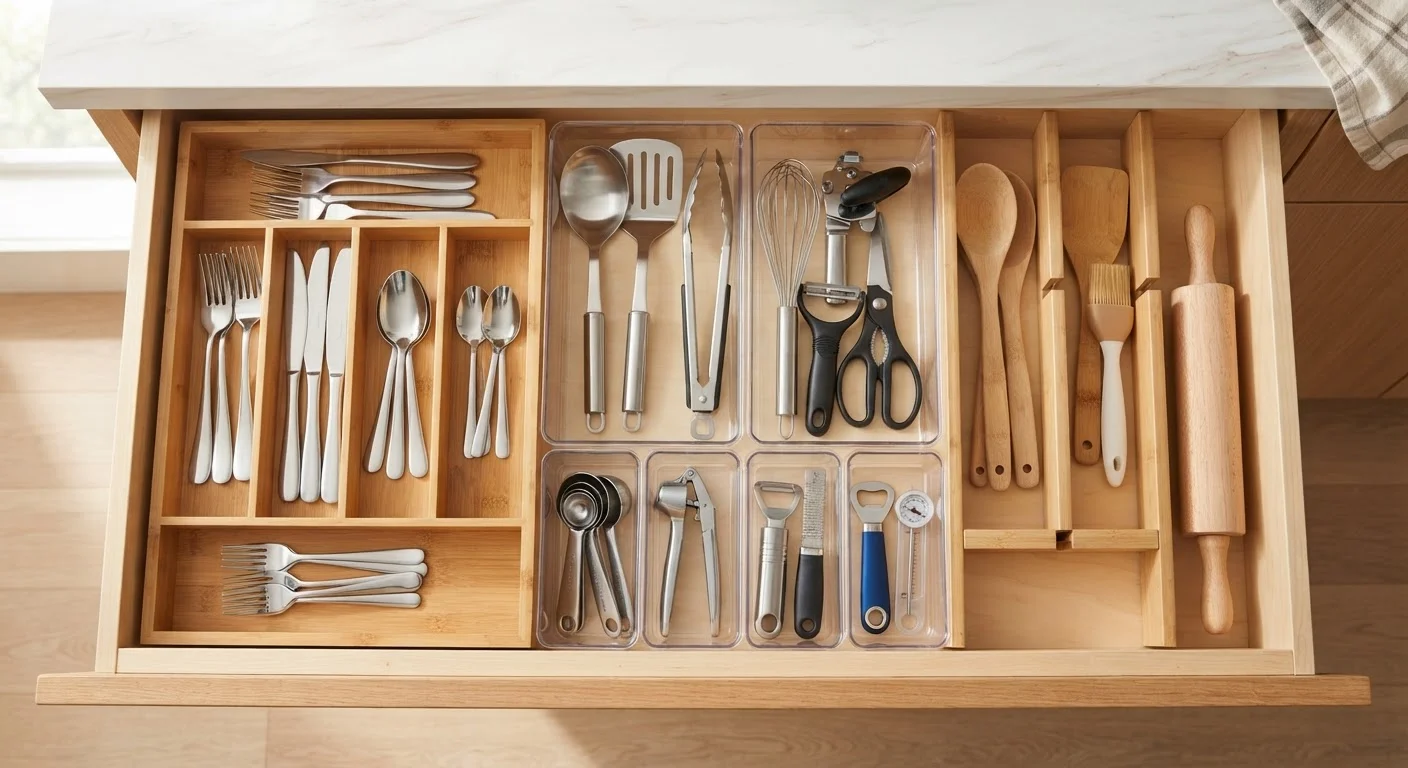
Dividers are rigid inserts — either fixed or adjustable — that create distinct lanes within a drawer. They work best when you have items with predictable shapes and consistent quantities: forks, knives, spatulas, measuring spoons.
Adjustable dividers use spring tension or sliding tracks to fit various drawer widths without adhesive. They're flexible if your storage needs change, but can shift over time in deep drawers. Fixed dividers — often sold as a complete tray with molded compartments — stay put but lock you into set sizes.
Go Taller for Utility Drawers
For deep utility drawers holding larger tools, look for dividers or bins with walls at least 2 inches tall. Standard cutlery dividers are often only 1–1.5 inches, which lets bulkier items hop the barrier and defeat the whole system.
For deep utility drawers holding larger tools, look for dividers with taller walls (at least 2 inches). Standard cutlery dividers are often only 1–1.5 inches tall, which leaves bulkier items able to hop the barrier.
Bins and Containers: Best for Flexibility and Grouping
Bins — small open-top containers arranged inside a drawer — work well when you're grouping by category rather than by individual item. Think twist ties, rubber bands, and spare batteries in a junk drawer, or baking tools kept together in one zone.
The advantage of bins is that you can reconfigure them easily as your needs change. Pull one bin out entirely without disturbing the others. They're also useful for items that don't have a neat flat profile, like garlic presses or corn holders, where a divider lane would leave a lot of dead space.
Modular bins that interlock or nest together prevent the organizer itself from sliding. If you're working with a small kitchen where every inch matters, these small-kitchen storage strategies can help you decide when bins make more sense than built-in dividers.
| Dividers | Modular Bins | Tray Inserts | |
|---|---|---|---|
| Best drawer type | Cutlery, flat utensils | Junk, miscellaneous items | Spices, packets, small tools |
| Flexibility | Low to moderate | High | Low |
| Holds irregular shapes | Poorly | Well | Moderate |
| Stays in place | Good (adjustable may shift) | Good if interlocking | Very good |
| Ease of cleaning | Moderate | Easy — remove and wash | Easy — wipe or dishwasher |
| Typical cost range | Low to moderate | Low | Low to moderate |
Tray Materials: What Actually Makes a Difference
Once you've chosen dividers or bins, the material determines how well they hold up day to day. The three most common options are bamboo, plastic, and stainless steel — each with real trade-offs.
- Bamboo: Naturally grippy so items don't slide, visually warm, and relatively affordable. It's not waterproof, though. Prolonged moisture exposure from wet utensils can cause warping or cracking over time. Best suited for drawers away from the sink or stove.
- Plastic (polypropylene or ABS): The most practical for high-use drawers. Dishwasher-safe options exist, and the surface wipes clean easily. Translucent versions let you see contents at a glance. Quality varies widely — look for heavier gauges that won't flex when loaded.
- Stainless steel: Durable and moisture-resistant, making it good for drawers near the sink or in humid kitchens. It can be noisier than bamboo or plastic and tends to cost more, but it won't warp, crack, or absorb odors.
For a broader look at container materials and what they're suited for, the container types reference guide covers the key distinctions in plain language.
Matching Organizers to Specific Drawers
Apply the logic above to your actual drawers rather than organizing in the abstract:
- Cutlery drawer
- Fixed or adjustable divider tray in bamboo or plastic. Compartments sized specifically for forks, knives, spoons, and a small section for extras.
- Utensil drawer
- Adjustable dividers with taller walls, or a deep bin arrangement that accommodates longer handles. Don't force long items into short lanes.
- Spice or packet drawer
- Low bins or a shallow tray with multiple small sections. Prevents packets from layering and getting lost underneath each other.
- Junk drawer
- Modular bins grouped by loose category. Resist the urge to subdivide too finely — it won't hold up in practice.
If drawer space is genuinely tight and you're wondering whether some items belong on walls or cabinet doors instead, vertical storage solutions can help you reassign what doesn't truly need to live in a drawer.