

Key Takeaways
- A proper pinch grip gives you more control and reduces hand fatigue during prep.
- The claw technique protects your fingers and lets you guide food safely toward the blade.
- Uniform cuts matter because food of the same size cooks evenly and at the same rate.
- A sharp knife is safer than a dull one — dull blades require more force and slip more easily.
- You don't need an extensive knife set — one well-maintained chef's knife handles most tasks.
Start here
Why Knife Skills Matter More Than Better Equipment
Build your foundation
The Pinch Grip: The One Habit That Changes Everything
Add safety
The Claw and Guiding Hand: Staying Safe While You Cut
Practice cuts
Core Cuts Every Home Cook Should Know
Maintain your tools
Keeping Your Knife Sharp Enough to Use
Why Knife Skills Matter More Than Better Equipment
Most home cooks believe their knife problems are an equipment problem. In reality, technique is almost always the limiting factor. A modest knife used with good form will outperform an expensive one gripped awkwardly every single time.
Good knife skills reduce prep time, improve the quality of your finished dishes, and — most importantly — lower your risk of cuts. They also make cooking feel less like a chore. When you can break down an onion or slice through a chicken breast confidently, the whole process becomes faster and more enjoyable.
As part of a broader approach to kitchen efficiency, knife skills connect directly to how well you can sequence your prep and work through a recipe without chaos. Before investing in new tools, it's worth asking whether you've fully learned the ones you already own — something explored in depth in our piece on getting more from your current equipment.
Pinch grip
A knife-holding technique where the thumb and bent index finger pinch the blade itself, just above the handle, for maximum control and balance.
Claw technique
A guiding-hand position where fingertips curl under so knuckles face the blade, physically protecting fingers while steadying food during cutting.
Honing
Realigning a knife's edge using a honing rod. It doesn't remove metal — it straightens a bent or rolled edge and is done regularly between sharpenings.
Sharpening
Grinding away metal from the blade using an abrasive surface to create a new, sharp cutting edge. Done less frequently than honing.
Uniform cuts
Cutting food into pieces of the same size so they cook evenly and finish at the same time — a key reason recipes specify cut types.
Julienne
A knife cut that produces thin, even matchstick-shaped strips of food, commonly used in stir-fries and salads.
The Pinch Grip: The One Habit That Changes Everything
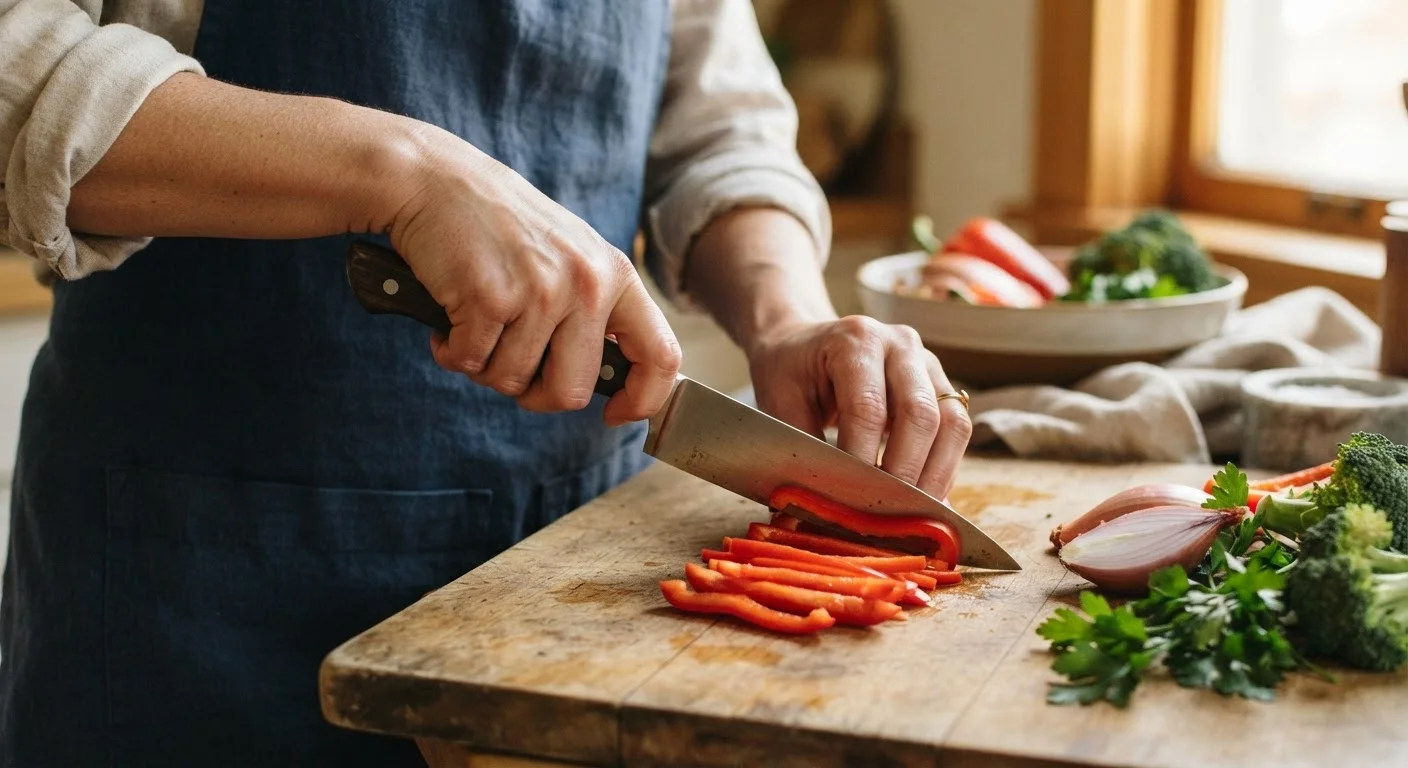
The single highest-impact change most home cooks can make is switching to the pinch grip. Instead of wrapping all four fingers around the handle, pinch the blade itself between your thumb and the side of your bent index finger, right at the point where blade meets handle. Your remaining three fingers curl around the handle for support.
This grip does several things at once: it lowers the knife's center of balance into your hand, reduces wrist fatigue over long prep sessions, and gives you fine control over where the blade goes. It feels awkward for the first few days, but becomes natural quickly with practice.
Use Low-Stakes Ingredients to Build the Habit
When learning a new grip or technique, choose inexpensive, forgiving vegetables like carrots, celery, or zucchini for practice. These hold their shape and don't punish minor slips the way slippery or irregularly shaped produce can. A few deliberate practice sessions — focused on form rather than speed — will build muscle memory faster than rushing through real meal prep.
Practice the pinch grip on low-stakes ingredients — a few carrots or a head of cabbage — before moving on to trickier items like raw meat or hard squash.
The Claw and Guiding Hand: Staying Safe While You Cut
Your non-dominant hand is just as important as the one holding the knife. The claw technique involves curling your fingertips under so your knuckles face the blade. The flat side of the blade then rests lightly against your knuckles as it moves. Your fingertips are tucked safely behind.
This does two things: it physically guards your fingers and it gives you a consistent guide rail for the knife. Without it, your cuts become inconsistent because the food shifts and your guiding hand moves unpredictably.
Practice the claw slowly at first, focusing on keeping your fingertips curled even when the food is awkward — a round tomato or a cylindrical zucchini. Creating a flat stable surface by halving round items first makes the claw much easier to maintain.
Core Cuts Every Home Cook Should Know
You don't need a culinary vocabulary to benefit from learning a small set of reliable cuts. These are the ones that come up in almost every recipe:
- Slice: A single smooth stroke through food. Use a rocking motion — the tip of the blade stays on the board while the heel lifts and comes down. Avoid sawing back and forth, which bruises delicate produce.
- Chop: Rough, fast cuts when precision isn't critical. Common for aromatics like onion and garlic that will dissolve into a sauce.
- Dice: Even cubes cut by first slicing, then cutting across those slices. Small (¼ inch), medium (½ inch), and large (¾ inch) dice are common recipe references. Uniformity matters more than perfect size.
- Mince: Very fine cuts, used most often for garlic, shallots, and fresh herbs. Rock the knife over the pile repeatedly, gathering with the blade between passes.
- Julienne (matchstick): Thin, even strips used for stir-fries and salads. Square up a vegetable by trimming the sides flat, then slice into planks, then cut planks into strips.
Uniform cuts are the underlying principle behind all of these. When pieces are the same size, they cook in the same amount of time. This is the mechanical reason why recipes call for specific cuts — not aesthetics. For more on how understanding recipes at this level improves results, see reading a recipe like a cook.
Keeping Your Knife Sharp Enough to Use
A dull knife is not safer than a sharp one — it's more dangerous. Dull blades require you to press harder, and when they slip, the force behind them causes more serious injuries. Keeping an edge on your knife is part of practicing good knife skills, not an optional extra.
Two tools matter here: a honing rod and a sharpener. A honing rod (also called a sharpening steel) doesn't actually sharpen — it realigns the microscopic edge that gets bent with regular use. Run the blade along the rod at roughly a 15–20 degree angle, a few strokes per side, before each cooking session. This alone will make a significant difference in how your knife performs day to day.
Actual sharpening — using a whetstone or taking the knife to a professional — is needed a few times a year for most home cooks. Signs that honing is no longer enough: the knife won't easily slice a ripe tomato without pressing, or it slides over paper instead of catching it.
Store knives on a magnetic strip or in a knife block to protect the edge. Leaving them loose in a drawer dulls the blade and is a contact hazard when reaching in.
Developing these foundational skills is a natural complement to building a more efficient kitchen overall. See our home cook's workflow checklist for a broader look at how prep habits fit together.