
Key Takeaways
- Wattage measures how much power an appliance draws, not how efficiently it does its job.
- Efficiency depends on output relative to input — a lower-watt appliance can still waste more energy.
- Usage patterns, standby draw, and duty cycles often matter more than peak wattage ratings.
- Standardized metrics like EER, UEF, and annual kWh estimates give a more complete efficiency picture.
- Energy Star certification signals relative efficiency within a category, but has limits worth understanding.
The Wattage Misunderstanding
When shoppers compare appliances, wattage is often the first number they check. It feels intuitive: lower watts should mean lower energy use, right? In reality, wattage describes a rate of power consumption — how many watts an appliance draws while running — but says nothing about how much useful work it produces per watt consumed. That distinction is the entire definition of efficiency.
Consider two space heaters rated at 1,500 watts each. On paper they look identical. But if one converts nearly all that power into usable heat while the other loses a significant portion to heat leakage through a poor housing design, their real-world efficiency differs despite identical wattage. The same logic applies across appliance categories, from refrigerators to water heaters to window air conditioners.
Understanding this gap between power draw and actual efficiency is foundational to smarter appliance evaluation — and it's covered in more depth in our guide on how spec sheets can obscure more than they reveal.
Myth
A lower-wattage appliance is always the more efficient choice.
Fact
Lower wattage reduces power draw but doesn't guarantee better efficiency if the appliance produces less useful output per watt.
Efficiency is the ratio of useful output to energy input. A 500-watt appliance that accomplishes the same task as a 1,000-watt unit is genuinely more efficient — but a 500-watt appliance that takes twice as long to finish the same job consumes the same total energy. Comparing wattage without comparing output or run time is comparing only half the equation.
Myth
High-wattage appliances always cost more to run than low-wattage ones.
Fact
Operating cost depends on wattage multiplied by run time — a high-watt appliance used briefly may cost less than a low-watt one running continuously.
Your electricity bill is based on kilowatt-hours (kWh), which is wattage × hours of use. A 2,000-watt oven used for 30 minutes consumes 1 kWh. A 100-watt device left on for 10 hours also consumes 1 kWh. Duration and duty cycle are inseparable from wattage when estimating real operating costs.
Myth
Wattage listed on packaging is what the appliance actually draws during normal use.
Fact
Listed wattage typically reflects peak or maximum draw, which may rarely occur during typical operation.
Many appliances operate at variable power levels. A refrigerator's compressor cycles on and off; a washing machine draws more during the spin cycle than during the fill phase. Peak wattage figures represent a worst-case electrical load, useful for sizing circuits but not for calculating average energy consumption. EnergyGuide annual kWh estimates, based on standardized usage cycles, are more representative of real-world costs.
Myth
If two appliances have the same wattage, they use the same amount of energy.
Fact
Identical wattage ratings tell you nothing about run time, duty cycle, or standby draw — all of which determine total energy consumed.
Two refrigerators rated at 150 watts may use substantially different amounts of electricity annually if one has a more effective insulation design and cycles its compressor less frequently. Annual kWh estimates on the EnergyGuide label account for these real-world operational differences, making them a much more reliable comparison tool than wattage alone.
Myth
An appliance with an Energy Star label is the most efficient option in its category.
Fact
Energy Star certification means an appliance meets a minimum efficiency threshold — products within the program still vary in how efficient they are.
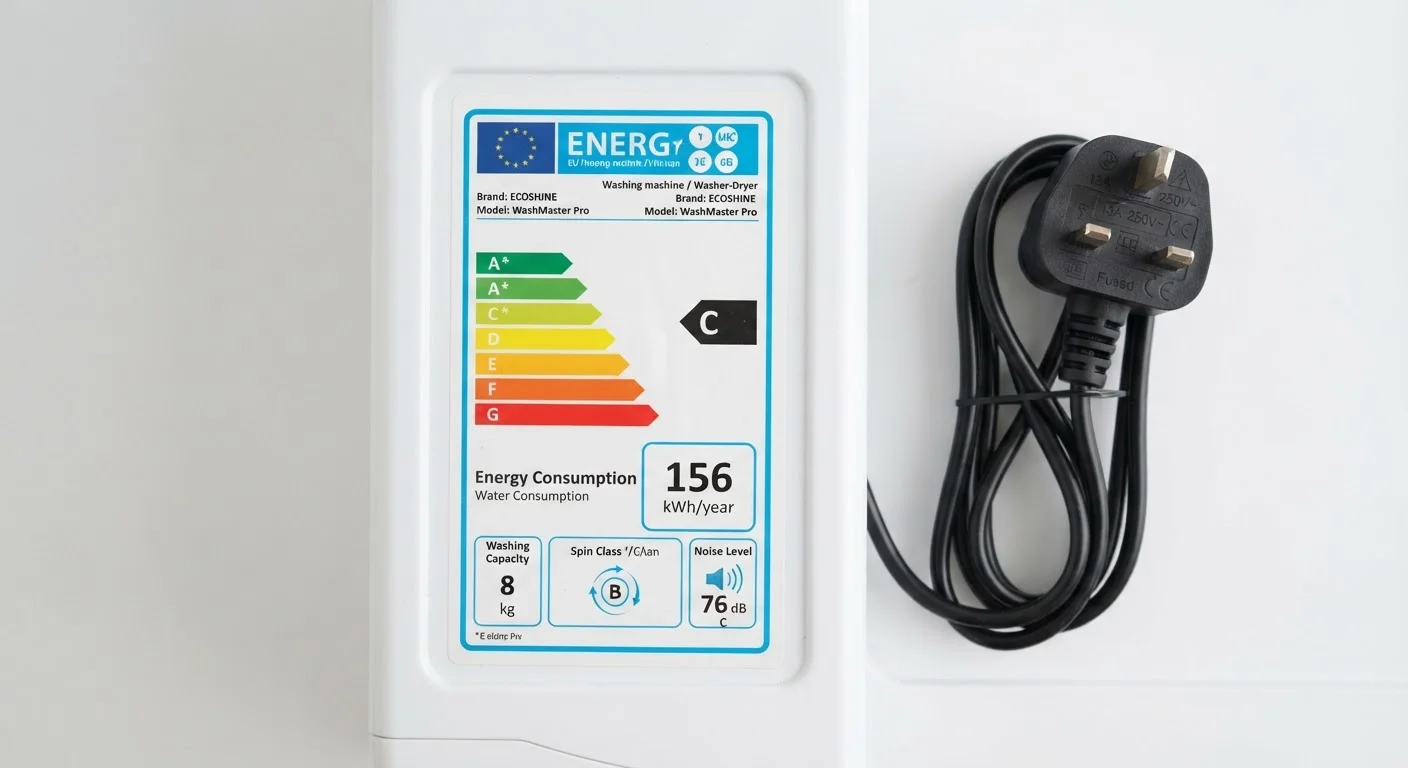
Energy Star sets a qualifying floor, not a ceiling. Two certified appliances in the same category can have meaningfully different annual energy consumption. The program's EnergyGuide label displays an estimated yearly kWh figure and places it on a scale showing where the model falls relative to similar products — that range, not just the certification badge, is the more actionable comparison point.
Metrics That Actually Measure Efficiency
Because wattage alone is incomplete, appliance categories use standardized efficiency ratios and annual consumption estimates that factor in useful output. These metrics are worth knowing.
- EER / SEER (Energy Efficiency Ratio / Seasonal EER): Used for air conditioners. Higher numbers mean more cooling output per watt of electricity consumed.
- UEF (Uniform Energy Factor): The current standard for water heater efficiency in the U.S., measuring how effectively a unit turns energy input into hot water, accounting for standby losses.
- Annual kWh estimates: Found on EnergyGuide labels, these project how many kilowatt-hours a specific appliance model will use over a year under standardized conditions — far more actionable than peak wattage.
- Lumens per watt: For lighting, this tells you how much visible light you get from each watt of electricity, rather than just how bright the bulb might seem.
These ratios exist precisely because the engineering community recognized that raw power draw is an insufficient proxy for efficiency. When a label or product listing omits these figures in favor of wattage alone, treat that as a signal to look deeper. Our article on what the Energy Star label tells you — and what it doesn't explains how certification programs attempt to standardize this comparison.
1–2¢
Cost per kWh for standby power annually
The U.S. Department of Energy has noted that standby power across all home devices can account for roughly 5–10% of a typical household's annual electricity bill.
~625 kWh
Median annual energy use, standard refrigerator
EnergyGuide label data shows that among full-size refrigerators, annual consumption varies widely — from under 400 kWh to over 800 kWh — for units with similar capacity and wattage ratings.
The Role of Usage Patterns and Standby Draw
Even if you identify a genuinely efficient appliance, how and when you use it shapes real energy costs more than any single spec. A highly efficient dishwasher run twice daily will consume more electricity than a less efficient one used three times a week. Duty cycle — the proportion of time an appliance is actively working versus idle — is rarely listed but significantly affects annual consumption.
Standby power (sometimes called phantom load or idle draw) adds another layer. Many appliances continue drawing power when not in active use — smart displays, connected appliances, and devices with remote-start features are common examples. An appliance with a modest operating wattage but high standby draw can quietly inflate your bill over months.
Don't Overlook the Standby Draw
Before assuming a connected or smart appliance is energy-conscious, check whether the manufacturer discloses standby power consumption. Devices with always-on displays, voice assistants, or network connections can draw several watts continuously. Over a full year, that idle draw can add a meaningful amount to your electricity bill even if the appliance's operating wattage appears modest.
If reducing household energy costs is a priority, behavioral changes around appliance use often deliver results that rival hardware upgrades — a point explored further in our guide on ways everyday homeowners cut utility costs without major upgrades.