
Lumens, Kelvin, and CRI: The Three Numbers That Define a Light Bulb's Performance

| Lumen range: soft accent lighting | 200–400 lm |
| Lumen range: general living room | 400–800 lm |
| Lumen range: kitchen task lighting | 700–1,100 lm |
| Warm white colour temperature | 2,700–3,000 K |
| Daylight colour temperature | 5,000–6,500 K |
| Minimum recommended CRI for home use | 80 |
| CRI for colour-critical tasks | 90+ |
Why Watts Stopped Being Enough
For most of the twentieth century, shoppers picked light bulbs by wattage — a 60-watt bulb was a 60-watt bulb. That shorthand broke down when LED technology arrived, because LEDs produce far more light per watt than incandescent bulbs. A 10-watt LED can match the output of a 60-watt incandescent, so wattage no longer signals brightness reliably.
Modern packaging replaces the wattage shorthand with three distinct measurements: lumens, Kelvin (K), and CRI. Each describes a different dimension of how a bulb performs. Read them together and you can predict exactly how a bulb will look and feel in a room — before you ever flip the switch. As noted in our guide on decoding product specs, knowing which numbers actually matter is the first step to shopping clearly.
| Lumen range: soft accent lighting | 200–400 lm |
| Lumen range: general living room | 400–800 lm |
| Lumen range: kitchen task lighting | 700–1,100 lm |
| Warm white colour temperature | 2,700–3,000 K |
| Daylight colour temperature | 5,000–6,500 K |
| Minimum recommended CRI for home use | 80 |
| CRI for colour-critical tasks | 90+ |
Lumens: The Actual Measure of Brightness
Lumens measure the total amount of visible light a bulb emits. More lumens means a brighter bulb, full stop. While wattage measures energy consumed, lumens measure light produced — these are not the same thing.
As a practical reference, a typical living room floor lamp calls for roughly 400–800 lumens per bulb, a kitchen work surface benefits from 700–1,100 lumens, and an outdoor security fixture may need 1,600 lumens or more. Bedroom and accent lighting often sits in the 200–400 lumen range where softer, ambient output is the goal.
When you're choosing bulbs for layered lighting — ambient, task, and accent — selecting different lumen levels for each layer gives you real control over the room's atmosphere. See our room-by-room lighting reference for specific lumen targets by room type.
Lumens
The unit of measurement for the total amount of visible light emitted by a source. Higher lumens means a brighter bulb, regardless of wattage.
Kelvin (K)
The unit used to express colour temperature in lighting. Lower Kelvin values (around 2,700 K) produce warm, yellowish light; higher values (above 5,000 K) produce cool, bluish-white light.
Colour Rendering Index (CRI)
A scale from 0 to 100 that measures how accurately a light source reveals the true colours of objects, compared to natural daylight as a reference point.
Colour Temperature
A description of the visual warmth or coolness of a light source, measured in Kelvin. It does not affect brightness — only the hue of the light produced.
Ambient Lighting
The general background illumination in a room, designed to provide an overall level of light rather than focusing on a specific task or object.
Task Lighting
Targeted, higher-intensity lighting directed at a specific work area, such as a kitchen counter, desk, or bathroom vanity.
Kelvin: Colour Temperature and Mood
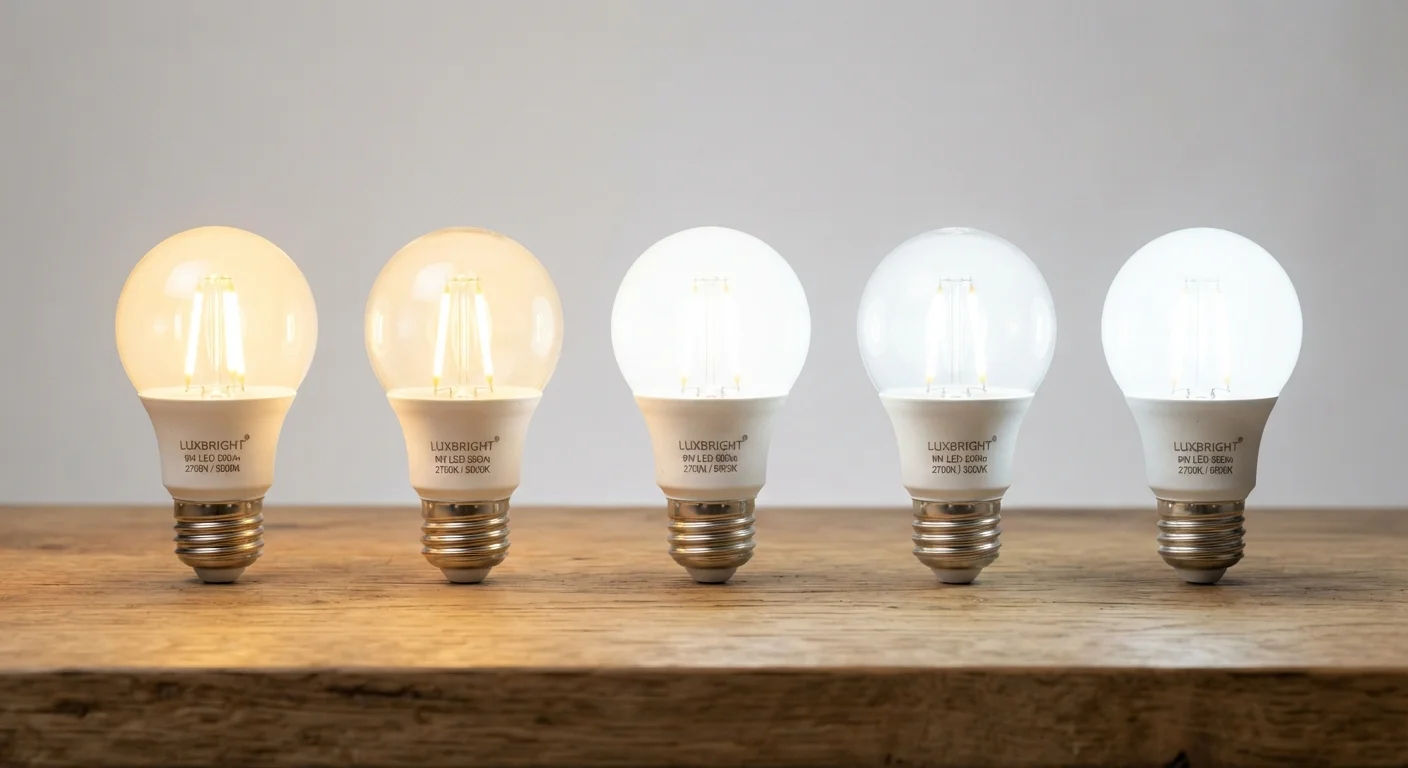
Colour temperature, measured in Kelvin, describes whether a bulb's light appears warm (yellowish), neutral (white), or cool (bluish-white). The Kelvin scale for residential lighting generally runs from about 2,700 K to 6,500 K.
- 2,700–3,000 K (Warm White): Resembles traditional incandescent light. Flattering in bedrooms, living rooms, and dining areas where a cozy atmosphere is the goal.
- 3,500–4,100 K (Neutral/Cool White): Crisper and more alert-feeling. Often chosen for kitchens, bathrooms, and home offices.
- 5,000–6,500 K (Daylight): Mimics midday natural light. Useful in garages, craft rooms, or task areas requiring high visual clarity.
One important nuance: Kelvin does not affect brightness. A 3,000 K bulb and a 5,000 K bulb with the same lumen output are equally bright — they simply cast light of a different colour. Mixing Kelvin values in the same room creates visual inconsistency most people notice as unsettling without knowing why. For more on how light interacts with colour perception, see how tone and light interact in living spaces.
CRI: How Accurately Colours Appear
Colour Rendering Index (CRI) measures how accurately a light source reveals the true colours of objects compared to a reference light source (natural daylight). The scale runs from 0 to 100, with 100 representing perfect colour accuracy.
80+
CRI considered acceptable for most home use
Lighting industry guidance generally places 80 CRI as the minimum threshold for residential applications.
90+
CRI recommended for colour-sensitive tasks
Tasks such as makeup application, artwork, and cooking benefit from bulbs rated 90 CRI or higher for accurate colour rendering.
0–100
Full range of the CRI scale
A CRI of 100 represents perfect colour accuracy relative to a natural daylight reference source.
A low-CRI bulb can make food look unappetizing, skin tones look flat, and paint colours appear shifted from what you chose in a store. A high-CRI bulb reveals colour as it actually is.
For most home applications, a CRI of 80 or above is generally considered acceptable. For tasks where colour accuracy matters — makeup application, artwork, cooking, reading fabric swatches — a CRI of 90 or above is worth seeking out. Bulbs marketed primarily on lumen output or energy savings sometimes sacrifice CRI; it's worth checking the packaging rather than assuming.
It's also worth noting that CRI has known limitations as a metric — it was designed using a set of test colours that don't always predict real-world colour rendering in every situation. A high CRI is a reliable minimum standard, but it is not the only relevant measure of light quality.
Colour perception is also shaped by your room's existing light sources — natural and artificial together. Common assumptions about natural light are worth revisiting before making final decisions.
Using All Three Numbers Together
The three specifications work as a system. Choosing a bulb by lumens alone risks getting light that's too harsh or too warm for the space. Choosing by Kelvin alone risks a beautifully tinted bulb that can't adequately light the room. Skipping CRI risks colours in your home looking subtly off even when brightness and temperature feel right.
A practical checklist when comparing bulbs:
- Decide the lumen range appropriate for the fixture and its purpose.
- Choose a Kelvin value that matches the mood and function of the room.
- Confirm CRI is 80+ for everyday use or 90+ for colour-sensitive tasks.
These three numbers, taken together, give you more genuine information than wattage, brand messaging, or vague descriptors like "warm glow" or "natural light" ever could. Once you're comfortable reading them, bulb shopping becomes a straightforward decision rather than a guessing game.