

Key Takeaways
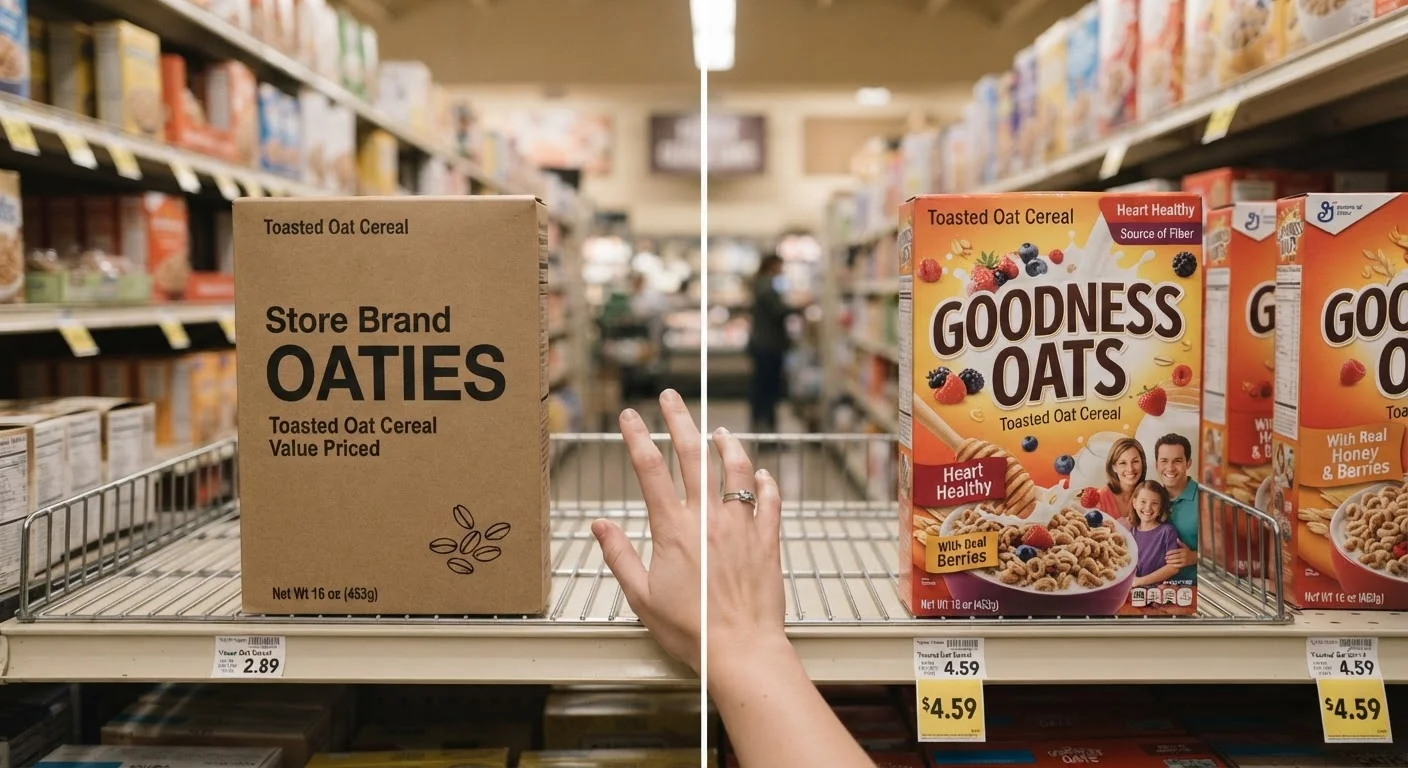
- Generic and name-brand products are not interchangeable across all categories — context determines value.
- Commodity products with standardized specs are where generics most reliably deliver equal performance.
- Name brands matter most when proprietary formulations, safety certifications, or long-term durability are involved.
- Price per unit is a useful starting metric, but total cost of use is often the more accurate comparison.
- Marketing claims from either source require the same level of healthy skepticism.
Option A
Generic / Store Brand
The lean, price-forward alternative.
Best for: Commodity purchases where formulation, ingredients, or specs are standardized and performance differences are minimal.
Option B
Name Brand
The recognized, often researched incumbent.
Best for: Categories where proprietary formulations, certifications, safety records, or consistent performance justify the premium.
If you're stocking everyday pantry staples and cleaning supplies
Generic / Store Brand
Commodity categories like flour, sugar, baking soda, and basic cleaners follow standardized compositions, making generics functionally equivalent at lower cost.
If you're buying over-the-counter medications or health-adjacent products
Name Brand
While active ingredients may match, name brands often carry more robust safety histories, clearer labeling, and third-party verification that matters for health decisions.
If you're purchasing tools or appliances expected to last years
Name Brand
Durability claims are easier to verify for established brands with documented track records; generic durable goods carry more performance uncertainty.
If you're budget-constrained and experimenting with an unfamiliar product
Generic / Store Brand
Starting with a generic limits financial exposure while you determine whether the product category actually fits your needs.
If you're buying personal care products with skin sensitivities to consider
Name Brand
Formulation consistency and allergen transparency tend to be better documented in name-brand personal care lines, reducing the risk of adverse reactions.
Why the Generic vs. Name Brand Question Has No Single Answer
Most shopping advice on this topic lands in one of two camps: either "generics are always a smart swap" or "you get what you pay for." Both are oversimplifications. The honest answer is that the right choice depends entirely on the product category and what you actually need from it.
The key distinction is between commodity products and differentiated products. A commodity product is one where the formulation, ingredient list, or performance spec is essentially fixed — think baking soda, acetaminophen, or copy paper. A differentiated product is one where the manufacturer's specific process, materials, or formula meaningfully affects how it performs — think a long-lasting exterior paint or a dishwasher with a specific wash cycle engineering.
Getting this distinction right is the foundation of the whole framework. For a deeper look at how specs and claims are used to blur this line, see how specifications and features are used to confuse, not inform.
| Criterion | Generic / Store Brand | Name Brand |
|---|---|---|
| Price point | Typically 20–40% lower | Higher; includes marketing costs |
| Formulation transparency | Variable; often limited | Generally better documented |
| Performance in commodity categories | Usually equivalent | Equivalent, at higher cost |
| Performance in differentiated categories | Often uncertain | More predictable and verifiable |
| Warranty and accountability | Limited or unclear | Typically robust and accessible |
| Third-party testing / certifications | Rare or unverified | More common and traceable |
| Ideal for | Standardized, low-risk purchases | Durable, health, or performance-critical buys |
Where Generics Hold Up Well
Generics consistently perform on par with name brands in categories where quality is defined by a fixed standard rather than a proprietary process. These include:
- Basic pantry ingredients — Flour, salt, vinegar, and dry pasta have standardized grades. A generic all-purpose flour meets the same milling specifications as a name-brand equivalent.
- OTC drug active ingredients — The FDA requires that generic drugs contain the same active ingredient at the same dosage and in the same form as their brand-name counterparts. The inactive binders and fillers may differ, but the therapeutic component does not.
- Household cleaning basics — Bleach concentration is regulated, and many store-brand cleaners share manufacturing plants with name-brand products, a fact that has been reported by consumer research outlets over the years.
- Office and paper goods — Copy paper, trash bags, and basic storage containers perform to measurable specs that generics meet routinely.
In these categories, paying a brand premium typically buys you packaging and marketing, not better performance. This is also where buying in bulk can amplify your savings on generics meaningfully.
~80%
Store-brand market share in some grocery categories
Consumer research organizations have noted that store brands command significant share in staple grocery categories, reflecting growing consumer confidence in generic equivalency.
20–40%
Typical price difference: generic vs. name brand
Across grocery and household products, store-brand items commonly cost 20 to 40 percent less than their name-brand counterparts, according to general retail pricing analyses.
Where Name Brands Earn Their Premium
The calculus shifts when you move into categories where performance is genuinely tied to proprietary engineering, curated sourcing, or long-term durability. Here, the price gap between generic and name brand often reflects a real difference — not just a marketing budget.
Durable goods and tools are one of the clearest examples. A name-brand power tool carries a documented performance history, consistent tolerances, and an established warranty infrastructure. A no-name equivalent may look identical on the shelf but lack the quality-control investment. As our guide to durability and build quality claims explains, certain construction details and certifications are reliable signals that generic labeling rarely provides.
Personal care products with dermatologist testing, allergen documentation, or specialty formulations also tend to justify brand premiums for consumers who need predictable, consistent results — particularly for sensitive skin or medically adjacent use.
Complex appliances benefit from brand accountability. If a name-brand refrigerator fails, parts, service records, and warranty claims have a clear path. The same isn't always guaranteed with store-brand appliances that may have opaque supply chains.
For an approach to evaluating any unfamiliar product in these categories, the framework for evaluating home products you know nothing about offers a practical starting point.
Applying the Framework at the Shelf
When you're standing in the aisle, a simple set of questions cuts through the noise:
- Is this a commodity or a differentiated product? If quality is defined by a fixed standard (regulated by a government body or industry specification), the generic is very likely equivalent.
- What's the cost of being wrong? For a box of generic pasta, the downside of dissatisfaction is a few dollars. For a tool you'll rely on for years, or a product with health implications, the risk calculus changes significantly.
- What is the total cost of use — not just the unit price? A generic paint that requires three coats versus a name brand that covers in two may not actually be cheaper once you account for labor and material volume.
- Is a sale price distorting the comparison? Name brands frequently run promotions that temporarily close the gap. Understanding whether a discount is genuine or a pricing tactic matters — our look at sale prices versus everyday low prices is worth a read before you decide.
For a detailed breakdown of how specific household product categories actually compare, store-brand vs. name-brand across categories provides category-by-category guidance that complements this framework. More general product evaluation resources are also available through our Product Know-How hub.
A Note on OTC Medications
For over-the-counter drugs, the FDA mandates that generics contain the same active ingredient, strength, and dosage form as brand-name equivalents. However, inactive ingredients — fillers, binders, dyes — can vary and may matter for people with specific allergies or sensitivities. If you have known reactions to inactive ingredients, review the full label carefully or consult a pharmacist. This article is general information, not medical advice.