

Key Takeaways
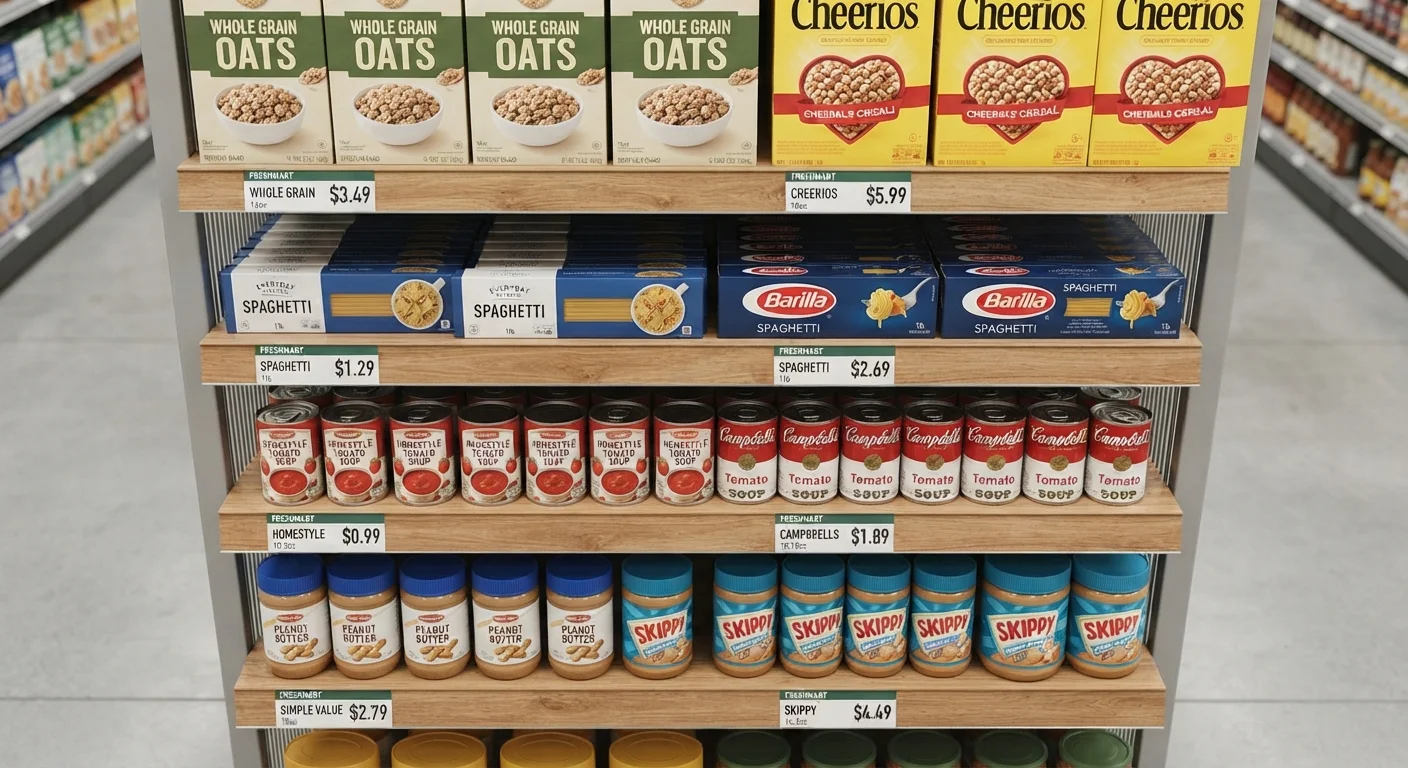
- Store brands typically cost 20–30% less than their name-brand equivalents on average.
- Quality gaps are smallest for pantry staples, cleaning supplies, and over-the-counter medications.
- Name brands hold a meaningful edge in a few categories, including tools and certain personal care items.
- Retailer private-label products are often manufactured by the same facilities as name brands.
- Testing store brands in low-stakes categories first is a practical way to reduce grocery spend.
Our Verdict
Store brands offer genuine savings with comparable quality in most pantry, cleaning, and basic health categories. Name brands retain a practical edge where formulation complexity, long-term durability, or personal preference plays a bigger role — but those cases are fewer than most shoppers assume.
| Best for | Recommended |
|---|---|
| Budget-conscious shoppers stocking everyday pantry staples | Store brand |
| Households looking to cut cleaning supply costs without performance loss | Store brand |
| Shoppers with strong flavor or texture preferences in food | Name brand |
| Buyers purchasing tools or appliances expected to last years | Name brand |
Why the Store Brand vs. Name Brand Debate Still Matters
For everyday homeowners, the choice between store-brand and name-brand products plays out dozens of times each month — at the grocery store, the hardware aisle, and the pharmacy. The stakes feel low in the moment, but those decisions compound over a year's worth of shopping trips.
Store brands (also called private-label or generic products) are owned and sold by retailers rather than third-party manufacturers. Many are produced in the same facilities as name-brand equivalents, then packaged under the retailer's label. That doesn't make them identical, but it does mean the quality gap is often narrower than the price gap suggests.
Understanding where the differences are real — and where they're largely marketing — is the foundation of smarter shopping. For a structured framework, see our guide to deciding between generic and name brand.
| Category | Store Brand | Name Brand | |
|---|---|---|---|
| Pantry staples | Comparable quality, lower cost | Recipe-specific advantage possible | Marginal difference for most items |
| Cleaning supplies | Strong value, similar active ingredients | May offer concentrated formulas | Check unit price before deciding |
| OTC medications | FDA-equivalent active ingredients | Brand recognition only | Generic wins on value |
| Tools & hardware | Fine for light occasional use | Better materials and warranty support | Name brand suits heavy-use scenarios |
| Personal care basics | Reliable for commodity items | Formulation differences in premium lines | Trial sizes reduce risk |
| Dairy & eggs | Grading standards ensure consistency | Minimal difference in regulated products | Store brand offers clear savings |
Pantry and Grocery: Where Store Brands Shine
The pantry is the strongest case for store brands. Canned vegetables, dried pasta, flour, sugar, oil, vinegar, and most baking staples are commodity products with tightly regulated standards. The ingredient lists are often identical to name-brand versions, and blind taste tests conducted by consumer research organizations have consistently shown shoppers struggle to distinguish them.
Exceptions exist: seasoning blends, sauces, and snack foods involve proprietary recipes where flavor can differ noticeably. If a specific taste or texture matters to you, a side-by-side test at home is more reliable than assuming either way.
Start With Low-Stakes Swaps
If you're new to store brands, begin with categories where quality is most standardized — canned goods, baking staples, and dairy. Keep the name-brand version on hand for a direct comparison if you're unsure. Most shoppers find a comfortable mix of store-brand and name-brand products rather than switching entirely.
Dairy products — milk, butter, eggs, and shredded cheese — are another strong store-brand category. Grading standards ensure consistency, and price differences can be substantial.
Cleaning and Household Supplies: Comparable Performance at Lower Cost
Most household cleaners — all-purpose sprays, dish soap, laundry detergent, and surface disinfectants — rely on active ingredients regulated by the EPA or comparable agencies. Store-brand versions formulated to the same active-ingredient concentrations perform comparably to name-brand counterparts in independent laboratory assessments.
The main caveat: ultra-concentrated name-brand formulas sometimes carry a lower cost-per-use when factored carefully. Always check the unit price label, not the shelf price. Understanding everyday low prices versus promotional pricing can also help you judge whether a name-brand sale actually beats a store-brand's everyday price.
Over-the-Counter Medications: A Clear Case for Generic
This is one of the few categories with regulatory clarity built in. In the U.S., the FDA requires generic OTC medications to contain the same active ingredients at the same dosage as their name-brand equivalents. Pain relievers, antihistamines, antacids, and sleep aids all fall under this standard.
The inactive ingredients — binders, coatings, flavorings — can differ, which occasionally matters for people with sensitivities. But for the general population, store-brand OTC medications represent straightforward savings with no meaningful efficacy trade-off.
This content is general information, not medical advice. Consult a qualified healthcare professional before making changes to any medication regimen.
Tools, Hardware, and Appliances: Where Name Brands Hold an Edge
Durability is harder to replicate at scale. In power tools, hand tools, and small appliances, name brands typically invest more in materials engineering, quality control tolerances, and long-term warranty support. A store-brand drill purchased for occasional light use may perform perfectly well; one that sees regular heavy use may wear faster.
The calculus here involves expected usage intensity and replacement cost. Occasional DIY users may find store-brand hardware more than adequate. Frequent users — or anyone doing work where tool failure has real consequences — may find name-brand durability worth the premium. Always check if permits or a licensed professional are required before undertaking significant home repair or improvement work.
For guidance on stretching your budget across larger purchases, see how bulk buying factors into real savings.
Personal Care: A Mixed Picture
Shampoo, lotion, sunscreen, and basic skin care products occupy a middle ground. Commodity products like cotton balls, bandages, petroleum jelly, and isopropyl alcohol follow the same logic as OTC medications — the active content is standardized, and store brands are a reliable choice.
Premium personal care products are trickier. Formulation complexity in moisturizers, hair treatments, and cosmetics means ingredient lists diverge more significantly. Preference and skin compatibility also vary individually. For products in this category, a trial-size test before committing to a large purchase is worth the small extra cost. Timing those purchases around seasonal pricing cycles can reduce the cost of experimentation.