

Key Takeaways
- Clicker training uses a sharp, consistent sound to mark the exact moment a pet performs a desired behavior.
- Verbal cues are words or sounds spoken by the owner — accessible anywhere without any equipment.
- Both methods rely on positive reinforcement; neither is inherently superior for all pets or situations.
- Consistency in timing and reward delivery matters more than which method you choose.
- Some owners combine both techniques as their pet advances through training stages.
- Species, individual temperament, and hearing ability can influence which method is more effective.
Option A
Clicker Training
The precise, consistent marker method.
Best for: Owners who want split-second timing accuracy and a signal that never varies in tone or volume.
Option B
Verbal Cues
The hands-free, always-available approach.
Best for: Owners who prefer a naturalistic, gear-free method that integrates easily into daily routines.
If you want pinpoint precision when shaping complex behaviors
Clicker Training
The clicker's neutral, unchanging sound marks the exact behavior at the exact moment, reducing confusion during multi-step skill building.
If you frequently train on the go or hands-free
Verbal Cues
Your voice is always available — no device to carry, drop, or forget — making verbal cues practical for busy, varied environments.
If your pet has significant hearing impairment
Verbal Cues
For hard-of-hearing pets, a visual hand signal paired with a spoken word (or touch cue) often outperforms an auditory click. Consult your veterinarian about your pet's specific sensory needs.
If you are a first-time trainer working with a highly distractible pet
Clicker Training
The clicker's distinct, non-emotional sound cuts through background noise more reliably than a voice that can vary with your mood or stress level.
If you want a method the whole household can use without buying equipment
Verbal Cues
Every family member can use the same words immediately, keeping cues consistent across caregivers without coordinating a shared device.
How Each Method Works
Both clicker training and verbal cues are forms of marker training — a technique rooted in operant conditioning, which is how animals learn that a behavior causes a specific outcome. If you'd like a plain-language breakdown of those terms, see our Pet Training Glossary.
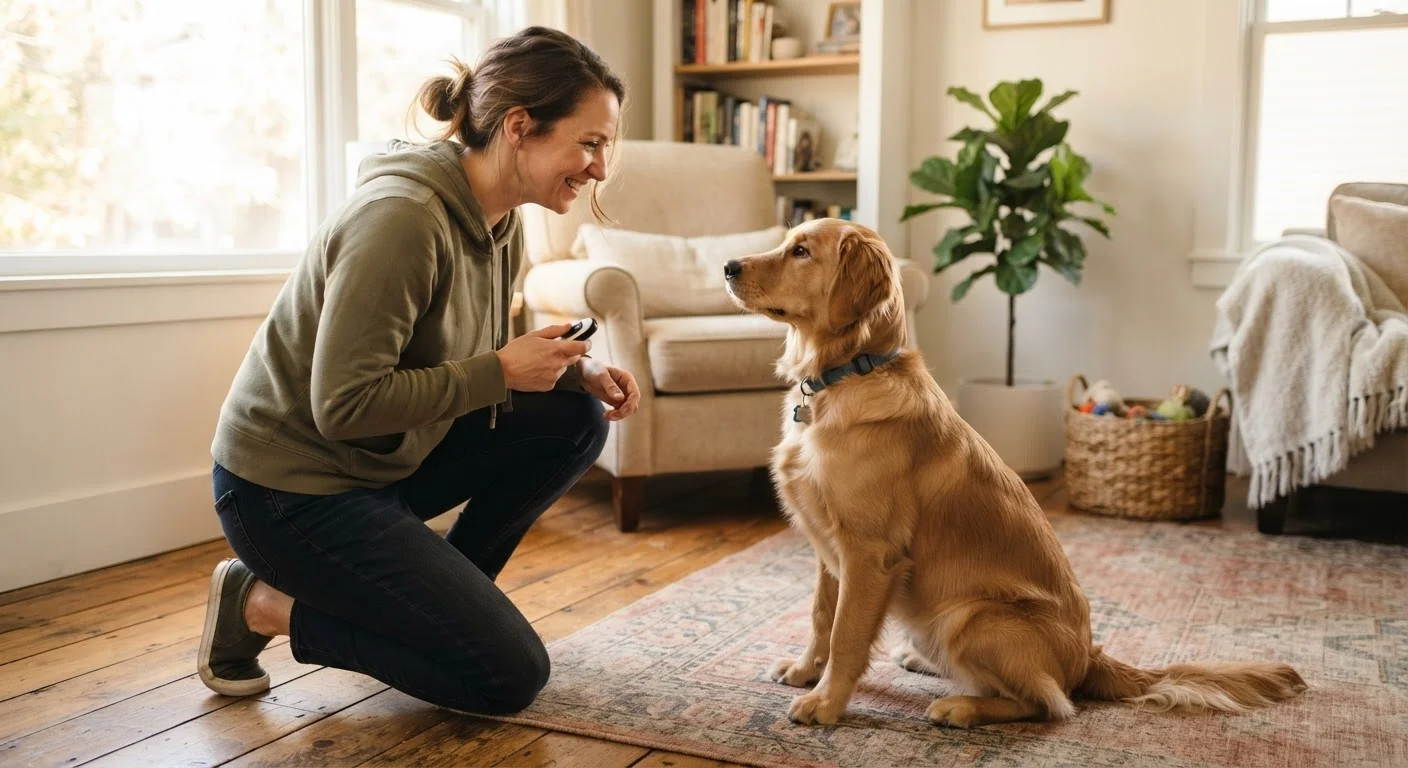
Clicker training uses a small handheld device that produces a short, sharp click. The owner clicks at the precise moment the pet performs a target behavior, then immediately follows with a treat or other reward. Over repetition, the pet learns that the click means "that exact action earns something good." The clicker itself is a conditioned reinforcer — it carries meaning only because it has been paired reliably with rewards.
Verbal cues follow the same logic, but the marker is a spoken word or sound — commonly "yes" or "good" — rather than a mechanical click. The word is delivered at the same moment the behavior occurs, followed by a reward. Because verbal cues eventually become command words ("sit," "stay," "come"), many owners use both a marker word and command words as separate tools within the same training framework.
| Criterion | Clicker Training | Verbal Cues |
|---|---|---|
| Equipment needed | Handheld clicker device | None — voice only |
| Signal consistency | Always identical sound | Can vary with tone/mood |
| Timing precision | Very high | Moderate to high |
| Ease for households | Requires shared device | Anyone can use same words |
| Suitable species | Dogs, cats, birds, small pets | Dogs, cats, some small pets |
| Hearing-impaired pets | Less effective | Pair with visual/touch cues |
| Learning curve | Moderate (timing practice) | Low to moderate |
Strengths and Limitations of Each Approach
The clicker's main advantage is consistency. Unlike a human voice, it does not change pitch, volume, or emotional tone between sessions — which matters when a pet is learning to associate a sound with a very specific action. This makes it particularly effective for shaping nuanced behaviors step by step, a process called shaping.
Its limitations are practical: you need a free hand, the device can be misplaced, and some animals are startled by the sound initially. Pets with noise sensitivities may need a gentler version, such as a softer-clicking model or a retractable pen used as a substitute.
Verbal cues are always with you, but voices are variable. A tired or frustrated owner may unintentionally change inflection, making the cue harder for a pet to recognize reliably. That said, many animals — especially dogs — learn to read additional emotional and contextual signals from their owners' voices, which can actually enrich communication over time.
A Note on Noise-Sensitive Pets
Some pets — particularly those with anxiety or a history of noise aversion — may startle at a standard clicker's sharp sound. If your pet reacts fearfully, you can condition them gradually to the sound using desensitization, start with a muffled click (clicker held in a pocket), or switch to a softer marker sound entirely. Always observe your pet's body language and consult a veterinary behaviorist if anxiety is a persistent concern.
For owners starting out, our guide on the first 30 days of training walks through how to introduce either method in a structured, low-pressure way.
Which Method Fits Your Pet and Lifestyle?
There is no universal answer — the right method depends on your pet's species, temperament, and sensory abilities, as well as your own routine. For example, small animals like rabbits and birds can respond well to clicker training because the click is species-neutral, whereas verbal tones may be harder for them to distinguish from ambient household noise. Learn more in our overview of training small pets.
Many experienced trainers recommend starting with a clicker to build precise habits early, then layering in verbal cues as behaviors become reliable. At that stage, the clicker can be faded out — the spoken word takes over as the primary marker. This hybrid approach gives owners the accuracy of the clicker during learning and the convenience of voice during everyday life.
Regardless of method, two factors consistently matter more than the tool itself: timing (marking the behavior within roughly one second) and reward value (using something your pet genuinely finds motivating). Both clicker training and verbal cues are forms of positive reinforcement, and that shared foundation is what actually drives learning. Also keep sessions appropriately short — our article on how long training sessions should last can help you avoid overworking your pet.
This article is for general educational purposes only and is not a substitute for guidance from a certified animal behaviorist or veterinarian, particularly for pets with behavioral challenges or medical conditions.