

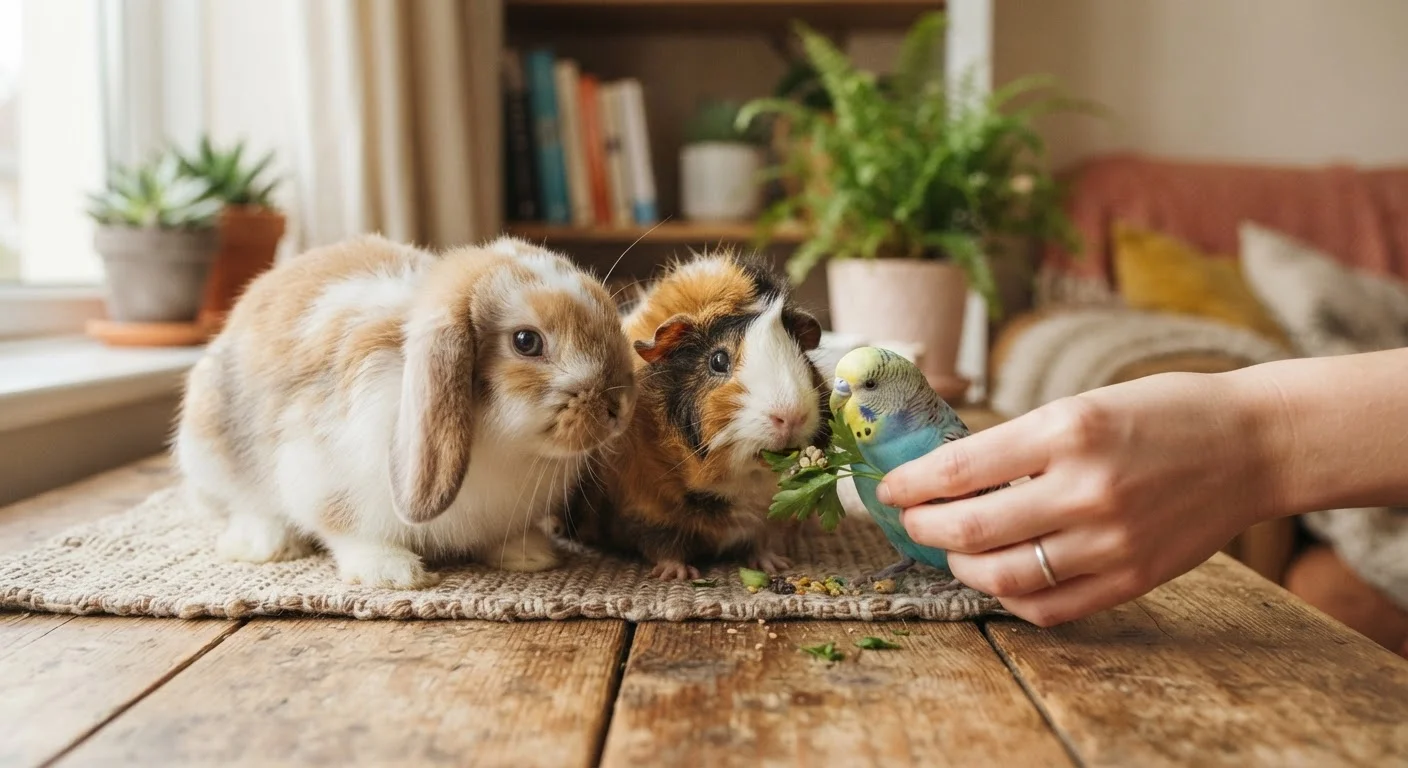
Key Takeaways
- Positive reinforcement works across species — rabbits, guinea pigs, and birds all respond to reward-based training.
- Short, consistent sessions of two to five minutes are more effective than long, infrequent ones.
- Each species has different motivators: food treats work broadly, but timing and delivery matter enormously.
- Clicker training is particularly effective for birds and rabbits because it provides a precise, consistent signal.
- Never use punishment or force — small animals stressed during training stop learning and may become fearful.
- Realistic goals vary by species; focus on practical behaviors like recall, handling tolerance, and simple tricks.
Why Small Pets Can — and Should — Be Trained
There's a persistent myth that training is only for dogs, maybe cats. In reality, any animal capable of associating an action with a consequence can be trained — and that includes rabbits, guinea pigs, and pet birds. Training isn't just about tricks; it reduces stress during vet handling, strengthens the bond between pet and owner, and provides genuine mental enrichment that improves animal welfare.
The core principle is the same across all species: behavior that produces a reward is likely to be repeated. This is operant conditioning, and it's not species-specific. What changes is how you apply it. If you're new to the terminology, the Pet Training Glossary is a useful plain-language reference before you begin.
Below are the most effective, evidence-informed techniques — broken down by what actually works for each type of small pet.
Use a marker signal to bridge the gap between behavior and reward
Whether you use a clicker or a short verbal word like "yes," a marker signal tells your pet the exact moment they did something right. This precision is critical for small animals because the window between correct behavior and treat delivery is tiny — hesitate even two seconds, and you may accidentally reward the wrong movement.
Clickers are especially effective for rabbits and birds, whose responses to sound are sharp and consistent. Guinea pigs also respond well, though some individuals are startled by the click sound initially. If that happens, muffle the clicker inside a pocket or switch to a soft verbal marker instead.
A marker signal eliminates guesswork — your pet knows exactly which behavior earned the reward.
Teach rabbits to come when called using luring and reinforcement
Recall — coming when their name is called — is one of the most practical behaviors a rabbit can learn. Start by saying your rabbit's name once, then immediately place a small, high-value treat (such as a tiny piece of fresh herb) on the ground in front of you. Repeat this in short sessions, gradually increasing the distance.
Avoid calling the rabbit's name repeatedly without following through with a reward; this teaches them to ignore the cue. Once recall is reliable indoors, it becomes genuinely useful during free-roaming time and reduces handling stress. Rabbits also learn to target (touch their nose to a finger or stick), which makes guiding them into carriers or onto scales much less stressful for both of you.
Recall training makes daily rabbit handling safer and significantly less stressful for the animal.
Train guinea pigs to tolerate and enjoy handling through desensitization
Guinea pigs are prey animals with strong flight instincts, which means abrupt or forceful handling can create lasting fear responses. The goal isn't just to teach tricks — it's to make routine care (nail trims, health checks) less distressing.
Desensitization means gradually exposing your guinea pig to handling at a pace they can tolerate, pairing each step with a treat. Start with your hand simply resting near them. Progress to gentle strokes, then brief lifts, always rewarding calm behavior. Never reach in quickly from above — that mimics a predator strike. Come from the side, move slowly, and let the animal sniff your hand first.
Guinea pigs can also learn simple behaviors like stepping onto a small platform or moving through a short tunnel, both of which make health examinations easier to perform at home.
Desensitizing guinea pigs to handling early transforms routine care from a struggle into a calm routine.
Teach pet birds using step-up training and incremental shaping
"Step up" — stepping from a perch onto your finger or hand — is the foundational behavior for most pet bird training. Hold your finger horizontally just above the bird's feet and apply gentle forward pressure against the lower chest. Most birds will step up reflexively; immediately reward with praise or a small treat.
Once step-up is reliable, birds can learn remarkably complex behaviors through shaping — rewarding successive approximations toward the final behavior. Parrots and cockatiels, in particular, have demonstrated the ability to learn color recognition, object retrieval, and even simple vocalizations linked to specific contexts. Keep sessions under five minutes; birds fatigue mentally faster than owners expect, and an overstimulated bird stops engaging productively.
Step-up training is the gateway behavior that unlocks almost every other bird training goal.
Keep sessions short, end on success, and track progress
For all small pets, session length is one of the most commonly mismanaged variables. Two to three minutes of focused, rewarding interaction beats fifteen minutes of diminishing returns. Always aim to end while the animal is still engaged and has just succeeded — this ensures they associate training with positive outcomes and approach the next session eagerly.
Keep a simple log: date, what you practiced, how the animal responded, and any adjustments you made. Patterns become visible over time — you might notice your rabbit is more engaged in the morning, or your bird is distracted near feeding time. Adjusting session timing based on your pet's natural rhythms makes a measurable difference in progress speed.
For broader context on how these principles scale to other pets, the Pet Health Basics hub covers the foundational care routines that support a trainable, mentally healthy animal.
Always end a session on a successful repetition — it shapes how your pet feels about training tomorrow.
Avoid punishment entirely — redirect instead
Punishment — including startling sounds, spray bottles, or physical corrections — does not teach small animals what you want them to do. It teaches fear. For prey species like rabbits and guinea pigs, a frightened animal is an animal that stops learning. For birds, punishment can permanently damage the trust required for cooperative training.
When an unwanted behavior occurs, simply withhold the reward (this is called extinction) or calmly redirect the animal toward an incompatible behavior that you can then reward. For example, if a rabbit thumps and runs when approached, pause the session, give them space, and restart from a step the animal is comfortable with. Progress is almost never linear — plateaus and regressions are normal and don't require escalation.
Punishment teaches fear, not behavior — redirection and patience are always the more effective path.
Putting It All Together at Home
Consistency matters far more than perfection. Even two focused minutes per day, repeated across several weeks, produces meaningful behavioral change in small animals. Keep treat portions tiny — especially for guinea pigs and rabbits, where overfeeding disrupts balanced nutrition. For guidance on what treats are species-appropriate, see our Pet Nutrition hub.
Match Treat Size to Your Pet's Body
Treats used in training should be no larger than a pea for rabbits and guinea pigs, and even smaller for birds. Oversized rewards slow the session down and can throw off your pet's daily nutritional balance. Variety also helps — rotate two or three favorite treat types so your pet stays motivated across multiple sessions.
If your small pet is newly adopted, don't rush into formal training. Spend the first week or two simply allowing them to acclimate to your presence and home environment. The First 30 Days training roadmap offers a practical framework for building trust before you introduce cues. When you're ready to choose between a clicker and verbal cues, this comparison guide can help you decide what suits your pet's temperament.
This article is for general informational purposes only. For questions about your specific pet's health, diet, or behavior, consult a qualified veterinarian or certified animal behaviorist.