

Key Takeaways
- Forced-air systems heat quickly and can share ductwork with central air conditioning.
- Radiant systems deliver steady, even warmth from the floor up with no airborne dust circulation.
- Installing radiant heating in an existing home is significantly more invasive and costly than forced-air.
- Forced-air requires regular filter changes and duct maintenance to stay efficient.
- Radiant systems have fewer moving parts, which generally means lower long-term maintenance demands.
- Your home's construction, climate, and budget all shape which system makes practical sense.
Option A
Forced-Air Heating
The established, versatile whole-home standard.
Best for: Homeowners who want a combined heating and cooling system with fast response times and existing ductwork.
Option B
Radiant Heating
The quiet, even-comfort alternative beneath your feet.
Best for: Homeowners prioritizing consistent, draft-free warmth and willing to invest more upfront — especially during new construction or full renovations.
If you already have ductwork and want a straightforward upgrade
Forced-Air Heating
Retrofitting a forced-air furnace into existing duct infrastructure is far less disruptive and costly than tearing up floors for radiant installation.
If you're building new or doing a major floor renovation
Radiant Heating
New construction is the ideal window to install hydronic or electric radiant systems before flooring goes down, avoiding the primary cost barrier.
If allergy management or indoor air quality is a priority
Radiant Heating
Radiant systems don't move air, so they don't recirculate dust, pet dander, or other airborne particles the way ducted systems can.
If you want one system to handle both heating and cooling
Forced-Air Heating
Forced-air furnaces pair naturally with central air conditioning using the same ductwork, making whole-home climate control straightforward.
If consistent, room-by-room comfort without drafts is your main goal
Radiant Heating
Radiant heat rises evenly from the floor, eliminating the temperature stratification and air movement that forced-air systems can produce.
How Each System Actually Works
Understanding the mechanics behind each system makes it far easier to evaluate which fits your home. Both deliver heat — they just do it in fundamentally different ways.
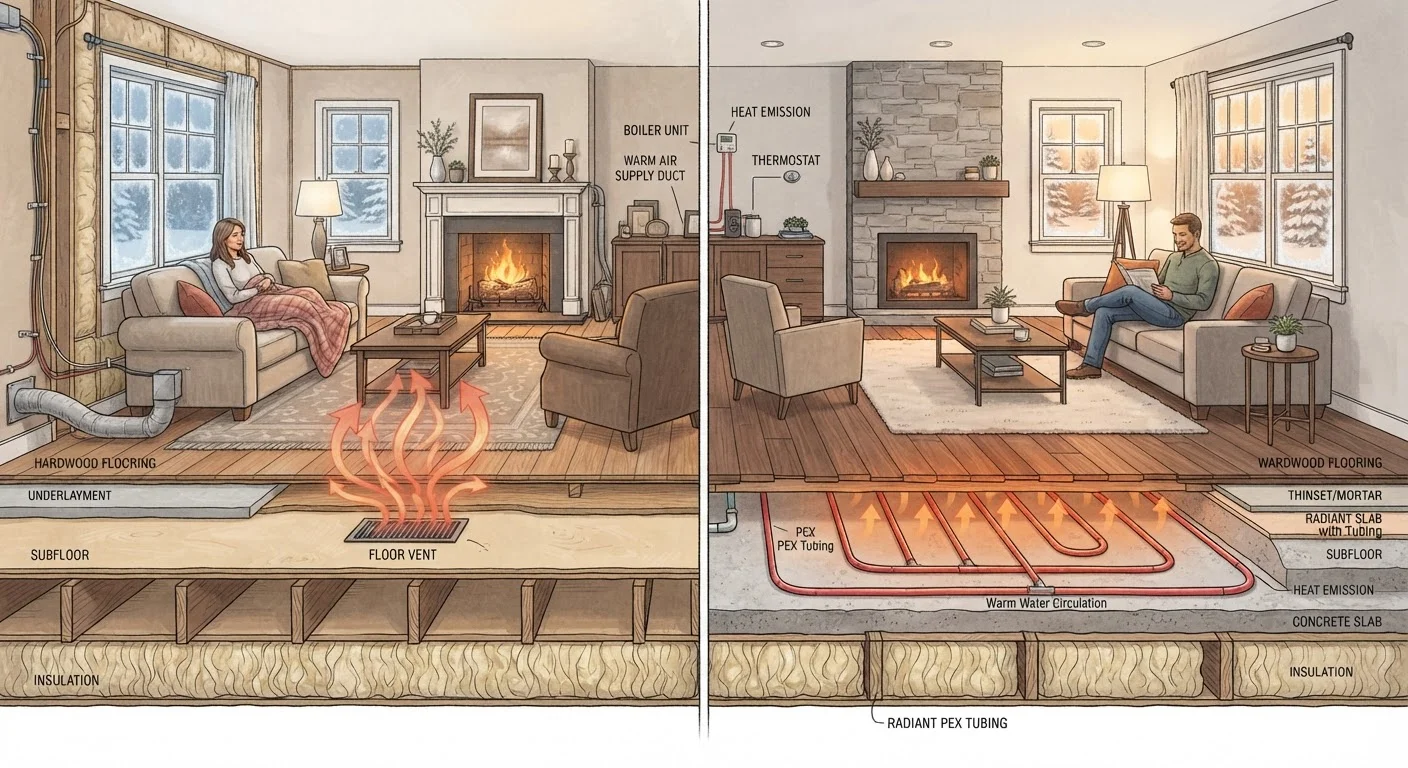
Forced-air heating uses a furnace to heat air, then pushes that warmed air through a network of ducts and out through vents (called supply registers) placed throughout your home. A blower fan drives this process, cycling air continuously. The same ductwork typically serves a central air conditioner in summer, making forced-air the backbone of most combined HVAC systems. For a broader look at how heating fits into your home's overall infrastructure, see how your home's core systems connect.
Radiant heating works by warming surfaces directly — most commonly the floor — which then emit heat upward into the room. There are two main types: hydronic systems circulate hot water through tubing embedded in or beneath the floor, while electric systems use resistive heating cables or mats. Because radiant heat doesn't rely on moving air, rooms warm more gradually but hold that warmth more evenly. If unfamiliar terms come up as you research, this HVAC glossary for homeowners covers the essentials in plain language.
| Criterion | Forced-Air Heating | Radiant Heating |
|---|---|---|
| Heat delivery method | Heated air through ducts and vents | Warm surfaces radiating heat upward |
| Response time | Fast — rooms warm within minutes | Slower — can take 30–90 minutes |
| Comfort consistency | Can vary; drafts near vents possible | Even, steady warmth throughout room |
| Air quality impact | Circulates dust; filtration needed | No air movement; minimal dust spread |
| Cooling integration | Yes — shares ducts with central AC | No — separate cooling system required |
| Retrofit ease | Moderate — easier with existing ducts | Difficult — often requires floor removal |
| Routine maintenance | Regular filter changes, annual service | Minimal; boiler checks for hydronic |
| Noise level | Audible fan and airflow noise | Silent operation |
Comfort, Air Quality, and Daily Experience
The day-to-day feel of each system differs in ways that matter to many households.
Forced-air systems heat a room quickly — an advantage when temperatures drop fast — but they also create air movement. That circulation can cause drafts near vents, stir up dust and allergens, and produce noticeable temperature swings as the system cycles on and off. Proper filtration and duct maintenance reduce these effects, but they don't eliminate them entirely. If you've noticed your home never quite feels as warm as your thermostat reads, uneven heating is often a duct and airflow issue.
Radiant systems, by contrast, heat objects and people rather than just the air, which many occupants find more comfortable — similar to the warmth of sunlight. Because there's no fan, there's no noise and no air movement. This makes radiant particularly appealing for households with dust sensitivities. The trade-off is slower warm-up time; radiant floors may take an hour or more to reach full output, so programmable scheduling matters more.
~90%
U.S. homes using ducted heating systems
According to U.S. Energy Information Administration residential energy surveys, the vast majority of American homes rely on forced-air or ducted distribution for heating.
2–3°F
Typical floor-to-ceiling temp difference with radiant
Research on radiant floor heating generally finds much smaller vertical temperature gradients compared to forced-air systems, which can show differences of 5–10°F or more.
1–3 months
Recommended forced-air filter replacement interval
Most HVAC manufacturers and industry guidance recommend replacing standard 1-inch furnace filters every one to three months depending on household conditions and filter type.
Installation, Retrofit Challenges, and Maintenance
For most existing homes, installation context tips the scales significantly.
Forced-air systems are the dominant choice in U.S. homes, meaning contractors, parts, and service are widely available. Replacing or upgrading a furnace in a home that already has ducts is a manageable project. Installing new ductwork in a home without it is more invasive but still feasible. Maintenance involves replacing filters regularly (typically every one to three months depending on filter type and household conditions), having ducts cleaned periodically, and scheduling annual furnace inspections.
Hydronic radiant systems, while efficient once running, require embedding tubing in flooring — a process that typically means removing existing floors or pouring new concrete. This makes retrofit installations expensive and disruptive. Electric radiant mats are simpler to install under tile or similar flooring, making them practical for bathroom upgrades, though they can carry higher operating costs depending on local electricity rates. Radiant systems generally have fewer mechanical components than forced-air, so routine maintenance is lighter — though hydronic systems do require periodic checks of the boiler and water pressure. Any significant installation or modification to heating systems may require permits; always verify local requirements before starting work. See when permits are required for home system work for guidance on navigating that process.
Permits and Licensed Work for Heating Systems
Installing or significantly modifying a heating system — whether a new furnace, boiler, or radiant floor system — typically requires a permit and inspection in most U.S. jurisdictions. Work involving gas lines or electrical connections to heating equipment is generally required to be performed by licensed professionals. Always contact your local building department to confirm what your specific municipality requires before any work begins.