

Key Takeaways
- Resting works by allowing heat-displaced juices to redistribute through the meat before cutting.
- Thicker cuts and high-heat cooking methods benefit most from resting time.
- Thin cuts and braised or slow-cooked meats need little to no resting.
- A loose foil tent preserves some heat without trapping steam that softens crusts.
- Carry-over cooking continues during rest — factor this into your target temperature.
Resting Meat
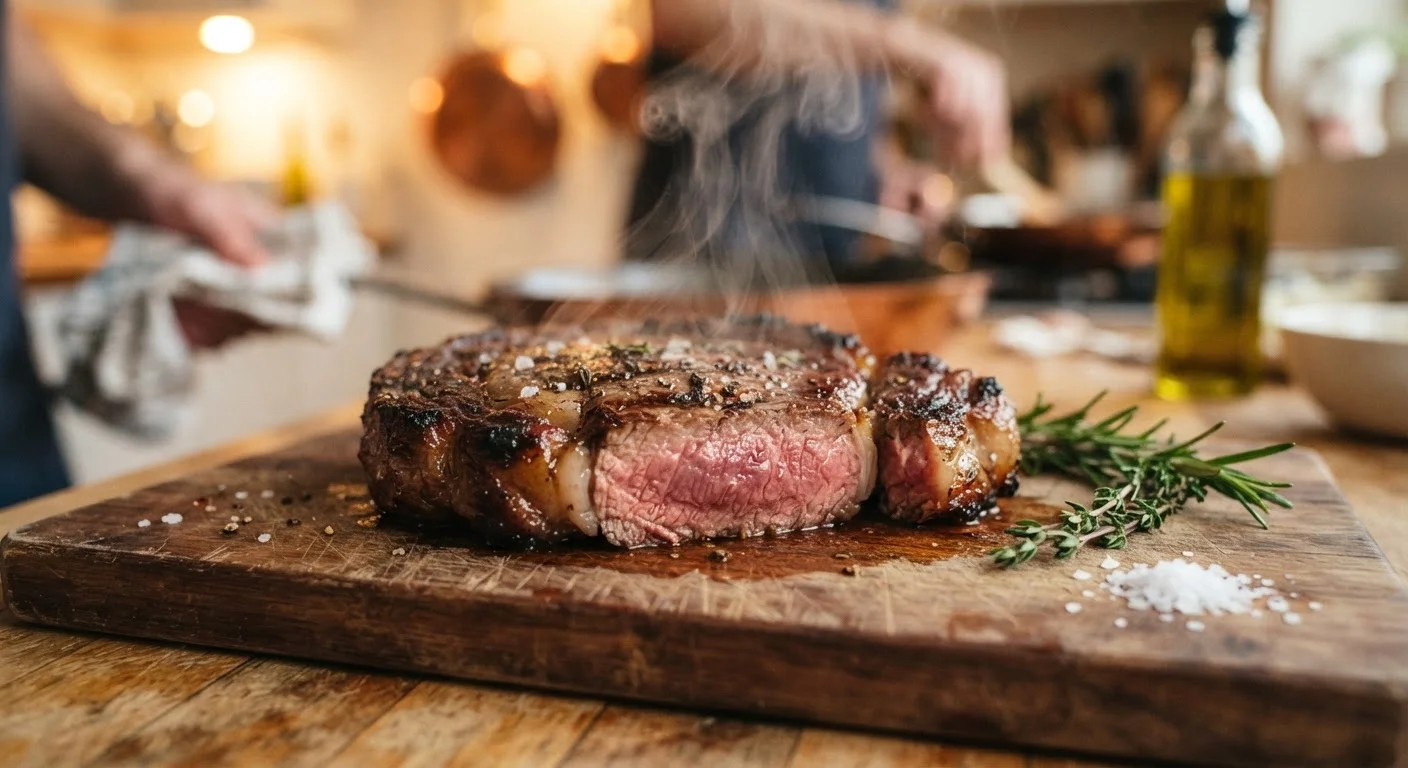
Resting meat means letting a cooked piece of protein sit off the heat for a short period before slicing into it. During cooking, heat forces moisture toward the center of the meat. Resting gives that liquid time to redistribute more evenly throughout the cut, so less juice runs out when you slice.
The process is driven by temperature gradients and muscle fiber contraction. As the exterior cools slightly, internal pressure equalizes, allowing moisture redistribution rather than immediate expulsion upon cutting.
The Science Behind the Rest
When meat hits a hot pan, grill, or oven, heat travels from the outside inward. The exterior muscle fibers contract quickly under that heat, squeezing moisture toward the cooler center. By the time your steak reaches your target internal temperature, there's a meaningful pressure gradient inside the meat — the center holds a concentrated pool of liquid that's been pushed there by the outer fibers tightening up.
Slice into it immediately and that liquid has nowhere to go but your cutting board. You've seen this: a pool of reddish juice spreading under a freshly cut steak is mostly not blood — it's myoglobin-tinged moisture that left the meat rather than staying in it.
Resting gives the muscle fibers time to relax as the temperature gradient between exterior and interior equalizes. The moisture disperses more evenly, and when you finally cut, far less escapes. It's a passive process that costs nothing except a few minutes of patience.
“The rest is not a pause — it's the final stage of cooking. The heat is still working, the fibers are still changing. Cutting early just moves that process to your cutting board instead of your plate.”
— Harold McGee, Food science writer and author of 'On Food and Cooking'
When Resting Actually Matters
Not every piece of meat benefits equally from resting, and understanding this saves you from waiting unnecessarily.
High-heat, thick cuts — ribeye steaks, pork chops over an inch thick, whole roasted chickens, beef tenderloins — are where resting earns its keep. These cuts experience the steepest temperature gradients during cooking, so the pressure buildup is greatest. A 10–15 minute rest on a large roast is genuinely worth it.
Braised and slow-cooked meats are a different story. Slow-cooked cuts like chuck or shin spend hours surrounded by liquid at relatively low temperatures. The moisture gradient never builds the same way, so there's no significant redistribution benefit. You can serve these straight from the pot.
Very thin cuts — a chicken cutlet pounded thin, a skirt steak under half an inch — also see minimal benefit. Their small mass means the temperature evens out almost instantly. The marginal gain from resting rarely justifies letting them cool.
Use Rest Time Productively
Don't just stand and wait while meat rests. Use those minutes to finish a pan sauce, plate your sides, or set the table. Building rest time into your sequencing means it costs you nothing in practice — the meal comes together right as the meat is ready to slice.
Carry-Over Cooking: The Other Reason to Rest
There's a second, often overlooked reason to rest meat: carry-over cooking. When you pull meat off the heat, the exterior is significantly hotter than the interior. That stored heat keeps traveling inward for several minutes, continuing to raise the core temperature even with no external heat source.
For a thick steak, carry-over can add 5–10°F to the internal temperature after it comes off the grill. This means you should pull the meat a few degrees before your target temperature, not at it. Ignoring carry-over is one reason home cooks consistently overshoot their doneness targets — a problem many kitchen myths never address clearly.
The rest period solves both problems at once: it lets carry-over cooking finish the job and gives juices time to redistribute. That's why the two benefits are inseparable in practice.
How to Rest Meat Without Losing Too Much Heat
The practical concern most home cooks have is serving cold food. A few straightforward habits keep resting meat warm enough:
- Tent loosely with foil, not tightly wrapped. Loose foil slows radiant heat loss without trapping steam against the crust — which would make a nicely seared exterior go limp.
- Use a warm plate or cutting board. A cold surface accelerates heat loss. Running your cutting board briefly under hot water, then drying it, makes a noticeable difference for smaller cuts.
- Factor rest time into your meal planning. Use those minutes to finish a sauce, pull vegetables from the oven, or plate side dishes. The rest doesn't add idle time if you're working around it. See our pre-cook checklist for strategies that help you sequence a full meal smoothly.
The goal isn't perfection — it's understanding what you're trading off. A steak rested two minutes instead of eight is still better than one sliced instantly. Any rest is better than none for high-heat, thick cuts.
And when you do slice, using a sharp knife with proper technique minimizes tearing that also costs you juice. Small habits compound in the kitchen.