

Key Takeaways
- A proper pinch grip gives you more control and reduces the risk of slipping.
- Four basic cuts — slice, chop, dice, and mince — cover the majority of home cooking tasks.
- A sharp knife is genuinely safer than a dull one.
- Consistent sizing matters more than speed when it comes to even cooking.
- Pairing knife skills with good prep habits shortens overall cooking time significantly.
Start here
Why Knife Skills Actually Matter
Next
The Grip and the Pinch: Getting Control First
Core technique
The Four Cuts You'll Use Most
Maintenance
Keeping Your Knife Sharp and Safe
Apply it
Putting It Into Practice
Why Knife Skills Actually Matter
Most home cooks spend more time at the cutting board than at the stove. Improving what happens there — before the heat is even on — pays dividends across every meal. Faster prep, more uniform pieces that cook evenly, and fewer near-misses with a slipping blade: these are the direct, practical results of a handful of foundational techniques.
This isn't about impressing anyone. It's about making the 20 minutes before dinner less frustrating and more consistent. The skills in this guide pair naturally with broader prep habits — see how mise en place changes home cooking for a complementary approach that builds on everything covered here.
Pinch grip
A knife-holding technique where you pinch the blade itself between thumb and index finger for more control and stability during cutting.
Honing
Using a honing rod to realign a knife's edge between uses. It maintains sharpness but does not remove metal the way sharpening does.
Julienne
Cutting an ingredient into thin, uniform matchstick-shaped strips, typically used as the middle step in producing a fine dice.
Claw hand
A protective hand position where your fingertips are curled inward so your knuckles face the blade and act as a guide while cutting.
Mince
A very fine chop, usually applied to garlic, ginger, or herbs, achieved by rocking the knife blade repeatedly over the ingredient.
Whetstone
A rectangular abrasive stone used to sharpen knife blades by grinding away small amounts of metal to restore a keen edge.
The Grip and the Pinch: Getting Control First
Before focusing on any cut, the grip has to be right. Most people hold a knife by the handle alone, which places the pivot point too far back and makes the blade harder to steer precisely.
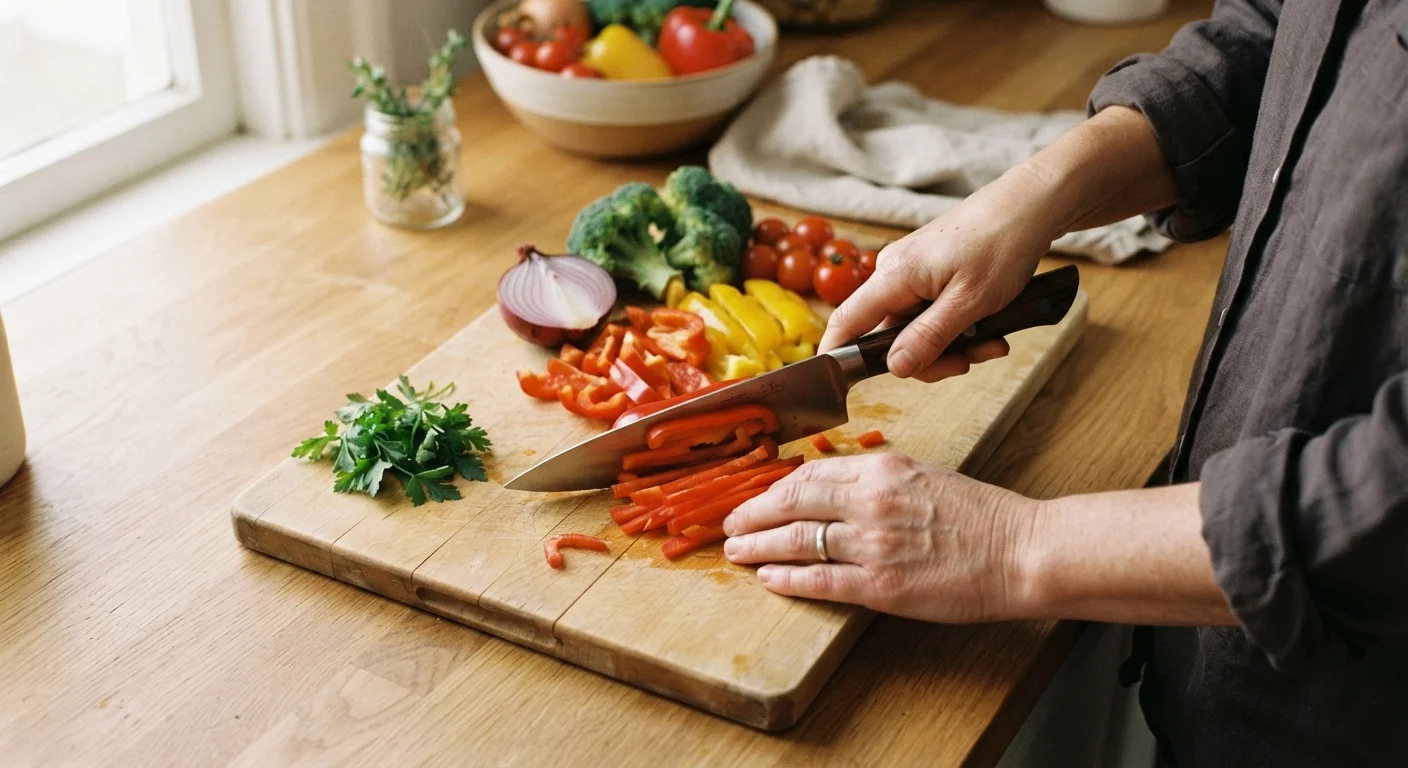
The pinch grip solves this. Extend your thumb and index finger forward onto the blade itself — just where the blade meets the handle — and pinch firmly. Your remaining three fingers wrap naturally around the handle. This lowers the knife's center of gravity and translates your wrist movements directly into the blade with far less effort.
The guiding hand matters just as much. Curl your fingertips inward into a loose claw shape so your knuckles face the blade. The flat side of the blade rests lightly against your knuckles as you cut, which acts as a physical guide and keeps fingertips safely back from the edge. Move the claw hand backward in small, deliberate steps as you work through an ingredient.
Stabilize Your Cutting Board First
A board that slides during cutting is a hazard. Place a damp kitchen towel or a non-slip mat underneath the board before you start. This one small step makes the entire cutting surface more stable and lets you focus on the cut rather than steadying the board.
The Four Cuts You'll Use Most
Rather than memorizing a long list of techniques, focus on the four cuts that appear in virtually every home cooking context.
Slice
Draw the blade forward (or backward) in a smooth arc rather than pressing straight down. This uses the full length of the blade and produces cleaner cuts with less effort. Use it for proteins, vegetables, and bread.
Chop
A faster, less precise cut suitable for herbs, garlic, or anything heading into a long-cooked dish where uniformity matters less. Anchor the tip of the knife on the board and rock the heel up and down, keeping the tip in contact with the surface.
Dice
This is the three-step process most home cooks benefit from learning properly. First, slice the ingredient into planks. Second, stack the planks and cut into sticks (julienne). Third, rotate and cut across the sticks to produce cubes. Consistent sizing — not speed — is the goal, because it determines how evenly the food cooks.
Mince
A fine chop used mostly for garlic, ginger, shallots, and fresh herbs. After an initial rough chop, place your non-dominant hand flat on the spine of the blade and rock it back and forth over the pile, rotating the cutting board as needed until the pieces are very fine.
For a deeper look at how these techniques slot into an efficient kitchen setup, this kitchen workflow checklist is worth working through alongside your practice.
Keeping Your Knife Sharp and Safe
A dull knife requires more force to cut, which makes it significantly more likely to slip and cause injury. Keeping an edge on your knife is one of the highest-return maintenance habits in the kitchen.
Honing (using a honing rod or steel) should happen before most uses. Hold the rod vertically with its tip on a stable surface and draw the blade down and across at roughly a 15–20 degree angle, alternating sides. This realigns the edge without removing material.
Sharpening — on a whetstone or using a pull-through sharpener — is needed less frequently, typically a few times per year for a regularly used home knife. Whetstones give the most control but have a learning curve; pull-through sharpeners are faster and more accessible for most home cooks.
Beyond the blade, two storage habits protect both the knife and your hands: never toss a knife loose into a drawer (a knife block, magnetic strip, or blade guard works better), and always hand-wash and dry knives rather than putting them in a dishwasher, which can damage edges and handles over time.
Never Catch a Falling Knife
If a knife slips off the counter or cutting board, the safest instinct is to step back and let it fall. Reaching to catch it dramatically increases the risk of a serious cut. Keep your workspace clear of clutter at the edges of the board to reduce the chance of a knife rolling off in the first place.
Putting It Into Practice
The most effective way to build these habits is through deliberate repetition on ingredients you already cook regularly. Pick one technique per week and apply it consciously. Onions are particularly useful for practicing the dice sequence. Herbs are ideal for developing a smooth rocking chop.
It's also worth evaluating whether your current equipment is actually limiting you. Mastering what you already own often matters more than adding new tools — a well-maintained 8-inch chef's knife handles the vast majority of home prep tasks without any additional equipment.
Focus on consistency over speed. Uniform cuts that cook evenly do more for the quality of a finished dish than any single ingredient swap or recipe tweak. Once the grip and the motion feel natural, the speed follows on its own.