

Key Takeaways
- R-value measures thermal resistance in building materials; higher numbers mean better insulation performance.
- Vacuum insulation panels and double-wall construction serve different needs — neither is universally superior.
- Marketing terms like 'keeps cold 24 hours' are unverified claims; look for measurable specs instead.
- Window covering insulation quality is measured by U-factor and SHGC, not just material thickness.
- Independent certifications and standardized test conditions are the most reliable spec signals to trust.
Why Insulation Specs Matter More Than Marketing Copy
Walk down any housewares aisle and you'll see bold promises: "stays cold all day," "triple-insulated," "maximum thermal retention." These phrases are marketing language, not engineering specs. Without a standard test condition or measurement unit behind them, they're impossible to compare across products or verify independently.
Good insulation specs give you a concrete number tied to a defined method. Whether you're evaluating a travel mug, a chest cooler, or cellular window shades, the principle is the same: look for quantified performance, not adjectives. This guide breaks down the key metrics by product category so you know exactly what to read on the label — and what to ignore.
For a related example of how vague claims can mislead, see our piece on verifying product waterproof claims — the same scrutiny applies here.
Drinkware and Food Storage: What Double-Wall and Vacuum Actually Mean
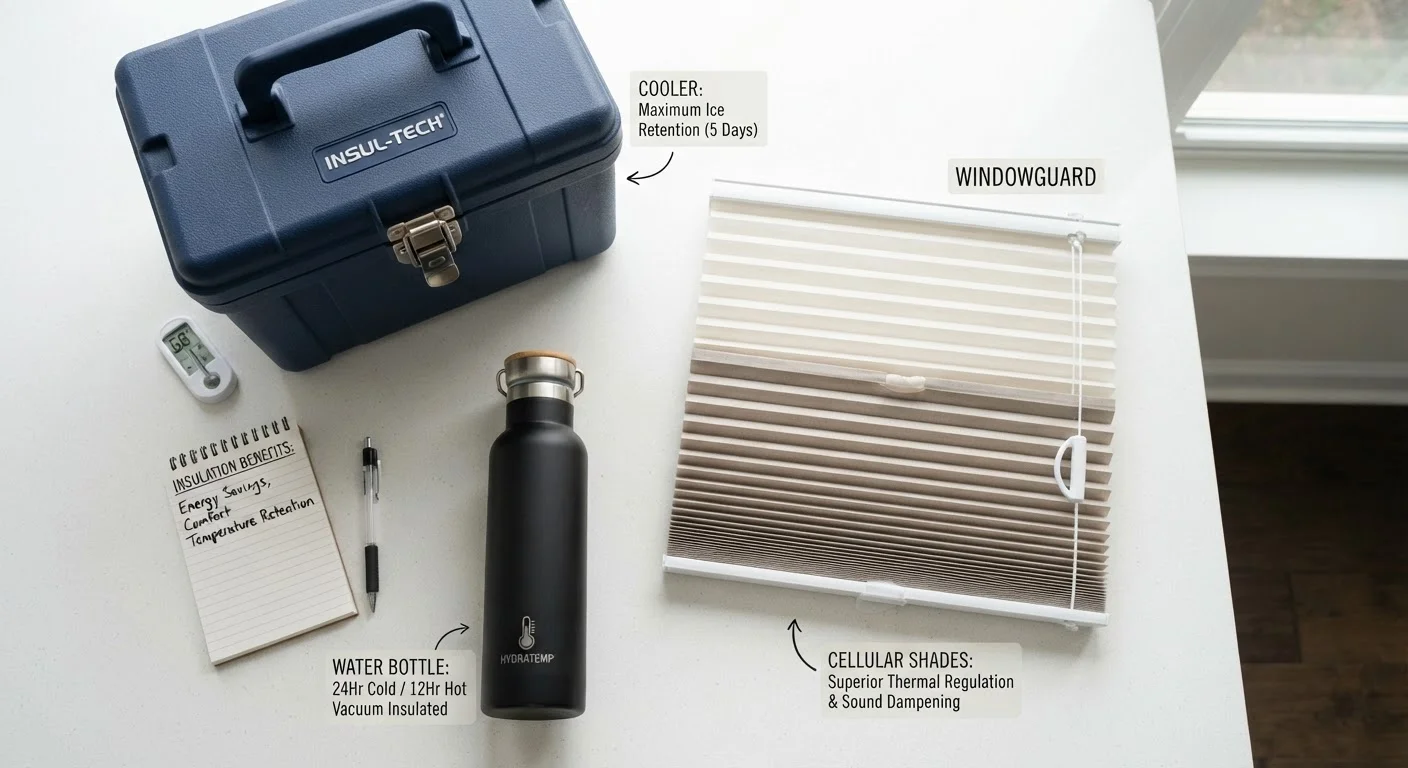
Insulated drinkware typically uses one of two constructions: double-wall (two layers of material with an air gap) or vacuum-insulated double-wall (the air is evacuated to create a near-vacuum). The vacuum version eliminates convective heat transfer almost entirely, making it significantly more effective — but both are marketed with identical-sounding language.
A reliable spec to look for is a stated temperature retention time under defined conditions (e.g., "maintains ice for 18 hours at 70°F ambient temperature"). Without the ambient temperature reference, the number is meaningless. Some manufacturers reference ASTM F2132 or similar testing standards; that's a meaningful signal that performance was measured, not estimated.
30%
Heat loss through poorly insulated windows
The U.S. Department of Energy estimates that heat gain and loss through windows accounts for approximately 25–30% of residential heating and cooling energy use.
R-38 to R-60
Recommended attic insulation range for most U.S. climates
The DOE's climate zone guidelines recommend R-38 to R-60 for attic insulation in most U.S. regions, depending on heating and cooling demands.
For coolers, ice retention time is the primary spec — but verify it's tested with a standard ice-to-water ratio and ambient temperature noted. A cooler claiming "7-day ice retention" tested in 50°F conditions will perform very differently in a summer trunk.
Window Coverings: U-Factor, SHGC, and What They Tell You
Windows are among the largest sources of heat gain and loss in a home, and the coverings you choose can meaningfully reduce that transfer — if you select them with the right specs in mind.
- U-factor measures how quickly a covering transfers heat. Lower is better — a U-factor of 0.20 resists heat flow more effectively than 0.50.
- Solar Heat Gain Coefficient (SHGC) measures how much solar radiation passes through. A lower SHGC keeps summer heat out; a higher one lets in passive solar warmth in winter.
Cellular (honeycomb) shades are among the more insulating fabric options because their air pockets slow conductive transfer. However, specs vary by cell layer count and fabric density — single-cell shades have a meaningfully different U-factor than double- or triple-cell versions. Look for products tested to NFRC (National Fenestration Rating Council) standards, the same body that rates window glass.
This connects directly to home weatherproofing decisions — see common weatherproofing myths for more on where energy-efficiency efforts actually pay off.
Best Practices for Reading Any Insulation Spec
Across all product categories, a few consistent practices help separate credible specs from marketing noise.
When specs are absent entirely, that's a data point too. A product that offers no measurable performance claims is one you're buying on faith alone. For a broader framework on reading product spec sheets without getting lost, our guide on reading mattress spec sheets applies the same translation approach to another complex category.