

Key Takeaways
- Foam density measures durability, not softness — higher density generally means longer-lasting foam.
- ILD rating tells you how firm a foam layer feels, not how durable it is.
- Coil gauge runs counterintuitively: lower numbers mean thicker, firmer wire.
- Coil count matters less than coil type and foam quality in most mattress decisions.
- Specs are a useful filter but can't replace physically testing a mattress when possible.
Start here
Why Mattress Specs Feel Overwhelming
Core concepts
Foam Specs: Density and ILD Explained
Go deeper
Coil Specs: Gauge, Count, and What They Signal
Fill in the gaps
Other Numbers Worth Paying Attention To
Apply it
How to Use Specs as a Filter, Not a Final Answer
Why Mattress Specs Feel Overwhelming
Mattress spec sheets are dense by design. Terms like ILD, PCF, coil gauge, and transition layer get stacked together in ways that feel technical but rarely come with plain-language explanations. The result: most buyers either ignore the specs entirely or get distracted by whichever number sounds most impressive.
The good news is that only a handful of numbers actually matter for most buying decisions. Once you know what each one measures and what direction is better for your situation, a spec sheet becomes a useful filter rather than a wall of noise. This guide walks through those numbers one category at a time. For a broader look at how product specs across many categories can be used to obscure rather than inform, see our piece on evaluating unfamiliar home products.
Foam Specs: Density and ILD Explained
Foam is measured two different ways, and confusing them is one of the most common mistakes buyers make.
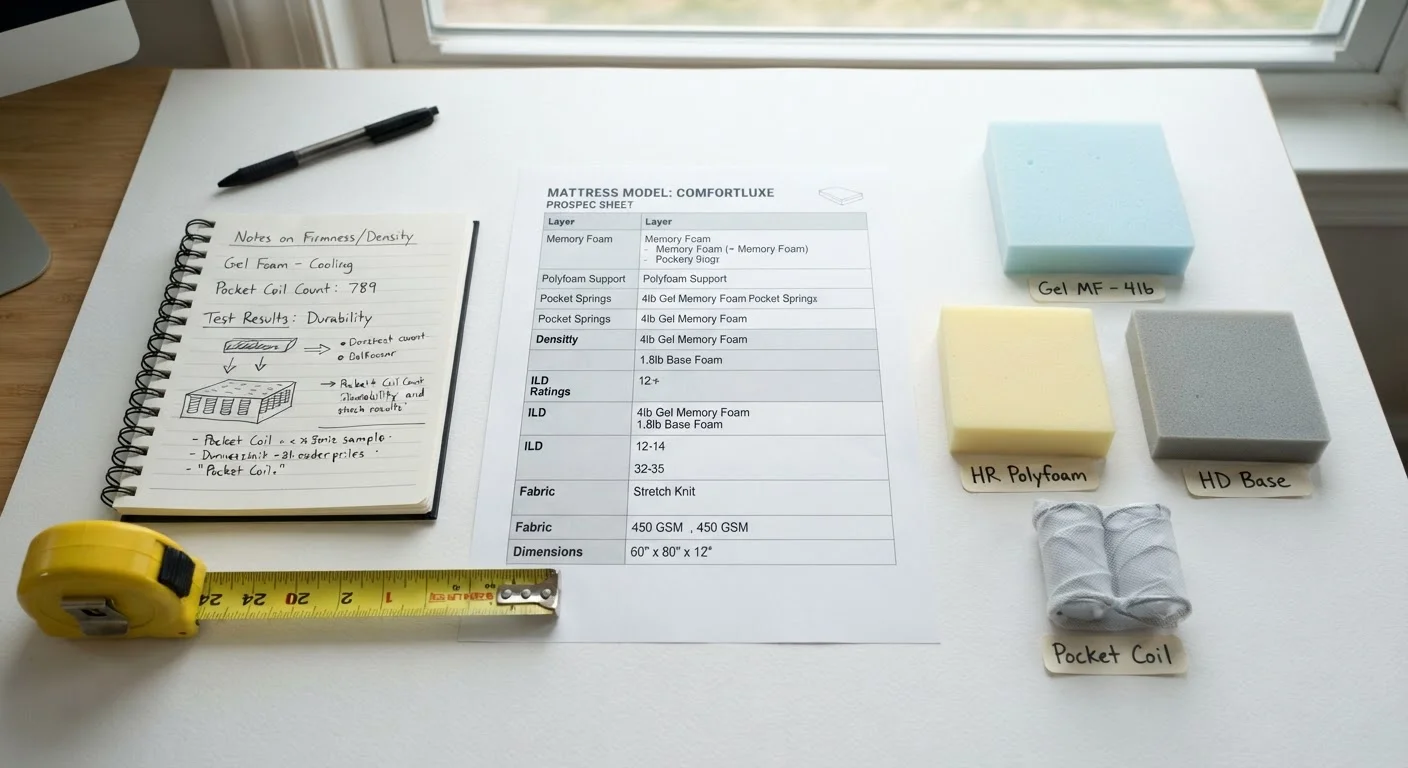
Density (PCF — pounds per cubic foot) measures how much material is packed into a given volume of foam. It's a durability indicator, not a comfort indicator. Memory foam in the 3–5 lb/ft³ range tends to hold up longer; foam below 1.5 lb/ft³ compresses and degrades more quickly. Polyfoam comfort layers often run lower densities by design — that's not automatically a problem, but it's worth knowing.
ILD (Indentation Load Deflection) is the firmness number. It measures how many pounds of force are needed to compress a foam sample by 25%. A lower ILD (roughly 10–20) describes softer foam; higher ILD (30 and above) describes firmer foam. Some manufacturers publish this per layer, which is more useful than a single number for the whole mattress.
Foam density
A measure of how much material is packed into a cubic foot of foam. Higher density generally signals more durable foam, not necessarily softer or firmer.
ILD (Indentation Load Deflection)
A number that describes how firm a foam layer feels — specifically, how many pounds of force it takes to compress the foam by 25%. Lower ILD = softer; higher ILD = firmer.
Coil gauge
The thickness of the steel wire in a spring coil. A lower gauge number means thicker wire and a firmer, more supportive spring.
Coil count
The total number of springs inside the mattress. Often used as a marketing figure — quality of the coil type matters more than raw count.
Polyfoam
A basic synthetic foam commonly used as a support or transition layer in mattresses. Less expensive and less durable than memory foam or latex at comparable densities.
Pocketed coils
Individual springs each wrapped in their own fabric pocket, allowing them to move independently. This reduces motion transfer compared to connected coil systems.
These two metrics answer different questions: density tells you how long the foam will last; ILD tells you how it will feel. You need both to evaluate a foam mattress fairly. For comparison, bedding labels use similar dual-metric logic — one number for durability, one for feel.
Coil Specs: Gauge, Count, and What They Signal
Innerspring and hybrid mattresses add another layer of spec vocabulary centered on the coil system.
Coil gauge describes wire thickness — and it runs backwards from what most people expect. A lower gauge number means thicker wire, which translates to a firmer, more supportive spring. A higher gauge means thinner wire and a softer feel. Consumer mattresses typically fall between gauge 12 (firm) and gauge 15 (softer). If you need strong edge support or sleep on your stomach, a lower gauge is generally more relevant.
Coil count is frequently marketed as a quality signal, but context matters. A queen-size mattress with 1,000 individually pocketed coils may outperform one with 2,000 connected Bonnell coils for motion isolation — even though the raw count is lower. The coil type (pocketed vs. offset vs. continuous) affects how independently each spring moves, which has real consequences for couples or light sleepers.
Focus on Layers, Not Just the Summary
Many spec sheets list overall mattress height but not the individual layer breakdown. When comparing mattresses, ask for or look up the layer-by-layer construction. A thick comfort layer of low-density foam can tell you more about long-term feel than total height alone.
Other Numbers Worth Paying Attention To
A few additional specs appear on mattress sheets and are worth a quick read:
- Overall height (profile): Measured in inches, this affects how sheets fit and how easy it is to get in and out of bed. It's not a quality indicator on its own.
- Cover or ticking material: Sometimes listed with fiber content or certifications. Organic or low-emission certifications (such as GOTS or CertiPUR-US) indicate the foam or fabric meets specific safety and emission standards — useful if off-gassing or material sensitivities are a concern.
- Weight limit or support range: Many spec sheets include a recommended weight range. This is worth checking — some mattresses are engineered specifically for lighter sleepers and may perform differently under heavier loads.
Spec Inflation Is Common in Mattress Marketing
Some manufacturers list coil counts for a king-size mattress and don't clarify that smaller sizes have proportionally fewer coils. Others highlight foam density for only one layer while obscuring the rest. If a spec sheet feels incomplete or highlights only one or two impressive-sounding numbers, that's worth scrutinizing. See our related guide on how specs are used to confuse buyers for more context.
How to Use Specs as a Filter, Not a Final Answer
Specs are most useful at the elimination stage. If a mattress lists foam density below 1.5 lb/ft³ throughout, or omits layer breakdowns entirely, those are signals worth noting. If ILD data isn't published at all, that's worth asking about before purchasing.
But specs can't tell you everything. Sleep position, body weight, and personal feel preference all interact in ways that no number fully predicts. Where possible, test a mattress in person or take advantage of a published sleep trial period before committing. Understanding how spec sheets can obscure as much as they reveal is equally valuable context when reading any product sheet.
Treat the spec sheet as your pre-screening checklist: it helps you avoid obvious low-quality options and gives you informed questions to ask. The final answer still comes from matching those specs to how you actually sleep.
Specs Vary by Mattress Type
Foam-only, hybrid, and innerspring mattresses each emphasize different specs. A foam mattress spec sheet will focus on density and ILD; a hybrid will include both foam and coil data. Latex mattresses use different firmness scales entirely. Always consider which type you're evaluating before comparing numbers across categories.