

Key Takeaways
- Purchase price is only one component of what a product actually costs you.
- Energy consumption, maintenance frequency, and lifespan all significantly affect total cost.
- A simple cost-per-year calculation helps compare options on equal terms.
- Consumables and replacement parts are commonly overlooked lifetime cost drivers.
- Higher upfront cost is not automatically better — the goal is the lowest total, not the lowest or highest sticker price.
Lifetime Cost
Lifetime cost — sometimes called total cost of ownership — is the full amount you spend on a product from the day you buy it until the day you replace or discard it. It includes the purchase price plus all ongoing expenses: energy use, maintenance, repairs, consumables, and eventual disposal. A product with a low sticker price can easily end up costing more in total than a pricier alternative that runs efficiently and lasts longer.
In engineering and procurement, this concept is formalized as Life-Cycle Cost (LCC) analysis, which discounts future expenditures to present value to allow direct comparison between options with different cost profiles over time.
Why the Sticker Price Is Just the Starting Line
When a product looks affordable on the shelf, it's tempting to stop thinking about price right there. But the purchase price is really just an entry fee. Everything that follows — electricity bills, filter replacements, repair calls, and eventual replacement — adds to what that product actually costs you.
This is the lifetime cost trap: a product priced low enough to feel like a deal, but expensive enough in operation to erase that savings and then some. It's one of the most common ways household budgets quietly overspend without anyone noticing.
Understanding lifetime cost doesn't require a spreadsheet or a finance degree. It requires knowing which cost categories to look for and building the habit of asking a simple question before buying: What will I spend on this beyond today?
~$1,100
Average annual U.S. household energy bill
According to the U.S. Energy Information Administration, the average American household spends around $1,100–$1,500 per year on energy, much of it tied to appliance efficiency.
10–15 years
Typical refrigerator lifespan
The U.S. Department of Energy notes that major appliances like refrigerators typically last 10–15 years, making energy efficiency ratings a significant long-term cost factor.
3x
Printer ink cost relative to hardware cost
Industry observers have noted that printer ink cartridge costs frequently exceed the cost of the printer itself within the first year or two of typical household use.
The Four Cost Categories That Add Up Over Time
Lifetime cost breaks down into four main categories, each of which can vary dramatically between products that appear comparable at the point of sale.
1. Energy Consumption
Appliances with motors, heating elements, or compressors — refrigerators, washing machines, water heaters, HVAC systems — run continuously or frequently. Even a modest difference in energy efficiency can mean hundreds of dollars over a decade. U.S. appliances are required to carry EnergyGuide labels with estimated annual energy costs, making this one of the easier categories to compare directly.
2. Maintenance and Consumables
Some products are inexpensive to buy but expensive to maintain. Printers are a well-known example: the hardware cost is low, but branded ink cartridges can cost more per year than the printer itself. Water filters, vacuum bags, HVAC filters, and replacement blades all follow similar patterns. Understanding unit pricing on consumables helps you see the true ongoing cost before committing to a platform.
3. Repairs and Reliability
A product that breaks down frequently generates costs beyond the repair bill — your time, the inconvenience, and sometimes spoiled food or water damage. Products built to lower tolerances often have shorter mean times between failures. Reading user reviews specifically for notes on reliability and repair costs is more informative than star ratings alone.
4. Lifespan and Replacement Frequency
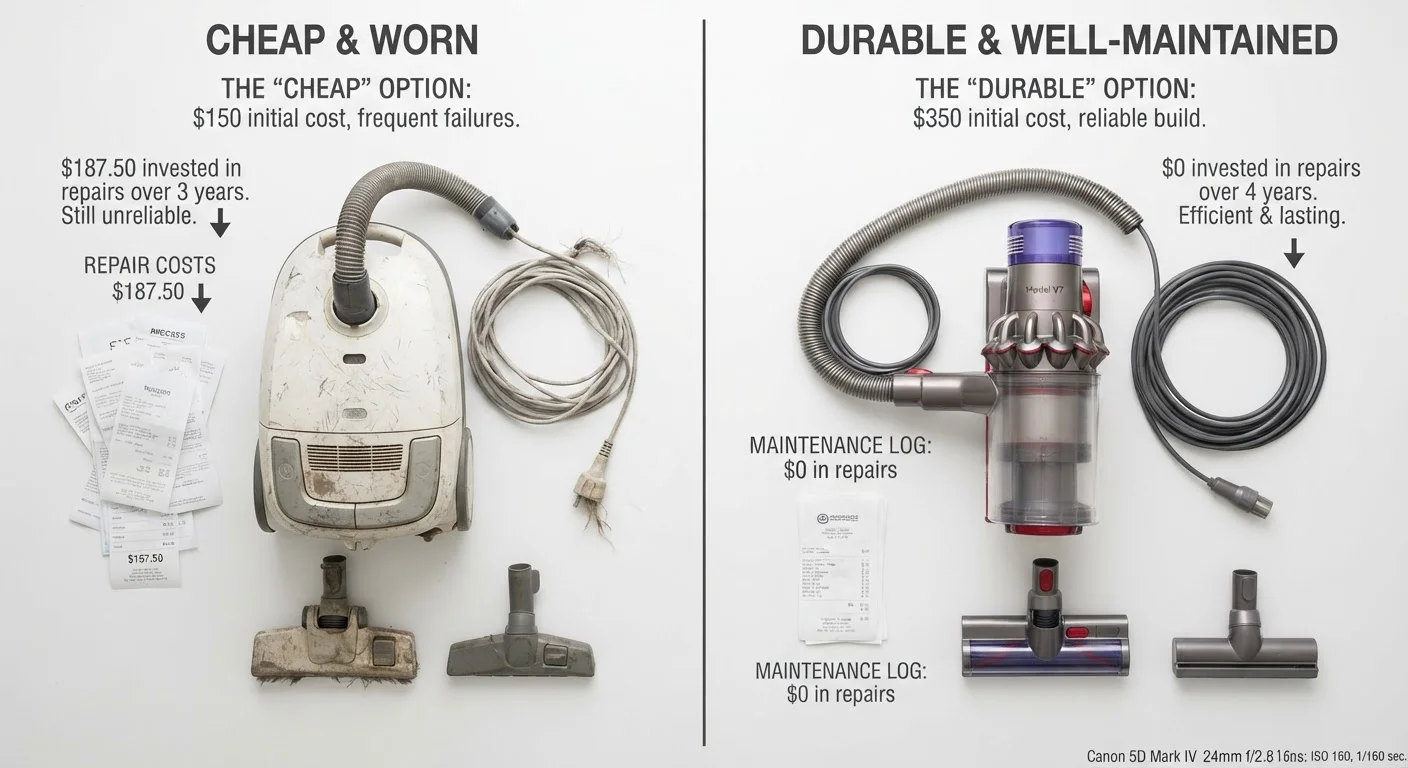
A $30 item that lasts two years costs more per year than a $70 item that lasts eight. Dividing total cost by expected lifespan gives you an annual cost figure that makes genuine comparison possible. Bulk buying analysis uses this same logic: more units at a lower unit price isn't savings if half go unused.
A Simple Framework for Estimating Lifetime Cost
You don't need to model every scenario precisely. A back-of-envelope calculation is usually enough to reveal whether a cheaper option is genuinely cheaper.
- Start with the purchase price. This is your Day 1 cost.
- Estimate annual operating costs. Add energy costs (from EnergyGuide labels or manufacturer specs), expected consumable costs (filters, cartridges, bags), and a rough figure for average maintenance based on reviews or manufacturer guidelines.
- Multiply by expected lifespan. Use realistic estimates — not manufacturer optimums. Consumer product lifespans for appliances are often published by trade organizations and consumer research groups.
- Divide the total by lifespan in years. This is your annual cost. Compare this number across options, not the sticker price.
This same framework applies beyond home products. The true cost of car ownership follows identical logic — fuel, insurance, maintenance, and depreciation all extend well past the purchase transaction. And in home maintenance, preventive maintenance versus reactive repairs is fundamentally a lifetime cost question: small, scheduled costs now versus larger, unpredictable costs later.
Use Annual Cost as Your Comparison Unit
When comparing two products, divide each option's estimated total lifetime cost by its expected lifespan in years. This gives you a single, comparable figure that accounts for both price and durability. A product that costs twice as much but lasts three times as long is objectively more cost-effective — and this simple calculation makes that visible before you buy.
Where Homeowners Most Commonly Get Caught
Certain product categories are particularly prone to the lifetime cost trap because their ongoing costs are invisible at the point of sale.
- Flooring: Budget materials may require replacement in five to seven years; higher-quality options can last decades with basic maintenance. The annual cost difference often favors the pricier option.
- Water filtration: Pitcher filters and under-sink systems have very different cartridge replacement costs and intervals. The hardware price tells you almost nothing useful.
- Lighting: LED bulbs cost more upfront than incandescent alternatives but use a fraction of the energy and last significantly longer — a well-documented case where lifetime cost analysis strongly favors the higher-priced option.
- Food choices: The real cost of convenience foods follows similar logic — per-serving cost of pre-cut or ready-made items often far exceeds the cost of preparing equivalent meals from scratch.
The pattern across all of these is the same: costs that don't appear on the price tag accumulate quietly, making an apparently affordable purchase feel increasingly expensive over time. Building the habit of asking what a product costs per year — not just today — is one of the more reliable ways to avoid the trap.