

Key Takeaways
- Ingredients are listed by weight before processing, so moisture content affects order — not just quality.
- 'Complete and balanced' is a regulated phrase meaning the food meets AAFCO nutritional profiles for a stated life stage.
- The guaranteed analysis shows minimum or maximum nutrient percentages, not exact amounts.
- Descriptive terms like 'with chicken' or 'chicken flavor' indicate very different amounts of that ingredient.
- Life-stage designation (puppy, adult, all life stages) matters more than marketing claims on the front of the package.
- A vet or veterinary nutritionist is your best resource when selecting food for pets with health conditions.
Pet Food Label
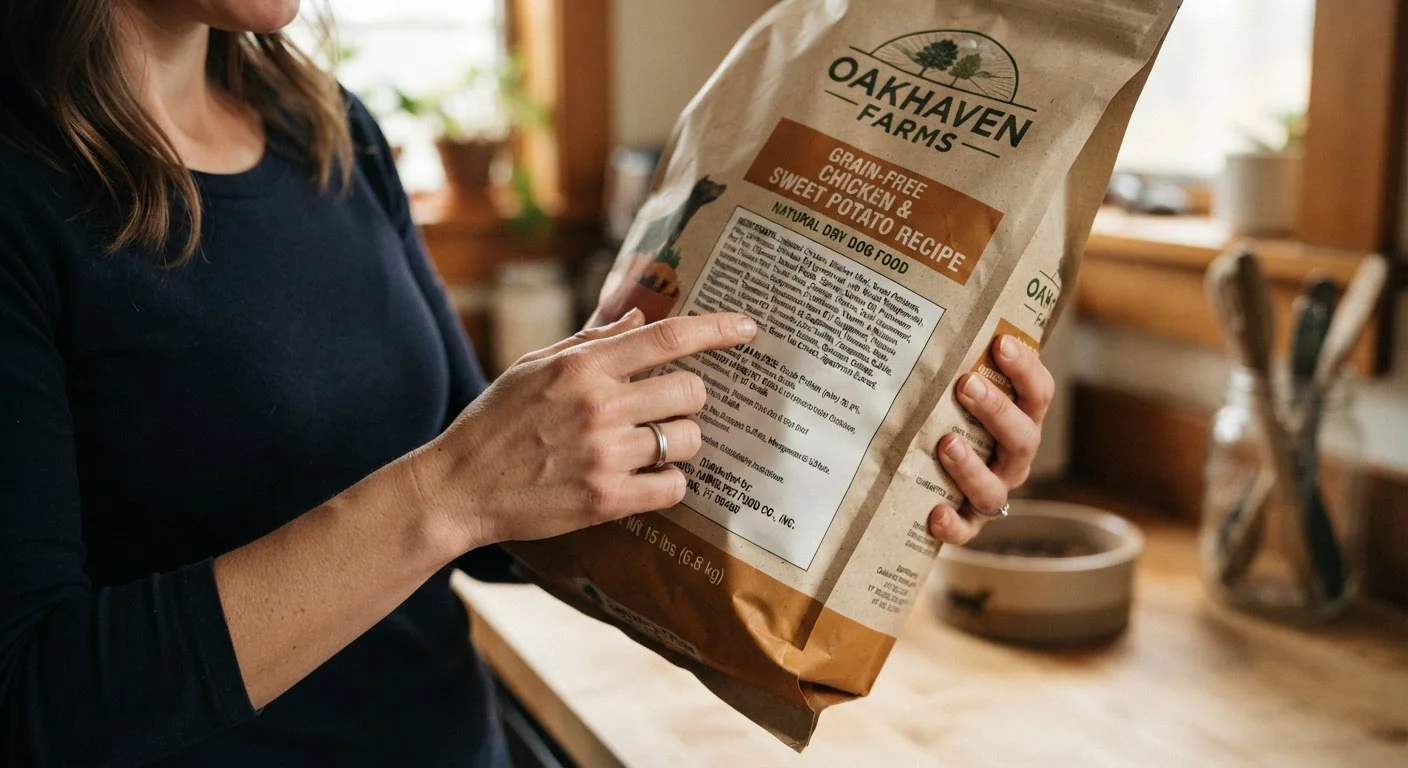
A pet food label is the regulated panel printed on every bag, can, or pouch of commercially sold pet food. It lists ingredients, nutritional guarantees, feeding directions, and manufacturer information in a standardized format. In the U.S., this format is governed by guidelines set by the Association of American Feed Control Officials (AAFCO) and enforced at the state level.
AAFCO itself does not directly regulate pet food — it publishes model regulations that individual states adopt. Actual enforcement authority rests with state feed control officials.
How the Ingredient List Actually Works
The ingredient list on a pet food label follows one simple rule: ingredients are ordered by weight before cooking or processing. This matters because moisture dramatically affects weight. Fresh chicken, for instance, is roughly 70% water. Once that moisture is removed to create 'chicken meal,' the same amount of chicken weighs far less — which is why chicken meal listed third may actually deliver more protein than fresh chicken listed first.
This doesn't make one form better than the other, but it does mean ingredient position alone is not a reliable quality indicator. What matters more is the overall nutritional profile the formula achieves.
Ingredient splitting is another pattern worth recognizing. A manufacturer may list 'ground corn,' 'corn gluten meal,' and 'corn bran' separately. Each appears lower on the list than if they were combined, which can make a grain look like a minor contributor when it is actually substantial. This is legal and common — knowing it helps you read the list with clearer eyes.
Ingredient Lists Reflect Pre-Cooking Weight
Because heat and processing change ingredient weights significantly, the finished food can look quite different from what the raw ingredient order suggests. This is why nutritionists evaluate the guaranteed analysis and dry matter nutrient content alongside the ingredient list, rather than relying on order alone.
Decoding Regulated Terminology
AAFCO sets naming rules that control how much of a named ingredient a product must contain. Understanding these thresholds quickly cuts through front-of-package marketing:
- 95% Rule: A product named 'Salmon Cat Food' must be at least 95% salmon (excluding water added for processing).
- 25% or 'Dinner' Rule: Labels reading 'Chicken Dinner,' 'Beef Entrée,' or 'Turkey Platter' need only 25% of that ingredient.
- 3% or 'With' Rule: 'Cat Food with Tuna' requires just 3% tuna.
- Flavor Rule: 'Chicken Flavor' requires only a detectable amount — there may be very little actual chicken present.
On the nutrition side, 'complete and balanced' is the phrase that carries the most regulatory weight. It means the food either met AAFCO nutrient profiles through lab analysis or passed a feeding trial. A food without this statement should not be a pet's primary or sole diet. For a deeper look at specific nutrients you'll encounter, see our plain-language nutrient glossary.
95%
Minimum ingredient threshold for single-named pet foods
Under AAFCO naming rules, a product called simply 'Beef Cat Food' must be at least 95% beef, excluding added water.
3%
Minimum required for 'with [ingredient]' labeling
AAFCO's '3% rule' means a food labeled 'with chicken' may contain as little as 3% chicken by weight.
4
Required nutrients in the guaranteed analysis panel
U.S. regulations require all pet food labels to list minimum crude protein, minimum crude fat, maximum crude fiber, and maximum moisture.
The Guaranteed Analysis: What It Shows and What It Doesn't
Every U.S. pet food label must include a guaranteed analysis panel showing four values: minimum crude protein, minimum crude fat, maximum crude fiber, and maximum crude moisture. These are legal floors and ceilings, not precise nutritional targets.
Two foods can share identical guaranteed analysis numbers yet differ considerably in digestibility, ingredient quality, or amino acid profiles. Crude protein, for example, measures total nitrogen — it doesn't distinguish between highly digestible animal protein and less-digestible plant protein.
To compare foods on a like-for-like basis, nutritionists use dry matter basis — a calculation that removes moisture from the equation. Wet foods look lower in protein by percentage than dry foods simply because they contain far more water. Converting both to dry matter reveals a truer comparison. Your vet can walk you through this if you're evaluating options for a pet with specific health needs.
For a structured checklist approach to evaluating any pet food, see our practical pet food evaluation guide.
Life Stage, Feeding Directions, and the Rest of the Label
The life stage statement — adult maintenance, growth and reproduction, or all life stages — tells you which AAFCO nutritional profile the food meets. This designation is more meaningful than front-of-package claims like 'premium,' 'natural,' or 'grain-free,' which carry no standardized regulatory definition.
Feeding directions are estimates based on average animals. Your pet's actual needs depend on their age, activity level, body condition, and any health conditions. Use the label's feeding guide as a starting point, then adjust based on your vet's recommendations and your pet's weight trends over time.
The manufacturer's contact information is required by law and is worth keeping in mind. If you have questions about sourcing, safety recalls, or specific ingredients, the manufacturer is your first contact point. The FDA also maintains a public database of pet food recalls you can check independently.
If you've ever considered preparing meals at home, note that homemade diets face a very different challenge — no label, no guaranteed analysis, and often significant nutritional gaps. See our guide to homemade pet food for a realistic picture of what that involves.
Use Your Vet as a Label-Reading Partner
If you're evaluating a food for a pet with kidney disease, allergies, weight issues, or other health conditions, bring the label to your next vet appointment. A veterinarian or board-certified veterinary nutritionist can interpret the guaranteed analysis in the context of your pet's specific needs far more accurately than a general label comparison. You can also ask about consulting a veterinary nutritionist for pets with complex dietary requirements.
This article provides general educational information about pet food labeling and is not a substitute for personalized veterinary advice. Always consult your veterinarian when selecting food for a pet with health conditions or special dietary needs.