

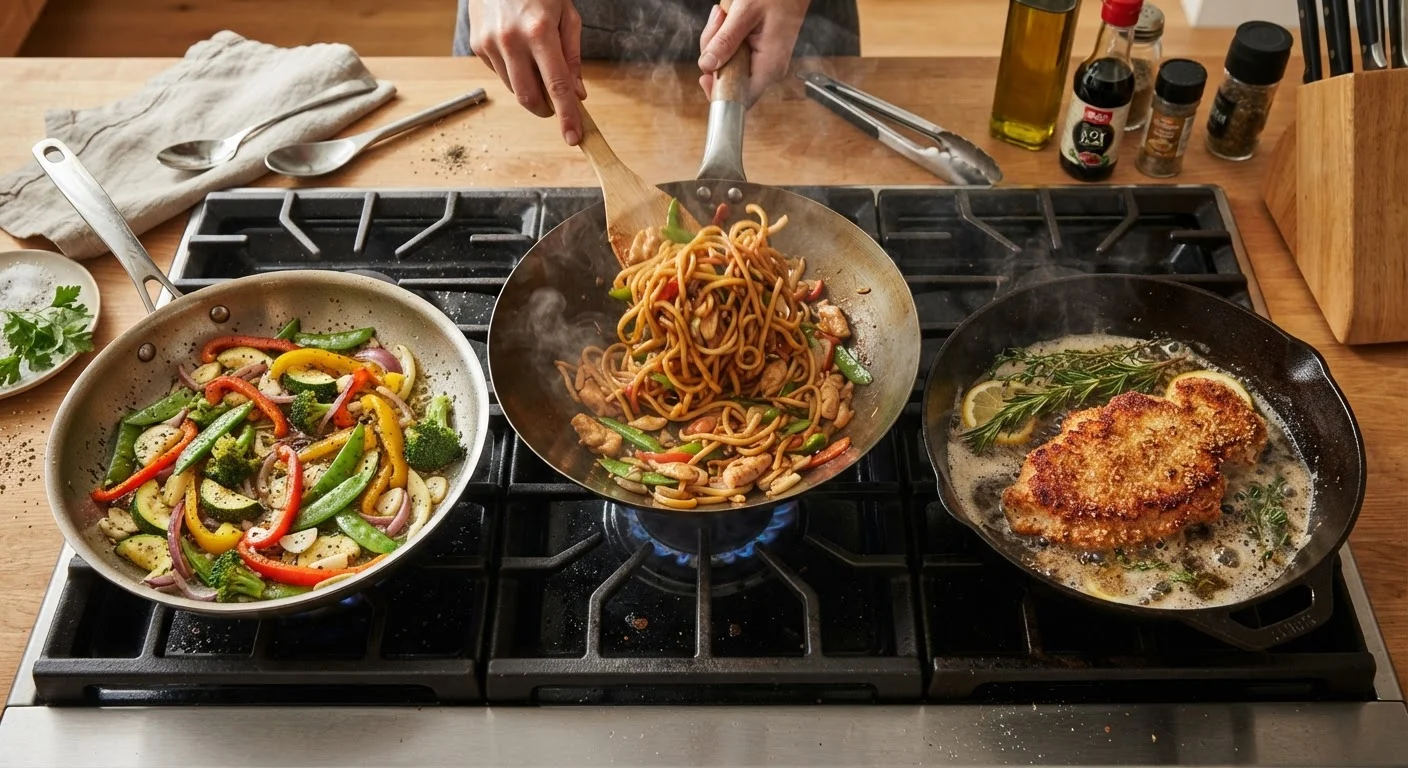
Key Takeaways
- Sautéing uses moderate-high heat and a small amount of fat to cook food quickly with occasional stirring.
- Stir-frying relies on very high heat and constant motion to cook small, uniform pieces in minutes.
- Pan-frying uses more oil and steady heat to create a browned, crisp crust on larger food items.
- Each method requires a different pan temperature, fat amount, and food preparation approach.
- Choosing the right technique depends on the size of your ingredients and the texture you want to achieve.
Option A
Sautéing
The quick, flavor-building everyday technique.
Best for: Best for tender vegetables, mushrooms, aromatics, and small cuts of protein that cook through in minutes.
Option B
Stir-Frying & Pan-Frying
High-speed tossing or shallow-oil browning for distinct results.
Best for: Stir-frying suits fast, high-heat meals with multiple ingredients; pan-frying creates a crisp exterior on larger pieces of food.
If you want to build a quick, flavorful base for soups, sauces, or pasta
Sautéing
Sautéing develops depth through light browning and fat-soluble flavor compounds without overcooking delicate ingredients.
If you're cooking a fast weeknight meal with vegetables and protein together
Stir-Frying
High heat and constant movement cook everything quickly while retaining color, crunch, and bright flavor.
If you want a crispy, golden crust on a chicken breast, fish fillet, or cutlet
Pan-Frying
Pan-frying's shallow oil and sustained contact with the pan surface create the Maillard browning that produces a satisfying crust.
If you're new to stovetop cooking and want the most forgiving technique
Sautéing
Sautéing operates at a more moderate pace than stir-frying, giving you more control and reaction time as you build skills.
What Sautéing Actually Means
The word sauté comes from the French verb sauter, meaning "to jump" — a nod to the technique of keeping food in motion in a hot pan. In practice, sautéing means cooking relatively small pieces of food in a thin layer of fat over moderate-to-high heat, with occasional tossing or stirring rather than constant movement.
The goal is to cook food through while developing some surface color and concentrating flavor. Garlic and onions softened in butter, diced zucchini cooked until just tender, or thin chicken strips browned in olive oil — all of these are sautéed, not stir-fried or pan-fried.
Key features of sautéing: a wide, shallow pan (a sauté pan or skillet works well), just enough fat to coat the surface, and heat that's hot but not smoking. Food should be cut small and dry so it colors rather than steams. For more on how heat affects your results at the pan level, see why pan temperature matters more than your recipe — it's a foundational skill that applies directly here.
| Criterion | Sautéing | Stir-Frying |
|---|---|---|
| Heat level | Moderate to high | Very high |
| Fat amount | Thin film (1–2 tsp) | Thin film (1–2 tsp) |
| Movement | Occasional toss or stir | Constant, vigorous motion |
| Food size | Small pieces or thin cuts | Uniform small pieces |
| Best pan | Sauté pan or skillet | Carbon steel wok or wide skillet |
| Result | Lightly browned, tender | Charred edges, crisp-tender |
| Compared to pan-frying | Less oil, smaller food | Less oil, faster cooking |
| Typical uses | Aromatics, vegetables, thin protein | Noodles, rice dishes, mixed vegetables |
Stir-Frying: Speed and High Heat
Stir-frying turns the heat up significantly higher than sautéing — traditionally wok-level high heat — and adds constant, vigorous movement. Every ingredient must be cut small and uniform so everything cooks at the same fast rate. The result, when done right, is food that's tender inside, lightly charred outside, and full of what Chinese cooks call wok hei (literally "breath of the wok"): a slightly smoky, high-heat flavor impossible to achieve at lower temperatures.
At home, the biggest challenge is that most residential burners don't reach wok-cooking temperatures. You can get close by preheating your pan thoroughly, cooking in small batches to avoid crowding, and keeping everything moving. A carbon steel wok or a wide stainless skillet handles high heat better than non-stick. For a deeper look at how different pan materials handle intense heat, cookware materials compared breaks down the practical differences.
450–500°F
Typical stir-fry pan surface temperature
Food science references suggest effective stir-frying requires pan surface temperatures in this range to achieve proper browning without steaming.
2–4 min
Average stir-fry cook time for most ingredients
Because of the intense heat used, most stir-fried dishes cook through in just a few minutes when ingredients are cut uniformly small.
Pan-Frying: Crust, Color, and Shallow Oil
Pan-frying differs from the other two methods primarily in the amount of fat used and the way food interacts with it. Instead of a thin film of oil, pan-frying uses enough oil to come roughly one-quarter to one-third of the way up the food — not full submersion like deep-frying, but enough to surround the sides and conduct heat effectively.
Food is typically larger: a whole chicken thigh, a fish fillet, a pork chop, or a breaded cutlet. The item sits in the hot oil with minimal disturbance, allowing the crust to set and brown before it's flipped. The result is a distinct, crispy exterior and a fully cooked interior — the kind of texture that's genuinely difficult to replicate any other way.
Choosing the right technique often depends on what texture you want and what the ingredient needs. For a broader framework on matching cooking methods to ingredients, dry heat vs. moist heat cooking methods lays out the underlying logic clearly. Pan-frying is always a dry-heat method — the fat is a conductor, not a braising liquid.
Understanding these three techniques gives you real flexibility in the kitchen. Whether you're building a quick weeknight plate or practicing foundational skills, knowing which method to reach for — and why — is what separates a reactive cook from a confident one. For broader meal-planning ideas that pair well with these techniques, see home cooking tips.
Don't Confuse Pan-Frying with Deep-Frying
Pan-frying uses shallow oil — typically enough to come partway up the food — while deep-frying fully submerges food in oil at a controlled temperature. The two methods produce different results and carry different safety considerations. Deep-frying at home requires careful attention to oil temperature and fire safety; pan-frying is more approachable for everyday cooking.