

Key Takeaways
- Fragrance — including 'natural' fragrance — is the leading cause of cosmetic contact dermatitis in sensitive skin.
- Fewer ingredients generally means fewer opportunities for irritation; simplicity is a feature, not a compromise.
- pH level and preservative choice affect how a product behaves on skin, independent of its active ingredients.
- Patch testing new products for several days before full-face use can prevent widespread reactions.
- Skin barrier repair — not just symptom relief — is the long-term goal of a sensitive-skin routine.
What 'Sensitive Skin' Actually Means
Sensitive skin isn't a single, fixed condition. Dermatologists generally describe it as skin that reacts disproportionately to products, environmental factors, or physical triggers — showing redness, stinging, itching, or tightness that normal skin tolerates without issue. The underlying cause varies: it may be a compromised skin barrier, a diagnosed condition such as rosacea or eczema, or simply a genetic tendency toward reactivity.
This distinction matters because it shapes your approach. A compromised barrier — where the outermost layer of skin doesn't adequately retain moisture or block irritants — is often at the root. When that barrier is weakened, even ordinarily mild ingredients can penetrate deeper than intended and provoke a response. Understanding this helps explain why the goal of a sensitive-skin routine isn't just avoiding bad ingredients; it's actively supporting barrier function over time.
This article provides general skincare education and is not a substitute for advice from a qualified dermatologist. If you experience persistent or severe skin reactions, consult a healthcare professional.
The Ingredients That Commonly Trigger Reactions
Knowing what to avoid is a practical first step. The following categories are well-documented as common irritants for reactive skin:
- Fragrance (synthetic and natural): The single most common cause of cosmetic contact dermatitis, according to dermatological literature. "Fragrance-free" and "unscented" are not the same — unscented products can contain masking fragrances.
- Alcohol (specifically denatured or SD alcohol): Used as a solvent and to create a lightweight feel, high-concentration alcohol can disrupt the skin barrier and increase transepidermal water loss.
- Preservatives (particularly MI/MCI): Methylisothiazolinone and methylchloroisothiazolinone are effective preservatives but are associated with a high rate of sensitization. Parabens remain controversial, though current evidence suggests they are generally less irritating than MI/MCI for most people.
- Essential oils: Lavender, eucalyptus, citrus oils, and peppermint are frequently marketed as natural and gentle but contain numerous potential allergens. "Natural" does not mean non-reactive.
- Exfoliating acids at high concentrations: AHAs and BHAs are beneficial for many skin types but can cause stinging and barrier disruption if introduced too quickly or used in formulas with a very low pH.
For a broader look at how common skincare ingredients function, see our plain-language ingredient reference.
"Natural" Does Not Mean Non-Irritating
Essential oils, botanical extracts, and plant-derived fragrances are among the most common triggers of allergic contact dermatitis in skincare users. Marketing language like "clean," "natural," or "plant-based" has no standardized regulatory definition in the US and does not indicate that a product is suitable for sensitive skin. Always evaluate individual ingredients rather than relying on label claims.
What to Look for Instead
Gentle formulas tend to share several positive characteristics, not just an absence of irritants:
- Ceramides: Lipids naturally found in the skin barrier. Products containing ceramides help replenish and reinforce the barrier's structure, reducing permeability to irritants.
- Glycerin and hyaluronic acid: Humectants that draw moisture into the skin without disrupting barrier function. Both are well-tolerated across a wide range of skin types.
- Niacinamide (at moderate concentrations): A form of vitamin B3 that supports barrier function, reduces visible redness, and is generally well-tolerated — though formulas above 5% can occasionally cause flushing in very reactive skin.
- Colloidal oatmeal: Recognized by the FDA as a skin protectant, it has demonstrated anti-inflammatory properties and is commonly used to soothe reactive skin.
- Squalane: A stable, plant-derived emollient that mimics the skin's own sebum and is considered low-sensitization for most skin types.
When reading an ingredient list, scan the first five to seven ingredients most carefully — these make up the majority of the formula by weight and have the greatest impact on how your skin responds.
Cosmetic ingredients are listed in descending order of concentration. An irritant listed near the bottom may be present in trace amounts, while a beneficial ingredient listed early has meaningful presence in the product.
If your skin feels tight or stings after cleansing, that's a signal the cleanser is too harsh — not that your skin is 'doing a deep clean.' Switch to something milder before addressing anything else in your routine.
Post-cleanse tightness indicates that the skin's natural lipid layer has been stripped, leaving the barrier temporarily compromised and more vulnerable to subsequent irritation from other products.
Formulation Matters as Much as the Ingredient List
Two products can share the same active ingredients yet behave very differently on sensitive skin. Formulation details that often go unnoticed make a real difference:
pH: Human skin has a naturally acidic pH of roughly 4.5–5.5. Cleansers or toners with a significantly higher or lower pH can disrupt this balance, weakening barrier function. Look for cleansers described as pH-balanced, and be cautious with products that produce a tight, squeaky-clean feeling — a common sign of excessive alkalinity.
Concentration: An ingredient that's beneficial at 2% can be irritating at 10%. Higher percentages of actives aren't always better. For sensitive skin, starting with the lower end of an effective range is usually the wiser approach.
Vehicle and texture: Creams and balms typically contain more occlusive and emollient ingredients that support the barrier, while some gel formulas rely on film-forming polymers or alcohols that can be drying. Neither is universally better — texture should match both your skin's needs and the climate you live in.
If you want to audit what your current products are actually doing, the skincare routine audit walks through a practical review process.
Building a Genuinely Gentle Routine
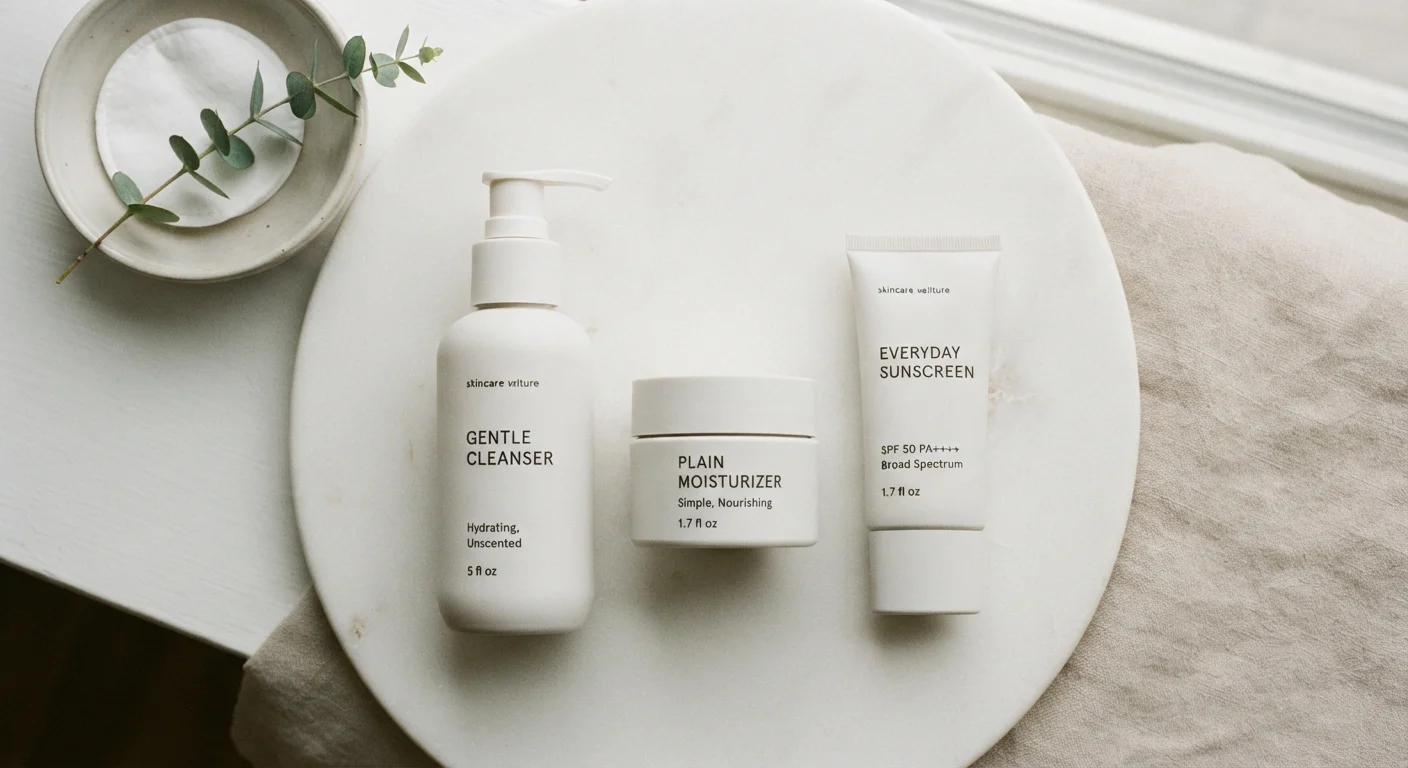
Simplicity is genuinely protective for sensitive skin — more steps mean more ingredients and more potential points of friction. A foundational routine can be just three steps:
- Cleanser: A low-lather, fragrance-free, pH-balanced formula. Avoid hot water, which can strip natural oils; lukewarm is adequate. Over-cleansing is a common and underappreciated source of barrier damage.
- Moisturizer: Applied while skin is still slightly damp to improve absorption. Look for ceramides, glycerin, or squalane. For very dry or reactive skin, a richer cream applied at night supports overnight barrier repair.
- Sunscreen (morning only): UV exposure is one of the primary external stressors on the skin barrier. Mineral formulas (zinc oxide or titanium dioxide) are generally considered lower-risk for reactive skin than chemical UV filters, though individuals vary.
Active ingredients — exfoliating acids, retinoids, vitamin C — can be introduced later, one at a time, with adequate time between additions to assess tolerance. For a minimal starting point, see the bare-minimum routine that works for most skin types.
Price is not a reliable indicator of gentleness. Many affordable formulas are specifically designed around minimal, well-tolerated ingredients. For guidance on evaluating lower-cost options, the affordable skincare swaps guide covers what to look for on the label.
Habits That Protect Sensitive Skin Daily
Products are only part of the picture. Consistent habits reduce background stress on the skin barrier and make any routine more effective:
- Patch test new products: Apply a small amount to the inner forearm or behind the ear for several consecutive days before using on your face. A reaction there is far easier to manage than a full-face flare.
- Introduce one new product at a time: Changing multiple products simultaneously makes it impossible to identify what caused a reaction. Wait two to four weeks before adding anything new.
- Avoid physical exfoliation: Scrubs and brushes create micro-abrasions that can worsen barrier disruption. If exfoliation is needed, low-concentration chemical exfoliants used infrequently are generally a gentler option.
- Protect against environmental triggers: Wind, cold, and low humidity all increase transepidermal water loss. A heavier moisturizer or protective balm in harsh weather conditions is a simple, practical defense.
- Be consistent rather than reactive: Sensitive skin tends to respond better to steady, predictable routines than to frequent product changes. Resist the urge to troubleshoot with new purchases at the first sign of irritation — sometimes removal of a product, or simply time, is the answer.
For those interested in extending gentle care beyond the face, our hair and body care hub covers accessible routines for the whole body.
This article is for general informational and educational purposes only. It is not medical or dermatological advice. If you experience persistent, severe, or worsening skin reactions, please consult a qualified healthcare professional.