

Key Takeaways
- Your owner's manual is organized by system — knowing that structure saves serious time.
- The maintenance schedule section is the most important part for keeping repair costs down.
- Manufacturer-recommended service intervals often differ from what service shops suggest.
- Warning light descriptions in the manual are often more accurate than generic online searches.
- You only need to read the sections relevant to your situation — not the whole book.
What you will need
Why the Manual Deserves More Than a Glance
Most drivers tuck the owner's manual into the glove box and never open it. That's understandable — it's dense, written in bureaucratic prose, and feels like homework. But no other document knows your specific vehicle the way that book does. The factory engineers who built your car wrote it, and it contains the exact maintenance intervals, fluid specifications, and warning light definitions for your trim and model year.
Ignoring it doesn't just mean missing some readings — it can mean following generic advice that doesn't match your actual vehicle, leading to over-servicing (and overspending) or under-servicing (and early wear). If you're working toward keeping your car running on a tight budget, the manual is one of your best free tools.
The good news: you don't have to read the whole thing. You just need to know which parts matter most and where to find them.
What you will need
What You'll Need Before You Start
Owner's Manual
The primary reference document containing all manufacturer specifications, maintenance schedules, and warning light definitions for your vehicle.
Sticky Page Tabs
Used to flag the maintenance schedule, fluid specs, and warning light pages for quick future reference.
Smartphone
Useful for photographing key manual pages so you have them accessible outside the vehicle.
Once you have your manual in hand, the steps below walk you through finding exactly what you need — without reading cover to cover.
Step-by-Step: Navigating Your Owner's Manual
Locate your manual and confirm it matches your vehicle
Most owner's manuals live in the glove compartment. If yours is missing, your automaker's website typically offers a free downloadable PDF — search for your make, model, and year followed by "owner's manual PDF."
Once you have it, confirm the manual matches your exact model year and trim level. A manual from one year can differ meaningfully from the next in fluid specs and service intervals.
Use the table of contents — not the index — for your first pass
Owner's manuals are organized by vehicle system: instruments and controls, comfort features, driving and operation, maintenance, and emergency procedures are common chapter groupings. The table of contents at the front shows this structure at a glance.
Resist the urge to flip randomly. Instead, scan the table of contents and identify two or three sections most relevant to you right now. For most drivers, that's Maintenance and Instruments / Warning Lights.
Find and read the maintenance schedule
This is the single most valuable section in the manual. It lists every scheduled service item — oil changes, filter replacements, tire rotations, brake inspections, spark plugs, timing belt or chain checks — organized by mileage or time intervals, whichever comes first.
The schedule is often presented as a table. Look for the interval closest to your current mileage, then check which items are due. Some manuals separate "normal" from "severe" driving conditions — severe typically means frequent short trips, dusty environments, or stop-and-go city driving.
Note your vehicle's fluid specifications
Somewhere in the maintenance or technical specifications section, you'll find the exact oil viscosity grade (such as 5W-30), coolant type, transmission fluid spec, and brake fluid type your vehicle requires. These aren't suggestions — using the wrong fluid can damage components.
This matters most when you're having work done somewhere other than a dealership. You can hand these specs to any shop or mechanic to ensure they're using the right products. For a broader look at what each fluid does, see our guide to your car's fluid system.
Look up any active warning lights
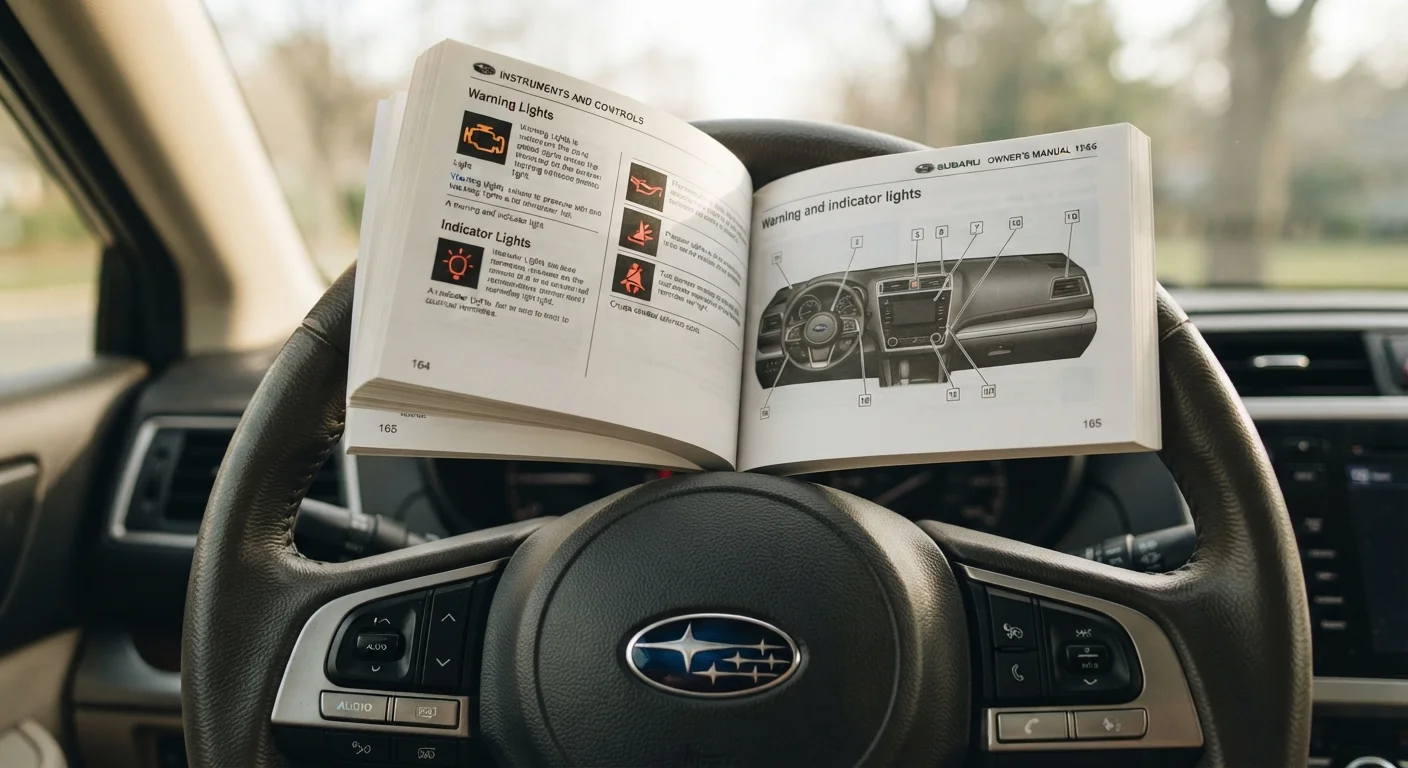
Your manual has a dedicated section — usually near the instruments chapter — that explains every dashboard warning light specific to your vehicle. Find the icon that matches what you're seeing and read the description carefully. It will tell you whether the situation requires immediate action, a service appointment, or simply monitoring.
For a quick reference guide, our warning lights explainer covers the most common symbols. But your manual is always the most accurate source for your specific vehicle.
Bookmark the emergency and roadside section
Most manuals include a section covering tire changes, jump-starting procedures, towing capacity, and what to do if your vehicle needs to be towed. This isn't reading you need to memorize, but knowing where it is before you need it matters — nobody wants to search 300 pages on the side of a highway.
Tab this section now. It takes thirty seconds and could save a lot of stress later.
Manufacturer Intervals Override Shop Recommendations
Service centers sometimes recommend more frequent oil changes or fluid flushes than your manufacturer actually requires. Your owner's manual is the authoritative source for your specific vehicle. Following it — rather than a generic posted interval — can save money without sacrificing reliability.
After working through these steps, tab or photograph the maintenance schedule and fluid specs pages. You'll refer to them regularly — especially before any service appointment. For a broader picture of what to expect across the year, our seasonal car maintenance guide pairs well with what you've just found in your manual.
Photograph the Key Pages
Snap photos of your maintenance schedule and fluid specification pages with your phone. That way you have them in your pocket when you're at a shop or auto parts store and need to verify a recommendation on the spot.
Putting It Into Practice
Reading your manual isn't a one-time task. As your mileage climbs, you'll return to the maintenance schedule to see what's coming up. When a new warning light appears, you'll check the instruments section before calling anyone. Over time, flipping to the right section becomes second nature.
If you're new to owning a vehicle, our first-timer's maintenance guide walks through the broader habits that keep a car reliable from day one. And when you're ready to take on some of those maintenance tasks yourself, our guide to safe DIY car maintenance helps you figure out what's reasonable to handle at home versus what needs a professional.
The manual makes all of that easier — not because it's exciting reading, but because it's accurate reading.