

Key Takeaways
- Unit price shows cost per standard measure, not just the total sticker price.
- Larger packages are not always cheaper per unit — size assumptions can be costly.
- Sale items can still be more expensive per unit than their regular-priced alternatives.
- Store-brand and name-brand products are easiest to compare using unit pricing.
- Many states require unit pricing on grocery shelf labels, making it widely available.
Unit Pricing
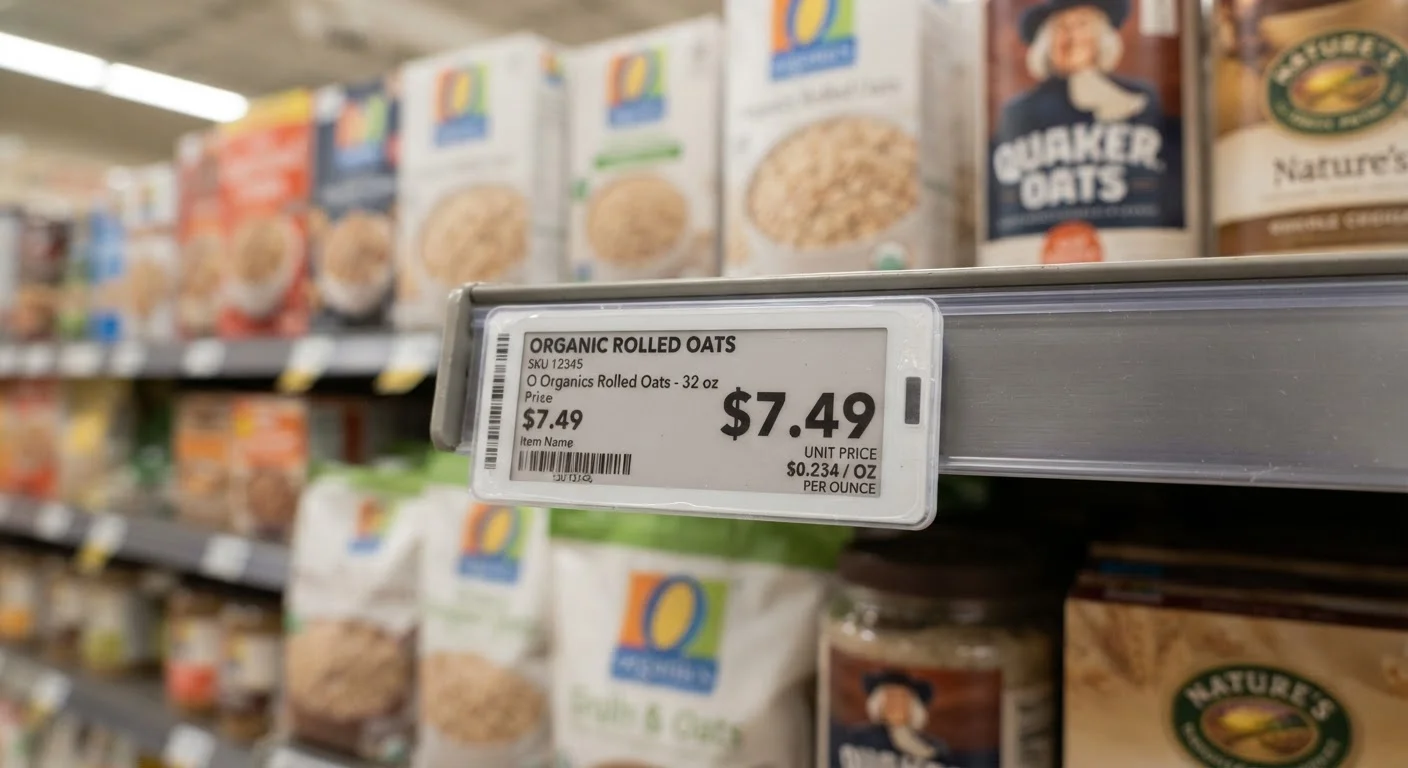
Unit pricing is the cost of a product broken down to a standard measure — such as per ounce, per pound, per liter, or per count. It's displayed on shelf labels alongside the total price and lets you compare products of different sizes or brands on a level playing field. Instead of guessing whether a 32-oz bottle is a better deal than two 16-oz bottles, the unit price does the math for you.
In the U.S., many states require unit pricing on shelf tags for packaged grocery items, though the specific rules — which stores must comply and which product categories are covered — vary by state.
What the Small Print Is Actually Telling You
Every grocery shelf label carries two prices: the big number everyone reads and a smaller one most people overlook. That smaller number — the unit price — is often the more useful of the two. It converts the total price into a cost per standard measure, so you're always comparing like with like regardless of package size or brand.
For example, if a 28-oz jar of pasta sauce costs $3.49 and a 15-oz jar costs $2.19, the sticker prices don't tell you much. But the unit prices — roughly $0.12 per oz versus $0.15 per oz — make the comparison immediate. The unit price is the shelf label detail that removes the guesswork.
This matters because grocery packaging is rarely standardized. Brands sell the same product in half a dozen sizes, and promotional packaging ("now 20% more!") shifts the math further. Unit pricing cuts through all of that. For a deeper look at how sticker prices and unit prices interact, see unit price vs. total price explained.
Common Misconceptions That Cost Money
The most widespread assumption is that larger packages always cost less per unit. This is frequently true but not reliably so. Retailers price products based on many factors — shelf space, inventory strategy, promotional cycles — and a mid-size or even smaller package sometimes lands at a lower unit cost.
A second misconception: sale prices are always the better deal. A product on sale may still carry a higher unit price than the store-brand version sitting right next to it at full price. The discount is real, but real compared to what? Unit pricing grounds that question in actual numbers.
~30+
U.S. states with unit pricing requirements
Consumer advocacy research has tracked state-level unit pricing laws, though coverage, exemptions, and enforcement vary significantly by jurisdiction.
Up to 30%
Potential cost difference between package sizes
Consumer research has shown unit price differences of this magnitude between package sizes of the same product, depending on category and retailer.
Flavoring and packaging changes create another trap. A product reformulated to a slightly smaller net weight but kept at the same price — sometimes called "shrinkflation" — won't look different on the shelf. The unit price, however, will quietly reflect the change. Tracking unit prices over repeat shopping trips is one of the few reliable ways to notice this happening. If your pantry budget feels squeezed, pantry staples that quietly drain your grocery budget explores other hidden cost drivers worth knowing about.
How to Use Unit Pricing Practically In-Store
Using unit pricing doesn't require mental math or a calculator app. The comparison is already done — your job is simply to look at the right number before reaching for a product.
A few habits that help:
- Check the unit measure first. Some labels show cost per ounce; others use per pound, per 100 grams, or per count. If two labels use different units, the comparison breaks down. Either convert manually or flag it and move on.
- Compare within the same unit. Store brands and name brands in the same category almost always share the same unit measure, making comparison straightforward.
- Factor in what you'll actually use. A larger container with a better unit price isn't a saving if half of it expires. This is especially relevant for perishables — when bulk buying actually saves money covers this trade-off in detail.
Take a Photo of the Unit Price
If you're comparing options across different aisles or stores, a quick photo of the shelf label preserves the unit price for reference. This is especially useful for bulk or club-store comparisons where you may not have the regular-store unit price memorized.
Unit pricing is also useful when evaluating sale prices. If the promotional unit price still exceeds the everyday unit price of an alternative product, the "deal" is less compelling than it appears. Understanding sale vs. everyday pricing puts that context into sharper focus.
Why This One Habit Compounds Over Time
Unit pricing isn't a one-time trick — it's a reference point that improves every shopping trip. Once you know the typical unit price for products you buy regularly, you can immediately recognize when something is priced unusually high or low, spot genuine value in an unfamiliar brand, and avoid being nudged by packaging that's designed to look like a deal.
The habit also travels across categories. The same logic that applies to pasta sauce applies to laundry detergent, shampoo, canned goods, and cleaning supplies. For a broader look at ingredient-level spending, pantry staples that quietly inflate your grocery bill pairs well with unit pricing awareness.
No single grocery decision will dramatically change a household budget. But consistently choosing the lower unit price across dozens of weekly purchases adds up meaningfully over months. The shelf label already contains the information — reading the right number is the only step that's required.