

Key Takeaways
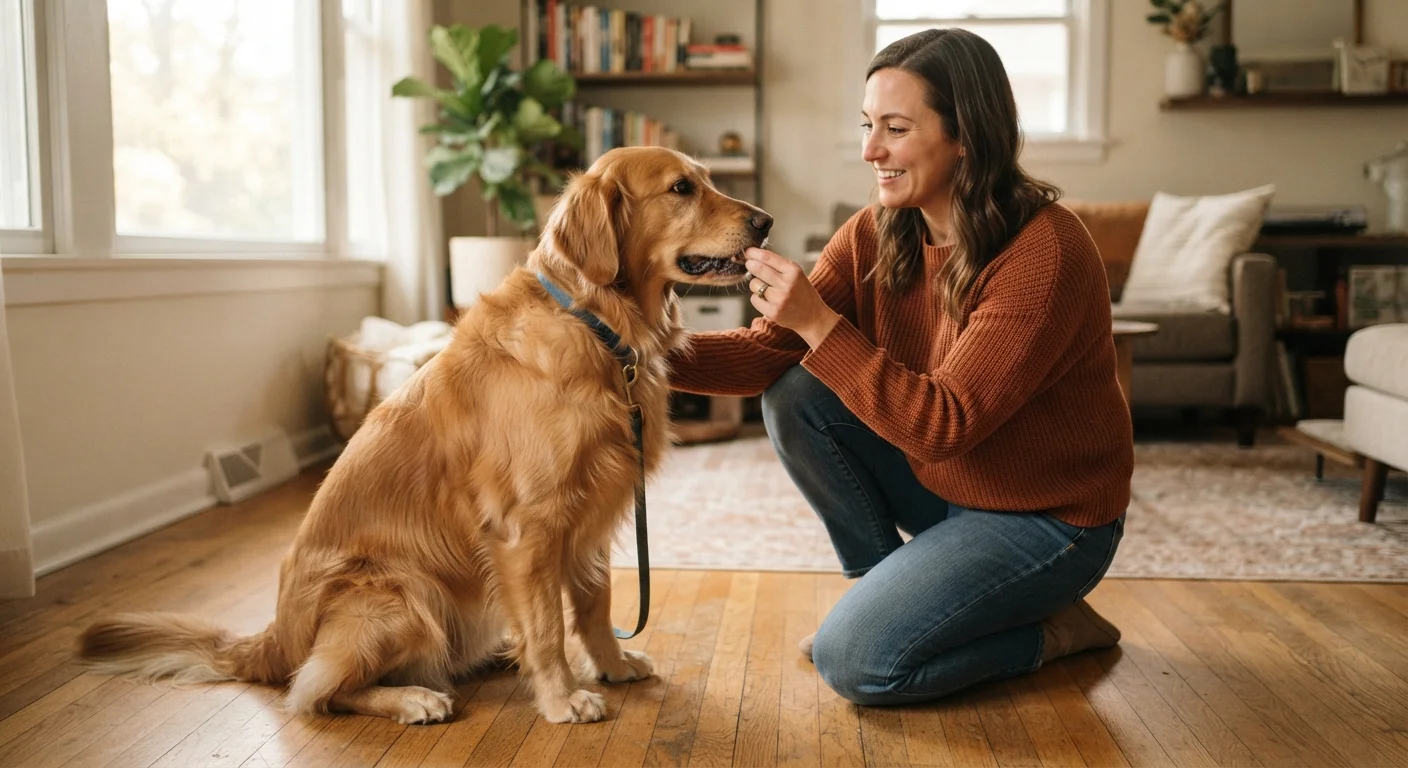
- Positive reinforcement — rewarding desired behaviors — is more effective and humane than punishment-based methods.
- Short, consistent daily sessions of 5–10 minutes produce better results than occasional long ones.
- Five foundation commands (sit, stay, come, down, leave it) form the backbone of a well-behaved dog.
- Early and gradual socialisation shapes a calmer, more confident dog throughout its life.
- Most common problem behaviors have root causes that training can address without force or fear.
- Dogs of any age can learn — consistency and patience matter more than the dog's starting point.
Why Positive Reinforcement Works
Positive reinforcement means adding something a dog values — a treat, praise, or play — immediately after it performs a desired behavior. This signals clearly to the dog: that action earned a reward. Over time, the dog repeats the behavior because it predicts good things. Decades of research in animal learning, grounded in operant conditioning principles, support this approach as both effective and kind. If you want a plain-language breakdown of training terminology, see our Pet Training Glossary.
Punishment-based techniques — yelling, leash corrections, or physical intimidation — can suppress behavior in the short term but often increase anxiety and erode the trust between dog and owner. An anxious dog is less able to learn. Positive methods build a dog that wants to cooperate, not one that complies out of fear.
Mark the exact moment your dog performs the correct behavior — a consistent marker word like "yes" or a clicker bridges the gap between action and reward so the dog learns precisely what earned the treat.
Timing is the single most critical variable in operant conditioning. A delay of even two seconds can cause the dog to associate the reward with the wrong behavior.
Vary your rewards rather than always using the same treat — rotating between food, a quick game of tug, or verbal praise keeps the dog engaged and prevents treat dependency.
Variable reward schedules, well-established in behavioral science, maintain higher and more persistent response rates than predictable, fixed rewards.
Setting Up for Success at Home
Your training environment matters as much as your technique. Before you ask your dog to learn anything, set the stage so success is the most likely outcome.
- Choose a low-distraction space. Start indoors or in a quiet yard. Add distractions only after the dog understands what you're asking.
- Use high-value rewards. Tiny, soft treats — pea-sized — work well. Save the highest-value treats for the hardest tasks.
- Keep sessions short. Five to ten minutes, two to three times daily, beats a single 45-minute session. Dogs tire mentally faster than most owners expect.
- End on a win. Finish each session with something the dog already knows well, so both of you end feeling successful.
If you've just brought a new dog home, our First 30 Days training roadmap covers how to structure those early weeks before formal training even begins.
Set Your Dog Up to Succeed
Never raise the difficulty of a training challenge until the dog succeeds at the current level around 80–90% of the time. Rushing leads to frustration on both sides. Think of difficulty as a dial you turn up gradually — distance, duration, and distraction should each be increased separately, not all at once.
The Five Foundation Commands
These five commands give your dog a reliable behavioral vocabulary and address most everyday safety and manners needs.
- Sit
- Hold a treat near the dog's nose and slowly move it back over the head. The dog's bottom naturally lowers. Mark the moment (with a word like "yes" or a clicker) and reward immediately.
- Stay
- Ask for a sit, say "stay," then take one step back. Return and reward before the dog moves. Gradually increase distance and duration over multiple sessions.
- Come (recall)
- The most important safety command. Crouch, open your arms, say "come" in an upbeat tone, and reward generously every single time the dog reaches you. Never call the dog to you for something unpleasant.
- Down
- From a sit, lure the treat toward the ground between the dog's front paws. As the elbows touch the floor, mark and reward.
- Leave it
- Place a low-value treat on the floor and cover it with your hand. When the dog backs away from your hand, mark and reward with a different, higher-value treat from your other hand. This teaches impulse control, not just avoidance.
93%
Dogs responding better to reward-based training
A study published in the journal Applied Animal Behaviour Science found that dogs trained with positive methods showed fewer problem behaviors and lower stress indicators than those trained with aversive techniques.
5–10 min
Ideal training session length per sitting
Veterinary behaviorists and certified trainers consistently recommend multiple short sessions daily over single extended ones, which tend to cause mental fatigue and disengagement.
3–14 weeks
Primary socialization window in puppies
According to established veterinary developmental science, experiences during this window have an outsized influence on a dog's lifelong temperament and confidence.
Socialisation: Building a Confident Dog
Socialisation is the process of exposing a dog to a wide variety of people, animals, sounds, surfaces, and environments — ideally during the primary socialization window (roughly 3–14 weeks of age), but meaningfully at any life stage. A well-socialised dog is calmer, less reactive, and easier to manage in public.
Effective socialisation is gradual and positive, never flooding. Flooding — forcing a dog to face something frightening until it stops reacting — causes lasting stress and can worsen fear. Instead:
- Introduce new stimuli at a distance the dog can tolerate without showing stress.
- Pair the new thing with something pleasant (treats, play).
- Let the dog approach at its own pace when possible.
- Watch for stress signals: yawning, lip-licking, turning away, or freezing. Back up a step if you see them.
For adult and senior dogs, the principles remain the same — the pace may simply be slower. Our article on training an older dog outlines exactly what to adjust for dogs that didn't receive early socialisation.
Solving Common Behaviour Problems
Most problem behaviors are normal dog behaviors happening in the wrong context. Understanding the function of a behavior — what the dog gets from doing it — is the first step to changing it.
Jumping Up
Dogs jump to greet because historically it's worked: people respond, make eye contact, and touch the dog. Remove the reward. Turn your back, fold your arms, and give zero attention until all four paws are on the floor. Then reward immediately and calmly.
Excessive Barking
Identify the trigger first. Boredom barking needs more mental and physical enrichment. Alert barking at the window can be managed by blocking visual access to the trigger, then gradually desensitising the dog to the stimulus. Demand barking — barking for food or attention — is extinguished the same way as jumping: consistently withhold the reward the dog is barking for.
Pulling on Leash
Stop moving the instant the leash goes tight. Only resume walking when there is slack. It feels slow at first but teaches the dog that tension stops forward progress. Consistency across every walk — and every person walking the dog — is non-negotiable.
Destructive Chewing
Chewing is a natural, necessary outlet. Provide appropriate chew items and manage the environment (crates, baby gates) so the dog cannot practice chewing forbidden objects. Redirect, don't just punish after the fact — dogs do not connect a reprimand to something they did minutes ago.
Keeping Training on Track Long-Term
Training is not a one-time event. Behaviors that aren't practiced regularly will fade — a phenomenon called extinction. Build maintenance into daily life by asking for known commands at natural moments: sit before meals, down before a game of fetch, stay at doorways.
All household members need to use the same cues and rules. Inconsistency — one person allowing the dog on the couch while another doesn't — teaches the dog to test each person separately rather than follow a clear household norm.
A dog's behavior is also closely linked to its overall health and wellbeing. A dog that is under-exercised, under-stimulated, or in pain may be harder to train. Our guide to foundational pet health is a useful companion read to ensure the basics are covered. Good pet nutrition also plays a role — a dog that feels well is a dog that learns well.
If a behavior problem persists despite consistent effort, or if your dog shows aggression, consider consulting a certified professional trainer or a veterinary behaviorist. Some challenges benefit from expert eyes.
This article is for general informational and educational purposes only. It is not a substitute for professional veterinary or behavioral advice. If your dog shows signs of aggression, severe anxiety, or any health concern, please consult a qualified veterinarian or certified animal behaviorist.