

Key Takeaways
- Dry kibble costs less per serving and stores easily, making it practical for most budgets.
- Wet food provides significantly more moisture, which supports urinary and kidney health in many pets.
- Neither format is universally superior — the right choice depends on your individual pet's health, age, and preferences.
- Many veterinarians support mixing both formats to balance cost, hydration, and palatability.
- Always check that any food — dry or wet — carries an AAFCO nutritional adequacy statement for your pet's life stage.
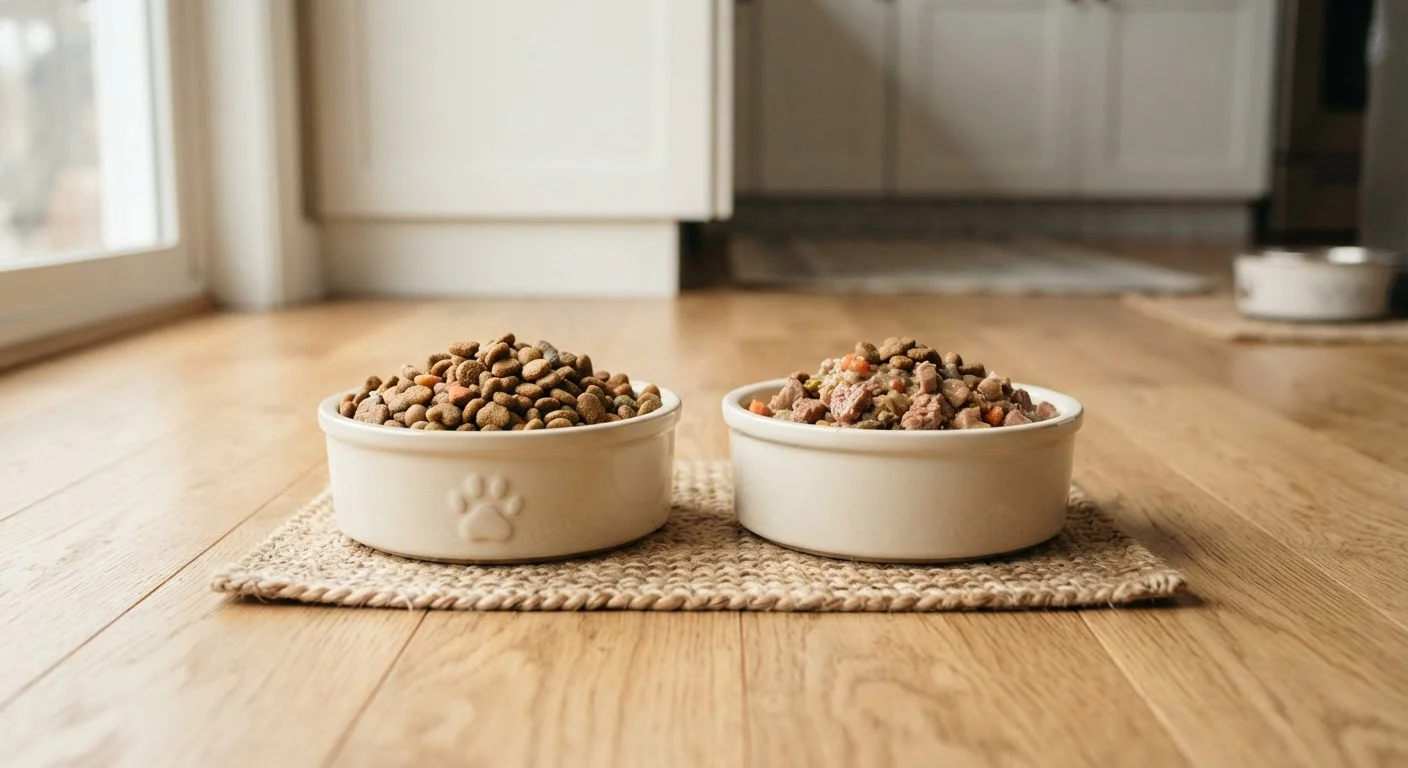
Option A
Dry Kibble
The convenient, shelf-stable everyday staple.
Best for: Pet owners seeking an affordable, easy-to-store option that also supports dental health through mechanical chewing.
Option B
Wet Food
The moisture-rich, highly palatable alternative.
Best for: Pets with hydration needs, picky appetites, dental issues, or difficulty chewing hard food.
If you're managing a tight pet food budget
Dry Kibble
Kibble generally costs less per calorie and stays fresh in storage far longer, reducing both spending and waste.
If your pet struggles to stay hydrated
Wet Food
Wet food contains roughly 70–80% moisture, helping cats and dogs meet daily fluid needs without relying solely on a water bowl.
If your senior pet has tooth loss or jaw pain
Wet Food
The soft texture is far easier to eat for animals with dental disease or missing teeth, reducing mealtime discomfort.
If you want a single, complete daily diet with minimal fuss
Dry Kibble
Kibble can be portioned quickly, left in the bowl without spoiling for hours, and is available in a wide range of life-stage formulas.
If your pet is a picky eater or has a reduced appetite
Wet Food
The stronger aroma and softer texture of wet food tend to be more enticing, which can encourage eating in finicky or unwell animals.
What Actually Separates Dry and Wet Pet Food?
The most fundamental difference between dry kibble and wet food is moisture content. Kibble typically contains around 6–10% water, while wet food usually sits at 70–80%. That gap has real downstream effects on digestion, kidney function, and caloric density — not just texture.
Because wet food is so much heavier with water, you feed a larger volume for the same caloric intake. This can feel more filling for your pet, but it also means cost-per-calorie comparisons require a bit of math. Dry food packs more energy into a smaller, lighter package, which is a practical advantage when buying in bulk. For a deeper look at making your food dollars go further, see our guide on stretching the pet food budget.
Both formats can meet complete nutritional standards if they carry an AAFCO (Association of American Feed Control Officials) nutritional adequacy statement. The label — not the format — is the starting point for evaluating any food. Learn exactly what to look for in our practical pet food evaluation guide.
| Criterion | Dry Kibble | Wet Food |
|---|---|---|
| Moisture content | ~6–10% | ~70–80% |
| Cost per serving | Generally lower | Generally higher |
| Shelf life (opened) | Weeks (resealed bag) | 1–2 days (refrigerated) |
| Dental scrubbing action | Moderate benefit | Minimal benefit |
| Palatability for picky eaters | Variable | Typically higher |
| Suitable for tooth/jaw issues | Not ideal | Well suited |
| Hydration support | Low | High |
| Ease of portioning | Very easy | Requires measuring/refrigerating |
Health Considerations: When Format Actually Matters
For cats especially, hydration is a chronic challenge. As obligate carnivores, cats evolved to obtain much of their water from prey — not a standing bowl. Wet food can meaningfully increase daily fluid intake, which veterinary guidance frequently highlights as supportive of urinary tract and kidney health. This doesn't mean dry food causes kidney disease, but cats prone to urinary crystals or those with early kidney concerns may benefit from the extra moisture wet food provides.
Dogs are generally less sensitive to food moisture content in terms of urinary health, though older dogs and those with kidney conditions may also benefit. Always discuss format choices with your veterinarian if your pet has an existing health condition — this article provides general information, not medical advice.
Dental health is often cited as a point in kibble's favor. The mechanical action of chewing hard biscuits can help reduce plaque buildup in some animals. However, veterinary dental organizations note that this effect is modest and not a substitute for regular tooth brushing or professional cleaning. Wet food, meanwhile, does not inherently cause worse dental disease — it simply doesn't provide that scrubbing action.
70–80%
Moisture content in typical wet pet food
Compared to roughly 6–10% in dry kibble, this difference significantly impacts daily fluid intake for cats and dogs.
~3–4x
Greater volume fed per calorie in wet food
Because water adds weight without calories, pets eating wet food typically consume a much larger volume for equivalent energy.
For pets with missing teeth, jaw pain, or recovering from oral surgery, wet food is often clinically recommended. For healthy animals, either format can work well — and a mixed approach is often a practical middle ground. Cats and dogs have different nutritional needs overall, so format decisions should factor in species-specific considerations too.
Practical and Cost Factors Every Owner Should Weigh
Dry kibble wins on convenience and economy in most households. A sealed bag keeps for weeks or months, requires no refrigeration after opening (beyond resealing properly), and is easy to portion accurately. Wet food, once opened, must be refrigerated and used within a day or two, which introduces more daily management and potential waste if your pet doesn't finish a portion.
Cost varies widely by brand and formula, but on a per-calorie basis, wet food is almost always more expensive than dry. Feeding a large dog exclusively wet food can become a significant budget strain. For smaller pets — a toy-breed dog or a single cat — the cost difference narrows enough that wet food becomes far more feasible as a staple.
Mixing Formats: A Flexible Middle Ground
Many veterinarians support combining dry and wet food in the same diet. A common approach is feeding a measured base of kibble with a small portion of wet food mixed in or served alongside. This can improve palatability, add moisture, and keep costs manageable. Just be sure the combined portions don't exceed your pet's daily caloric target — overfeeding is easy when adding a second format.
Mixing formats — a base of kibble supplemented with a small amount of wet food — is a widely used approach that balances palatability, hydration, and cost. If you're also considering making food at home, understand that homemade pet food requires careful nutritional balancing that goes beyond simply combining ingredients. For broader feeding fundamentals, our piece on feeding your pet well without overcomplicating it covers portion sizing and life-stage diets in plain terms.