

Key Takeaways
- Habit-tracking apps can boost consistency by making progress visible and creating accountability.
- Over-reliance on apps can shift focus from how you feel to how you score.
- Privacy trade-offs are real — most free apps monetize your health data in some form.
- Apps work best as scaffolding, not a permanent replacement for self-awareness.
- People who benefit most are those building new routines, not maintaining established ones.
Makes invisible patterns visible over time
Logging data consistently reveals trends — like weekend sleep debt or midweek hydration gaps — that are easy to overlook without a record.
Reduces decision fatigue around daily habits
A pre-set routine in an app removes the need to decide each morning what to track, lowering the mental effort required to stay consistent.
Provides low-stakes accountability
Knowing you'll log an outcome — whether you went for a walk or skipped it — creates a gentle internal prompt that nudges behavior without external pressure.
Consolidates multiple wellness areas in one view
Rather than juggling separate notes for sleep, water, and movement, a single dashboard gives a holistic snapshot of how different habits interact.
Useful starting point for conversations with healthcare providers
Documented trends in sleep quality or mood patterns can offer a healthcare professional more context than memory alone, though the data should be shared with appropriate caveats about accuracy.
Data privacy risks are often underestimated
Many free habit apps generate revenue by sharing or selling anonymized user data to third parties. Reviewing the privacy policy before entering sensitive health information is worth the extra step.
Streak mechanics can fuel all-or-nothing thinking
Binary streak counters reward unbroken chains but can cause users to feel their efforts are worthless after a single missed day, which research associates with increased habit abandonment.
Logging fatigue sets in for many users within weeks
Studies on digital behavior suggest engagement with self-tracking tools drops significantly after the initial novelty period, often before lasting habits have formed.
Metrics can displace genuine self-awareness
When hitting a number becomes the goal, users may dismiss how they actually feel — logging a 'good' sleep score while still feeling exhausted, for example.
Most apps lack professional clinical oversight
Health recommendations built into apps are typically generalized defaults, not personalized guidance — a meaningful distinction for anyone managing a chronic condition or recovering from illness.
Our Verdict
Health habit apps are genuinely useful tools for people starting out or rebuilding routines — they reduce friction, surface patterns, and make abstract goals concrete. However, they carry real risks around data privacy, perfectionism, and mechanical engagement that can quietly undermine the deeper self-awareness you're trying to build. Used intentionally and periodically reviewed, they can support lasting wellness; used passively or obsessively, they can get in the way.
Best suited to people establishing new wellness habits who want structured feedback, and least suited to those prone to anxiety around metrics or all-or-nothing thinking.
What Health Habit Apps Actually Do
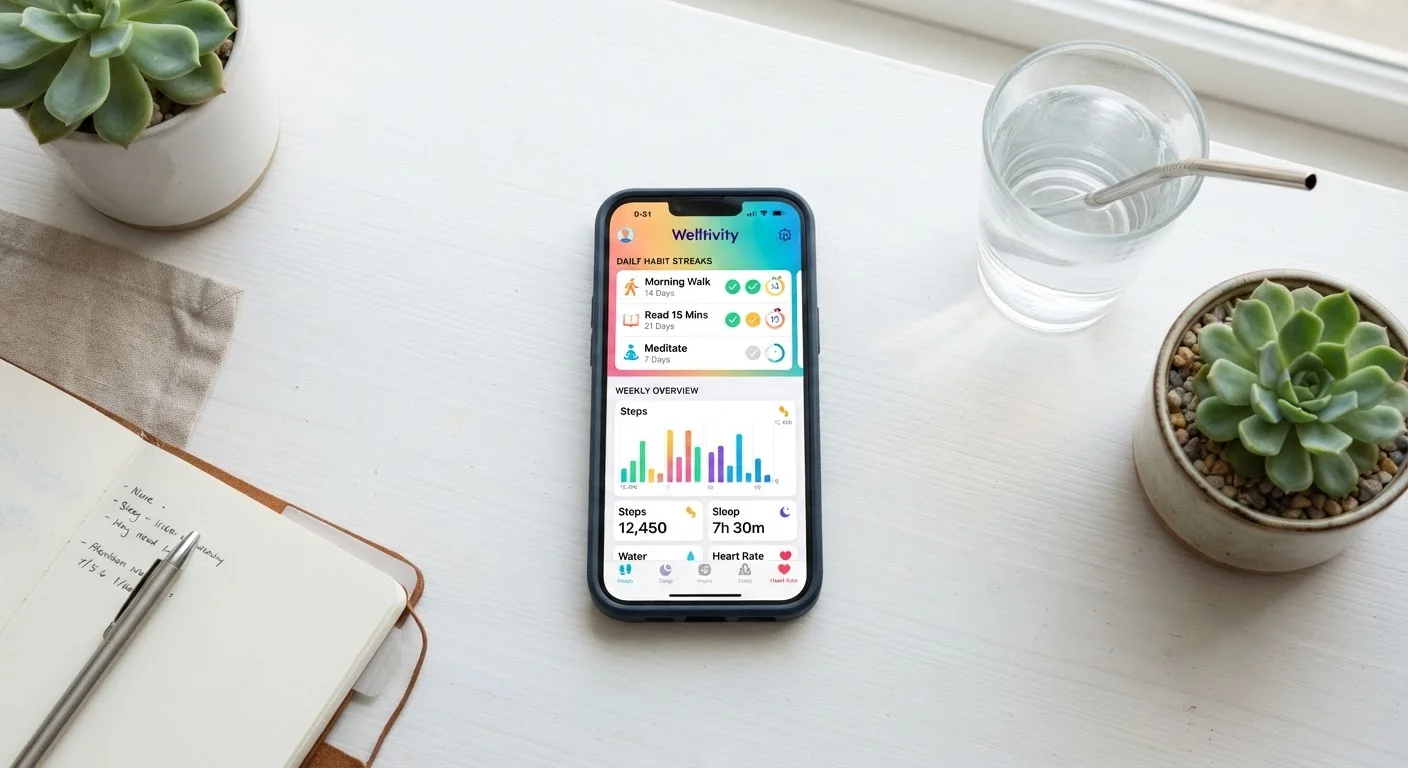
Health habit-tracking apps let you log daily behaviors — sleep hours, water intake, movement, meals, mood — and visualize them over time. Some generate streak counts, send reminders, or aggregate data into weekly summaries. Others connect to wearables to automate data entry.
On paper, this sounds straightforwardly useful. In practice, what the app tracks and how it presents that data shapes your relationship with your own habits in ways worth thinking through before you commit. Whether you're working toward better sleep or more consistent movement, understanding the tool's design logic helps you use it on your terms rather than the app's.
For a broader look at building sustainable daily routines, see our realistic daily wellness framework — it covers sleep, nutrition, movement, and mental health together.
The Real Advantages of Tracking
When used thoughtfully, habit apps offer concrete benefits that are backed by behavioral research.
Makes invisible patterns visible over time
Logging data consistently reveals trends — like weekend sleep debt or midweek hydration gaps — that are easy to overlook without a record.
Reduces decision fatigue around daily habits
A pre-set routine in an app removes the need to decide each morning what to track, lowering the mental effort required to stay consistent.
Provides low-stakes accountability
Knowing you'll log an outcome — whether you went for a walk or skipped it — creates a gentle internal prompt that nudges behavior without external pressure.
Consolidates multiple wellness areas in one view
Rather than juggling separate notes for sleep, water, and movement, a single dashboard gives a holistic snapshot of how different habits interact.
Useful starting point for conversations with healthcare providers
Documented trends in sleep quality or mood patterns can offer a healthcare professional more context than memory alone, though the data should be shared with appropriate caveats about accuracy.
Pattern recognition is perhaps the most underrated benefit. Many people genuinely don't know how inconsistent their sleep schedule is, or how rarely they drink water before noon, until they see the data laid out. Visibility creates an honest baseline that memory alone rarely provides.
If you're building a home environment that supports these habits alongside your tracking, our guide on setting up a wellness-supportive home offers practical, low-cost ideas.
Where Habit Apps Fall Short
The same features that make apps engaging can work against you if you're not paying attention.
Data privacy risks are often underestimated
Many free habit apps generate revenue by sharing or selling anonymized user data to third parties. Reviewing the privacy policy before entering sensitive health information is worth the extra step.
Streak mechanics can fuel all-or-nothing thinking
Binary streak counters reward unbroken chains but can cause users to feel their efforts are worthless after a single missed day, which research associates with increased habit abandonment.
Logging fatigue sets in for many users within weeks
Studies on digital behavior suggest engagement with self-tracking tools drops significantly after the initial novelty period, often before lasting habits have formed.
Metrics can displace genuine self-awareness
When hitting a number becomes the goal, users may dismiss how they actually feel — logging a 'good' sleep score while still feeling exhausted, for example.
Most apps lack professional clinical oversight
Health recommendations built into apps are typically generalized defaults, not personalized guidance — a meaningful distinction for anyone managing a chronic condition or recovering from illness.
A Note on App-Generated Health Scores
Many apps assign a single wellness score or readiness number based on inputs like sleep duration, resting heart rate, or activity levels. These scores are proprietary algorithms, not clinical diagnostics. They can highlight broad trends, but should not be treated as medical assessments. If a score prompts concern about your health, consult a qualified healthcare professional rather than adjusting your routine based on the number alone.
Streaks and scores are motivating — until a missed day triggers disproportionate discouragement. Research in behavioral science suggests that binary streak systems can increase anxiety around habits rather than building intrinsic motivation. If a rest day feels like failure, the tool is working against your wellness goals.
A useful counterweight: the consistency-over-perfection approach draws on behavioral science to help you build habits that survive imperfect days.
How to Use Apps Without Letting Them Use You
The most effective approach treats an app as temporary scaffolding rather than a permanent fixture. Review your settings periodically — turn off notifications that feel pressuring, ignore metrics that don't reflect what actually matters to you, and audit which data the app stores or shares.
~80%
Users who abandon health apps within 3 months
Multiple mobile health engagement studies have found that the majority of users stop actively using wellness apps within weeks to months of download.
30%+
Health apps that share data with third parties
Privacy analyses of popular health and wellness apps consistently find a substantial share transmitting user data beyond what users typically expect from their privacy settings.
A practical habit: do a brief weekly check-in using both your app data and your own felt sense of how the week went. If the two diverge significantly, trust the felt sense and use that gap as information. Our weekly wellness self-audit offers a structured template for exactly this kind of review.
Finally, tracking health habits shares some logic with tracking household finances — both work best with clear goals and regular review rather than passive accumulation of data. If you're curious how those principles apply to budgeting, the household budget tracking starter guide covers the parallels well.
This article is for general informational purposes only and does not constitute medical advice. Consult a qualified healthcare professional for guidance tailored to your personal health needs.