

Key Takeaways
- Your physical environment directly influences how easy or hard healthy habits feel to maintain.
- Small, low-cost changes — like repositioning items — can meaningfully reduce friction around wellness routines.
- Dedicated zones for sleep, movement, hydration, and rest signal your brain to shift into the right mode.
- Consistency matters more than a perfect setup; start with one area and build gradually.
- You do not need expensive equipment or a large home to create a wellness-supportive environment.
What you will need
Why Your Environment Shapes Your Habits More Than Willpower Does
Most wellness advice focuses on motivation, mindset, or discipline — but behavioral research suggests that the physical environment is often a stronger driver of behavior than any of those internal factors. When the path of least resistance leads toward a healthy choice, people make it more often, not because they tried harder, but because their surroundings made it easier.
This principle is sometimes called environmental design: deliberately arranging your space so that the cues, prompts, and tools for healthy habits are visible, accessible, and hard to ignore. It works in the other direction too — friction and inconvenience are powerful deterrents. If your yoga mat is buried in a closet, you will rarely use it. If your water bottle is on the counter, you will reach for it dozens of times a day.
The good news is that you do not need to redesign your home. Small, strategic adjustments — most of them free — can meaningfully lower the friction around the habits that matter most to you. For the foundational principles behind why consistency in small adjustments beats all-or-nothing overhauls, see consistency over perfection for long-term wellness.
Start With One Zone, Not the Whole Home
Trying to redesign every room at once often leads to decision fatigue and stalls progress entirely. Pick the single space where a wellness habit is most struggling — your bedroom, kitchen counter, or a corner of the living room — and set that up first. Once it feels natural, expand from there.
What You Need Before You Start
Before rearranging anything, gather a clear picture of your current routine and the spots in your home where healthy habits already occur naturally — even briefly. This audit (Step 1 below) takes only a few minutes and prevents you from making changes in the wrong places.
What you will need
Reusable water bottle or large pitcher
Keeps water visible and accessible to support consistent hydration throughout the day.
Yoga mat or exercise mat
Defines a dedicated movement zone and lowers the barrier to starting a quick stretch or workout.
Blackout curtains or an eye mask
Reduces light exposure in your sleep space to support better sleep quality.
Small shelf, tray, or basket
Creates a visual anchor for a habit zone — grouping items like a journal, skincare products, or a lamp in one tidy spot.
Notebook and pen
Supports journaling or morning intention-setting as part of a mindful daily routine.
This Is General Guidance, Not Medical Advice
The suggestions in this article are general wellness and home-organization tips intended for healthy adults. They are not a substitute for professional medical, mental health, or therapeutic advice. If you are managing a health condition, please consult a qualified healthcare professional before making changes to your environment or routine.
Step-by-Step: Setting Up Each Wellness Zone
Work through the steps below at your own pace. You do not need to complete them all in one session — choosing one or two zones to set up first is a reasonable and effective approach. As you build each zone, you are reducing the decision-making load that tends to derail routines before they become automatic.
Audit your current space with fresh eyes
Walk through your home and note where healthy habits currently happen — and where they consistently fall apart. Ask yourself: Is my water bottle somewhere I actually see it? Is there any clear floor space for movement? Does my bedroom feel restful? You are looking for friction points — environmental obstacles that make good habits harder than they need to be. Write down two or three specific problem areas before moving on.
Designate a visible hydration spot
Place a large water bottle, carafe, or pitcher somewhere you cannot miss it — on your kitchen counter, beside your coffee maker, or on your desk if you work from home. Visibility is the key mechanism here: when water is in your line of sight, you drink it more consistently. Avoid storing it in a cabinet. For more context on why hydration habits often go wrong, see what most people get wrong about daily water intake.
Create a small, dedicated movement zone
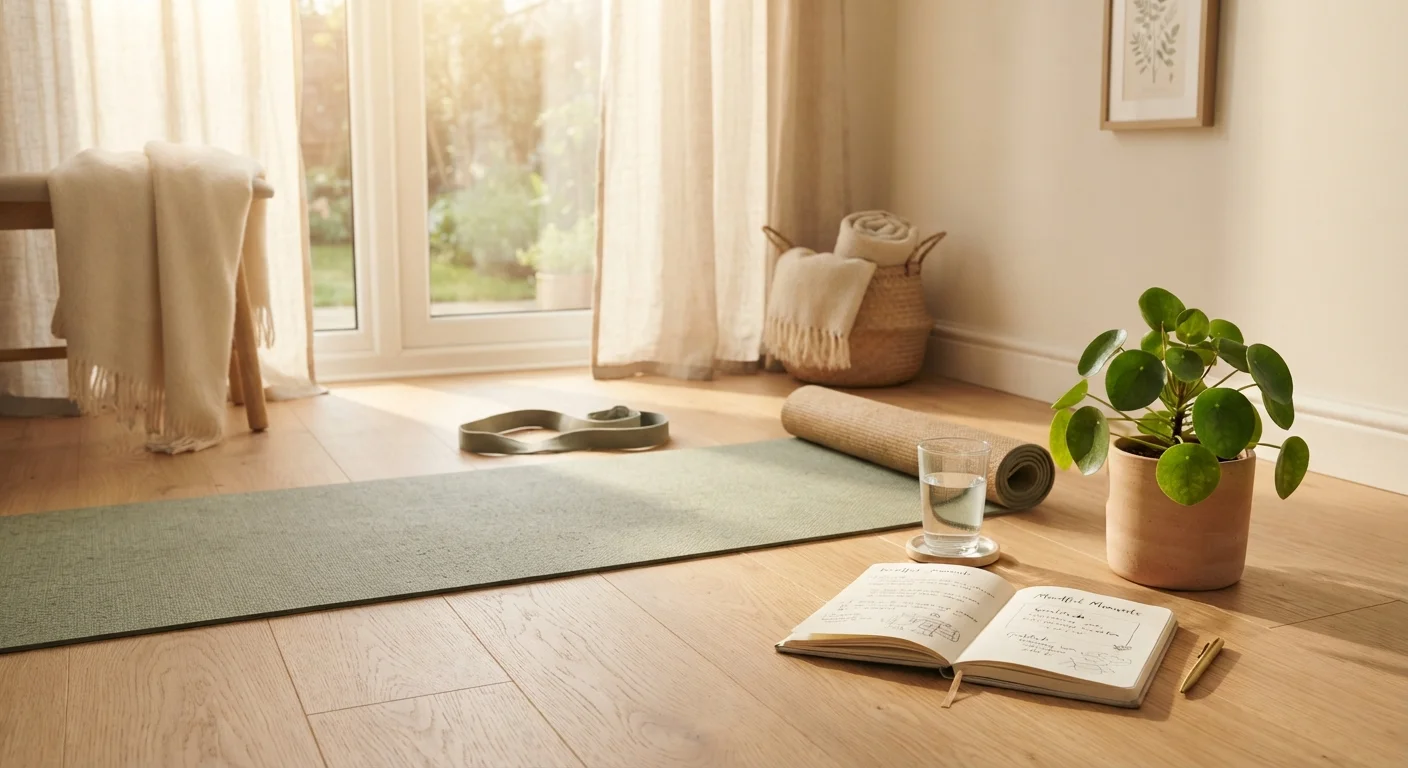
Clear a patch of floor — even 6×4 feet is enough — and keep a rolled-out mat or a clear floor visible as a constant cue. The goal is to eliminate the setup step: if you have to move furniture or hunt for equipment before exercising, you will often skip it. This zone does not need to be a gym; it simply needs to exist and stay usable. If space is tight, a corner of the bedroom or living room works perfectly well. For ideas on fitting movement into a sedentary day, see desk-friendly movement strategies.
Optimize your sleep environment
Your bedroom should signal rest, not productivity. Remove or cover devices with bright standby lights. If outside light is an issue, blackout curtains or a basic eye mask are low-cost options. Keep the room cooler if possible — research consistently shows that a slightly cool room (generally around 65–68°F for most adults) supports sleep onset, though ideal temperature varies by individual. Charge your phone outside the bedroom if you can; this one change reduces late-night scrolling significantly. For a deeper look at the habits that support restful sleep, see sleep hygiene explained.
Set up a simple rest or mindfulness corner
Choose one spot — a chair, a floor cushion, a corner of a couch — and make it yours for quiet time, reading, or brief mindfulness practice. Keep it uncluttered and free from work items. A small tray with a notebook, a book, or nothing at all is enough. The physical separation from your work or screen area is what matters most. For a jargon-free introduction to mindfulness practice, see getting started with mindfulness. You might also find creating a reading corner you will actually use helpful for making this space sustainable.
Use your kitchen layout to support healthier eating habits
Behavioral research consistently shows that what is visible and easy to reach gets eaten. Place fruit, nuts, or pre-cut vegetables at eye level in your refrigerator and on your counter. Move less-nutritious options to higher shelves or opaque containers. This is not about restriction — it is about making the easier choice also the healthier one. For broader kitchen organization strategies, explore the kitchen organization hub.
Review and adjust weekly
A wellness-supportive home is not a one-time project. Spend five minutes each week asking what worked and what still feels like a struggle. Adjust one thing at a time — move the mat, reorganize a shelf, try a different spot for your water. This ongoing refinement is what makes the environment actually fit your life rather than an idealized version of it. The weekly wellness reset self-audit offers a structured way to do this check-in across sleep, movement, and nutrition together.
Avoid Overcomplicating Your Setup
A wellness-supportive home does not require a renovation, a dedicated room, or expensive equipment. Over-investing in gear before building the habit often creates pressure that works against you. Keep changes simple, reversible, and budget-friendly, especially at the start.
For a comprehensive look at how sleep, movement, nutrition, and mental habits fit together into a daily framework, see small habits and measurable shifts for daily wellness. If you are also thinking about how to care for your body as part of this routine, building a simple body care routine from scratch is a practical companion resource.
This article is for general informational and educational purposes only. It is not a substitute for professional medical, mental health, or therapeutic advice. Always consult a qualified healthcare professional with questions about your personal health or wellbeing.