

Key Takeaways
- The three-second rule is a minimum baseline, not a universal target for all conditions.
- Reaction time alone accounts for roughly 1–1.5 seconds of stopping distance before braking even begins.
- Rain, fatigue, poor visibility, and heavy loads all require extending your following gap.
- Tailgating is one of the most common contributing factors in rear-end collisions.
- Speed does not reduce the time you need to react — it only increases the distance required.
Safe Following Distance
Safe following distance is the space you intentionally keep between your vehicle and the one directly ahead of you while driving. It gives you enough time to perceive a hazard, react, and bring your car to a full stop without hitting the vehicle in front. Most driving educators in the U.S. teach this as the three-second rule: a gap that takes at least three seconds to cross at your current speed.
Following distance and stopping distance are related but distinct: stopping distance includes both reaction distance (how far you travel before your foot hits the brake) and braking distance (how far you travel while decelerating). Safe following distance must account for both.
What the Three-Second Rule Actually Measures
The three-second rule is one of the most widely taught driving concepts — and one of the least understood in practice. Most drivers have heard it, but far fewer can explain what those three seconds are actually protecting against.
Here's the core idea: when you're driving, your brain doesn't react the instant something happens ahead. There's a delay — typically estimated between 1.5 and 2 seconds for an alert, rested driver — between perceiving a hazard and physically pressing the brake. That delay alone, at 60 mph, can consume close to 180 feet of road before your brakes even engage.
The three-second gap is designed to absorb that reaction window and still give your brakes enough road to do their job. It's not about being cautious — it's about basic physics. You cannot compress time, but you can build in distance to compensate for it.
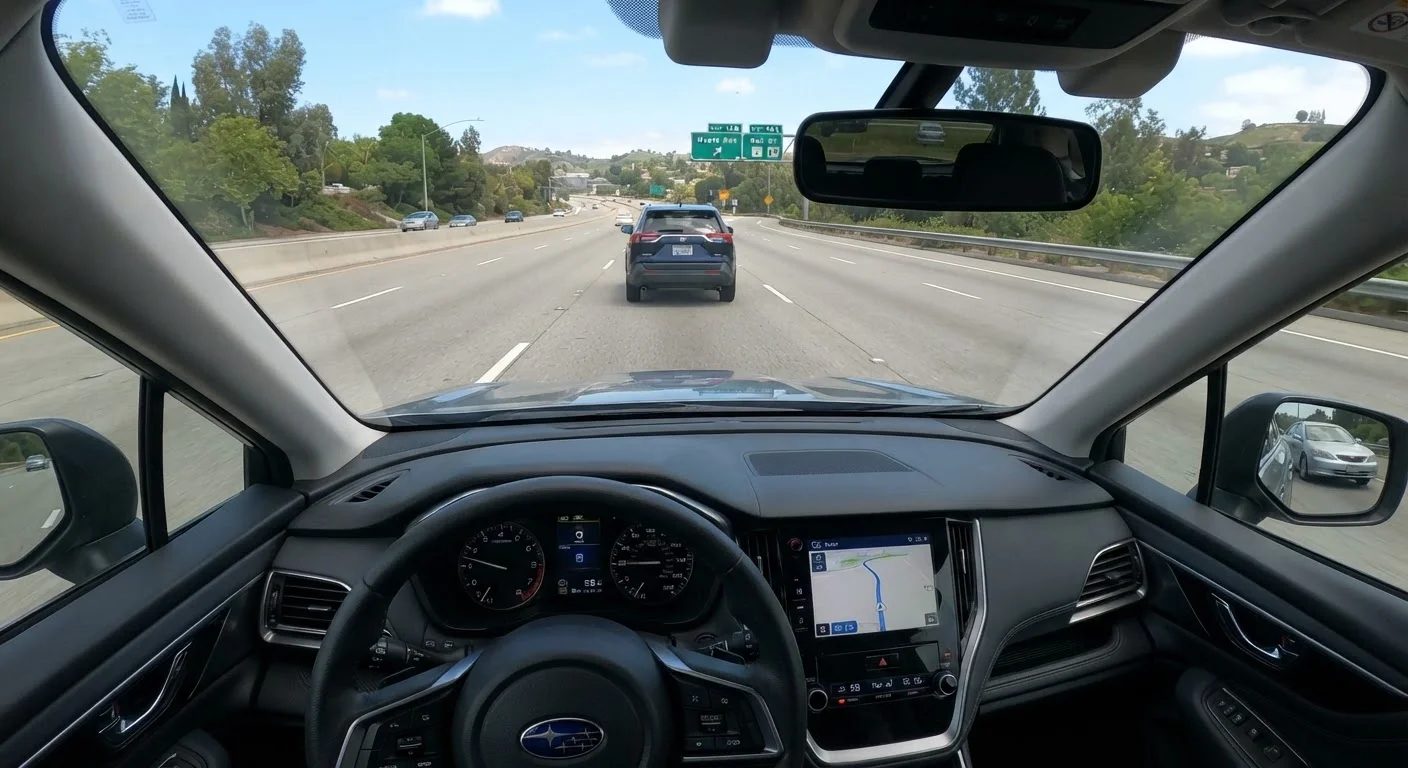
To use the rule: choose a stationary landmark — a sign, a bridge pillar, a crack in the pavement. The moment the vehicle ahead passes it, start counting: one-one-thousand, two-one-thousand, three-one-thousand. If your front bumper reaches that same landmark before you finish, you're following too closely.
~40%
Share of crashes involving rear-end collisions
According to NHTSA data, rear-end collisions are among the most frequently occurring crash types on U.S. roads, and following distance is a key contributing factor.
1.5 sec
Average driver reaction time
Research on driver response times suggests that an alert driver typically takes 1.5 seconds or more to perceive a hazard and begin braking — before the vehicle slows at all.
~300 ft
Three-second gap at 65 mph
At 65 mph, a three-second following gap equates to roughly 285–300 feet of road — significantly more than most drivers estimate when eyeballing the space.
When Three Seconds Isn't Enough
Three seconds is a minimum built for ideal conditions: dry pavement, alert driver, daylight, no load. Remove any one of those factors and your safety margin shrinks — sometimes dramatically.
Rain and wet roads: Water reduces tire-to-pavement friction, extending stopping distances by 50% or more depending on speed and tire condition. A three-second gap in heavy rain effectively becomes a one-and-a-half-second gap in dry conditions.
Fatigue and distraction: Reaction time is not fixed. A tired or distracted driver may take three or more seconds just to perceive a problem — consuming the entire gap before the brakes are touched. For more on how less-obvious distractions erode your response time, see distractions behind the wheel that drivers routinely overlook.
Towing or heavy loads: Added weight increases stopping distance. If you're towing a trailer or carrying a full truck bed, your brake system is working harder for longer.
Speed: The three-second rule scales with speed — the gap in feet grows automatically. But at very high speeds, even a correctly timed three-second gap may not prevent a serious collision if the vehicle ahead stops abruptly. On highways, four to five seconds is a more conservative and defensible standard.
Adjust Your Gap Before You Need It
Don't wait until you see brake lights to think about your following distance. Scan two to three vehicles ahead of the car directly in front of you. If you spot traffic slowing or a potential hazard in the distance, begin easing off the gas and widening your gap before the situation reaches you. This forward-looking habit dramatically reduces how often you need to brake hard.
Why Drivers Consistently Underestimate the Gap
If the three-second rule is so straightforward, why do rear-end collisions remain one of the most common crash types on U.S. roads? A few human factors work against us.
Speed distorts perception. At higher speeds, a three-second gap looks enormous in the rearview mirror — and uncomfortably large from inside the car. Our brains are tuned to equate proximity with safety, which is precisely backwards when moving at speed.
Traffic pressure. When traffic is heavy, maintaining space invites other drivers to merge into your lane. Many drivers unconsciously close the gap to discourage this, trading real safety for perceived orderliness. As our guide on why tailgating is more dangerous than it feels explains, the physics of stopping distances don't bend for social pressure.
Overconfidence in skill. Experienced drivers often feel their reflexes are sharper than average — and sometimes they are. But even skilled drivers can't override physics. Reaction time has a biological floor that practice does not eliminate. Overconfidence at the wheel is a well-documented pattern among long-tenured drivers.
Maintaining a proper following gap is a discipline, not a talent. It requires consciously resisting the social and perceptual pressures that push drivers to close in.
Practical Ways to Build the Habit
Understanding the rule is the easy part. Keeping the gap in real-world traffic takes deliberate practice until it becomes automatic.
- Use the count every time you think you might be close. Don't eyeball it — actually count. The few seconds it takes will recalibrate your sense of distance quickly.
- Identify landmarks proactively. Before you're in a situation where you need to check your gap, scan ahead for fixed reference points you can use.
- Ease off rather than brake. If your gap is shrinking because the car ahead slowed, releasing the gas before braking preserves momentum for the car behind you and reduces chain-reaction risk.
- Treat merges as a reset. When a car merges into your space, use it as a cue to re-establish your gap, not a signal to close in on them.
For a broader look at the principles that connect following distance to highway safety, the road safety complete reference for everyday drivers covers how spacing decisions interact with merging, speed management, and emergency response. On entry ramps specifically, gap management begins before you even reach the main lanes — see merging onto a highway without causing a hazard for how that plays out.