

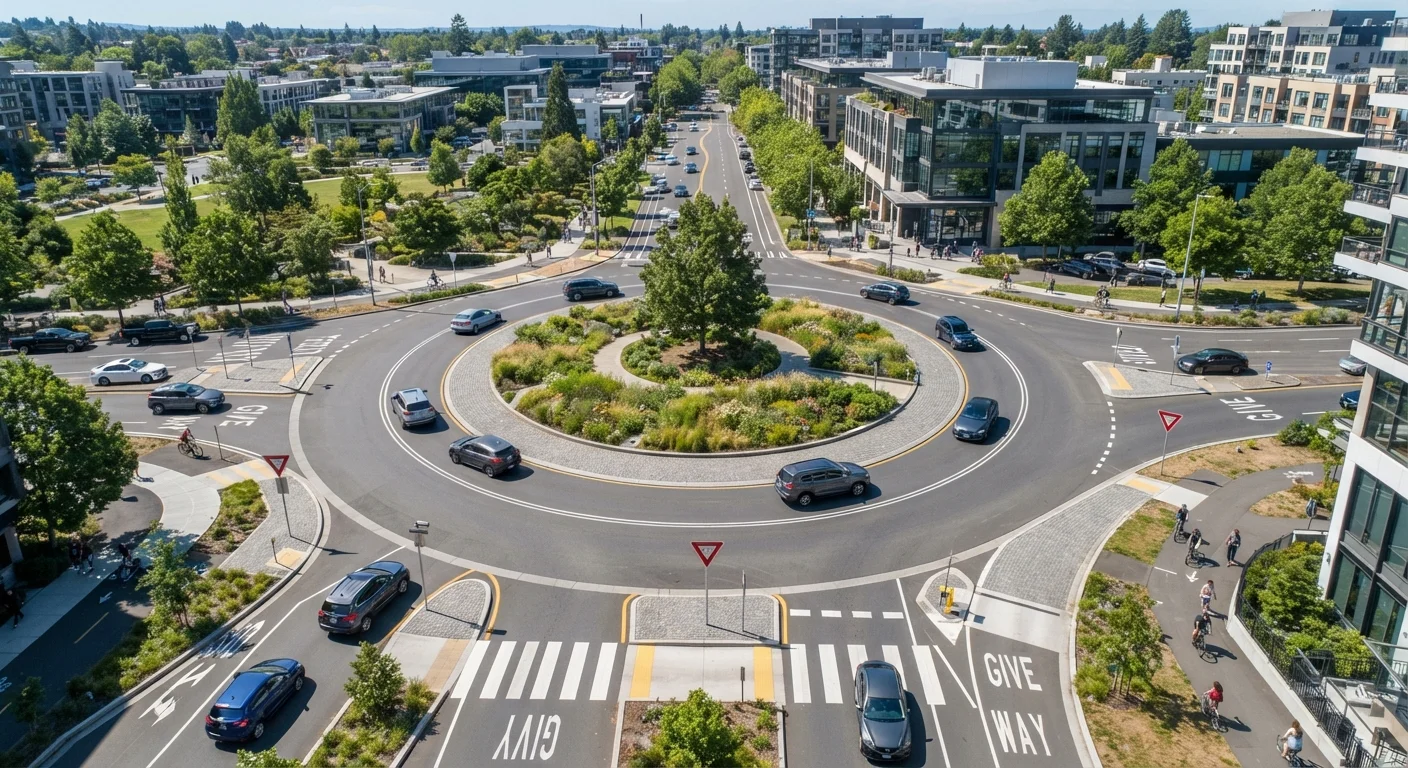
Key Takeaways
- Vehicles already inside the roundabout always have the right of way over entering traffic.
- Yield at the entry point — never stop inside the circle unless traffic demands it.
- Choose your lane before entering based on which exit you need.
- Signal your exit so other drivers and pedestrians can anticipate your move.
- Multi-lane roundabouts require staying in your chosen lane throughout the circle.
- Slow, predictable driving is safer than rushing through gaps in traffic.
What you will need
Why Roundabouts Trip Up So Many Drivers
If you learned to drive on four-way stops and traffic lights, a roundabout can feel like an unwritten rule you were never taught. The good news: the logic is simple once it clicks. Roundabouts move traffic in one direction — counterclockwise in the US — around a central island. There are no red lights, no all-way stops, and no left turns that cut across oncoming traffic.
The core rule is straightforward: traffic inside the circle has the right of way. You yield at the entry, wait for a safe gap, then merge in. This single principle resolves almost every moment of confusion a roundabout creates.
Roundabouts are intentionally designed to reduce serious crash risk. Because all vehicles travel in the same direction at low speeds, head-on and high-speed angle collisions — the most dangerous types — are essentially eliminated. Understanding the design helps you trust the system instead of fighting it.
For a broader look at right-of-way rules and traffic fundamentals, see Road Safety: A Complete Reference for Everyday Drivers.
What you will need
Choosing the Right Lane Before You Enter
Lane selection is the step most drivers skip, and it's where multi-lane roundabout mistakes are born. As a general rule used in most US jurisdictions:
- Right lane: Use when taking the first exit (turning right) or going straight.
- Left lane: Use when going straight, turning left (second or third exit), or making a full U-turn.
Check pavement markings and directional signs posted before the entry point — these will confirm the correct lane for your exit. Don't rely on memory alone; local roundabout layouts vary.
Look for Pavement Arrows Early
US roundabout approach lanes almost always have painted arrows and exit-destination signs posted well before the yield line. Glance at these as soon as you see the roundabout ahead — not at the last second. Making lane decisions early reduces hesitation and makes your driving more predictable to everyone around you.
Once you've selected a lane, commit to it. Changing lanes inside the circle is one of the leading causes of roundabout collisions. Think of your lane choice as a contract you make before you enter.
Roundabout navigation shares some instincts with highway merging — you're reading gaps and committing to a path. Our guide to merging onto a highway covers that related skill if you want to build on it.
Step-by-Step: Navigating a Roundabout Safely
Follow these steps each time you approach a roundabout, whether it's single-lane or multi-lane. With repetition, the sequence becomes automatic.
Slow down on the approach
Reduce your speed well before the yield line. Most roundabouts are designed for entry speeds of 15–25 mph. Look for the yellow advisory speed sign posted on the approach and treat it as a real target, not just a suggestion.
Select your lane before the entry
Read the overhead or roadside signs and the pavement arrows. Match your lane to your intended exit. For a single-lane roundabout, this step is automatic — there's only one option.
Yield to circulating traffic
At the dashed yield line, check for vehicles already inside the roundabout coming from your left. Wait for a gap large enough to enter smoothly — you should not have to brake hard once you're in the circle.
Enter and maintain your lane
Merge into the circle at a steady, controlled speed. Keep pace with circulating traffic — don't slow dramatically once inside. Stay in your chosen lane and keep a safe following distance from the vehicle ahead.
Signal and exit
As you pass the exit before yours, activate your right turn signal. This tells other drivers and pedestrians that you are about to leave the circle. Exit at a controlled speed and yield to any pedestrians in the crosswalk on the exit leg.
Special Situations to Watch For
Pedestrians and cyclists: Most roundabouts have crosswalks on the approach roads, not inside the circle. Yield to pedestrians crossing your entry or exit leg before you enter or exit — this is legally required in all US states. Cyclists may ride in the travel lane rather than the shoulder; give them space and don't pressure them to move faster.
Large vehicles: Trucks and buses sometimes need to use both lanes or mount the truck apron (the raised, textured ring around the central island) to complete the turn. If you see a large vehicle entering or circling, give it extra clearance — don't try to squeeze through alongside it.
Emergency vehicles: If you hear sirens while inside a roundabout, complete your exit first, then pull over on the exit road. Stopping inside the circle creates a blockage and puts everyone at risk.
Don't Stop Inside the Roundabout
Stopping mid-circle — unless you're about to hit something — creates a chain-reaction hazard. Drivers entering behind you won't expect a stationary vehicle in the flow lane. If you miss your exit, stay calm: simply continue around the circle and take your exit on the next pass.
New or anxious drivers sometimes freeze at the yield line. If you're still building confidence in traffic situations, Driving Safety from Scratch is a solid starting point for the broader skills that underpin roundabout navigation.