

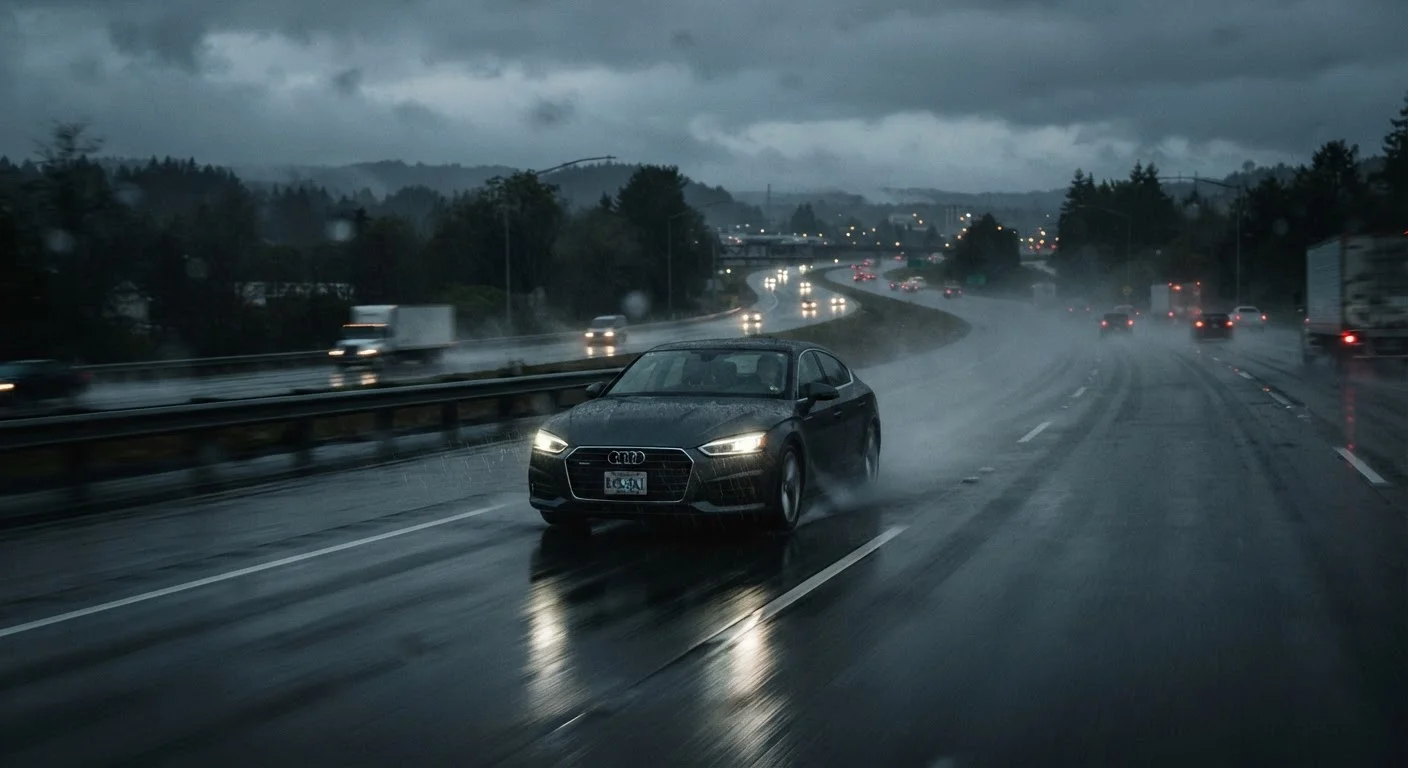
Key Takeaways
- Hydroplaning can occur at speeds as low as 35 mph — you don't need to be going fast.
- Braking hard during a skid is one of the most common and dangerous instinctive reactions.
- Following distance should roughly double in heavy rain compared to dry conditions.
- Worn tires dramatically increase your hydroplaning risk, even in moderate rainfall.
- Turning on headlights in rain is required by law in most U.S. states, not just a courtesy.
Hydroplaning
Hydroplaning happens when a layer of water builds up between your tires and the road surface faster than your tires can push it away. At that point, your tires lose contact with the pavement and your car is essentially skimming on water. Steering, braking, and acceleration all lose effectiveness almost instantly.
Hydroplaning risk increases significantly above 35 mph on wet roads and is heavily influenced by tire tread depth, tire pressure, and water depth on the surface.
Why Rain Catches Even Experienced Drivers Off Guard
Most drivers feel reasonably confident in light rain. The trouble starts when that drizzle turns into a downpour and the road surface changes faster than your awareness does. Water doesn't just reduce visibility — it fundamentally changes how your car interacts with the pavement.
The instincts that serve you well on dry roads — braking firmly, steering quickly, accelerating through a slide — can work directly against you when the road is wet. Understanding why rain changes your car's behavior is the first step to adjusting your responses in real time.
For a broader foundation on staying safe behind the wheel, see our introduction to road safety for new drivers.
~75%
Weather-related crashes occurring on wet pavement
According to data from the U.S. Federal Highway Administration, the majority of weather-related vehicle crashes happen on wet roads rather than in snow or ice.
35 mph
Speed at which hydroplaning can begin
Tire engineers and safety researchers generally cite speeds around 35 mph as the threshold where hydroplaning risk becomes meaningful on wet roads.
50%+
Potential increase in wet-road stopping distance
Wet pavement significantly extends braking distances compared to dry conditions, with the increase varying based on speed, tire condition, and road surface.
What Hydroplaning Actually Feels Like
Hydroplaning rarely announces itself dramatically. In many cases, the steering wheel suddenly feels light, almost effortless — because it is. Your front tires are no longer gripping the road. You may notice the engine revving without the car accelerating, or the rear of the car starting to drift sideways.
The instinctive response for most people is to brake hard or yank the wheel. Both reactions can cause a spin or send the car in an unintended direction. The correct response is counterintuitive: ease off the accelerator smoothly and hold the wheel steady, pointing where you want to go. Let the tires gradually reconnect with the road surface before making any steering corrections.
This is also why cruise control in rain is a real hazard — it can reapply throttle the moment traction dips, making a hydroplane worse rather than better.
Turn Off Cruise Control When Roads Are Wet
Cruise control is designed for steady, predictable conditions. On wet roads, it can reapply throttle when traction dips — the opposite of what you want. Switch it off as soon as rain starts and drive with your foot on the pedal so you have full, immediate control.
Stopping Distance Changes More Than You Think
On a dry road, a car traveling at 60 mph typically needs roughly 300 feet to stop — factoring in reaction time and braking distance. On a wet road, that number can increase by 50% or more depending on tire condition, road surface, and rainfall intensity.
Most drivers don't adjust their following distance enough to account for this. The physics of tailgating are already unforgiving on dry roads — in rain, the margin for error shrinks further. A good rule of thumb: double the following distance you'd use in dry conditions.
Intersections, bridges, and shaded spots under trees tend to be the slipperiest areas. Bridges cool faster than road surfaces and can retain standing water longer, so extra caution at those points is warranted.
What Your Tires Are Actually Doing
Tire tread isn't just a grip surface — those grooves are channels designed to push water out from under the contact patch. A tire in good condition can evacuate several gallons of water per minute at highway speeds. When tread wears down, that capacity drops sharply, and the risk of hydroplaning rises even in moderate rain.
Tire pressure matters too. Under-inflated tires flex more, which can reduce the efficiency of those water-evacuation channels. It's worth checking your tire pressure regularly — not just before long trips. See our car maintenance hub for guidance on what to check and how often.
You don't need to be a mechanic to assess basic tire health. Insert a quarter into a tread groove with Washington's head facing down — if you can see the top of his head, the tread is getting low and it's time to have the tires evaluated by a professional.
Visibility and the Lights Rule Most Drivers Get Wrong
Headlights in rain are about being seen as much as seeing. In heavy rain, your car can become nearly invisible to other drivers — especially against a gray sky or on a road with standing water creating glare. In most U.S. states, the law requires headlights whenever windshield wipers are in use. This isn't just a courtesy; it's a safety rule with legal weight.
Avoid using high beams in heavy rain. The extra light reflects off the water droplets and actually reduces how far ahead you can see. Low beams keep the light angled toward the road surface, which is where it's most useful.
Slowing down is non-negotiable when visibility drops significantly. If conditions become severe enough that you cannot see the road clearly ahead, it's safer to pull well off the road — past the shoulder if possible — turn on your hazard lights, and wait for conditions to improve. Rain-related crashes often happen when drivers try to push through conditions their speed doesn't match. For a comparison of how other adverse conditions demand different adjustments, see our guide on driving in fog, ice, and wind.