

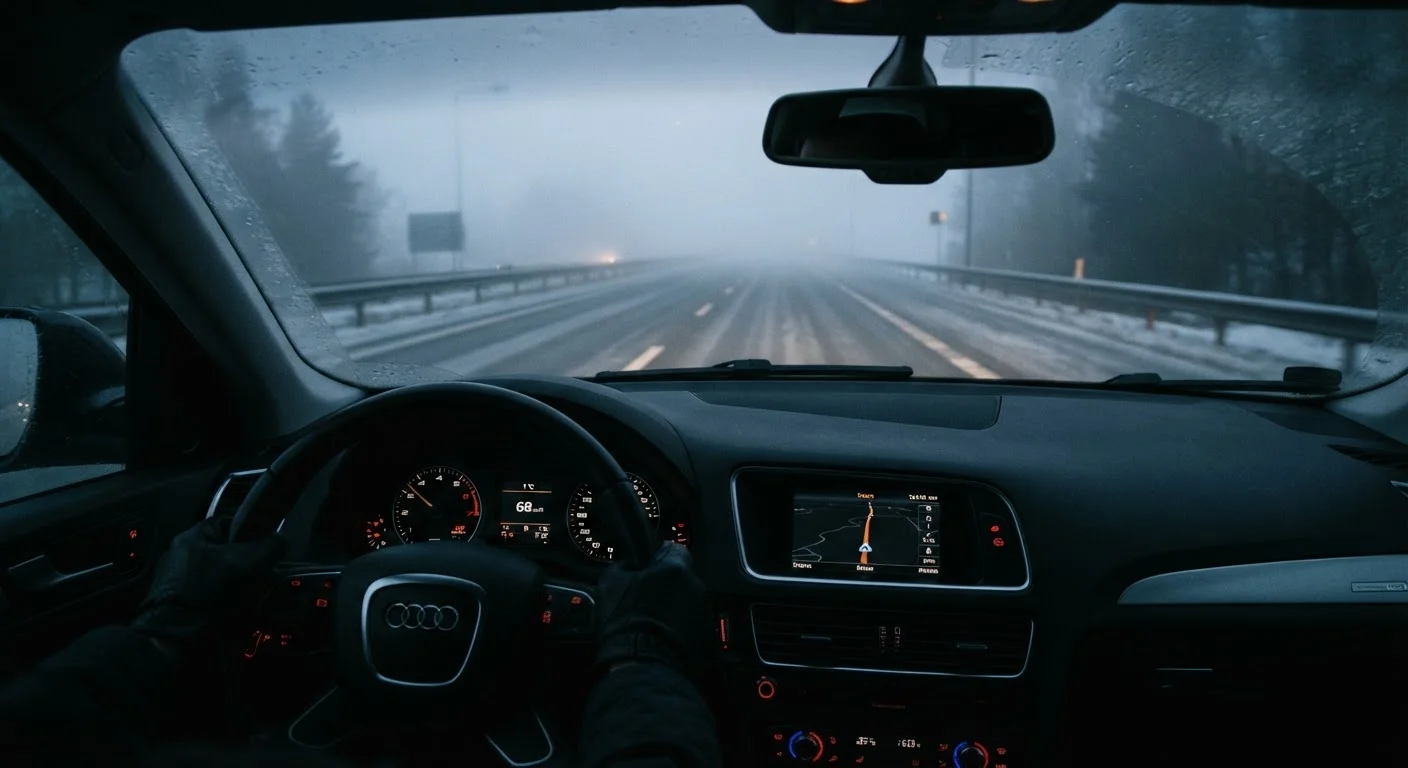
Key Takeaways
- Fog reduces visibility most — slow down, use low beams, and increase following distance significantly.
- Black ice is nearly invisible; gentle, smooth inputs to steering and braking are critical on icy roads.
- Strong crosswinds affect high-profile vehicles most and require a firm, two-handed grip and reduced speed.
- Each condition changes your stopping distance, visibility, and vehicle control in distinct ways.
- When conditions are severe, pulling over and waiting is always a safe, valid choice.
Our Verdict
Fog, ice, and wind aren't just different degrees of 'bad weather' — they're fundamentally different problems that require different techniques. Fog calls for visibility management, ice demands ultra-smooth vehicle inputs, and wind requires active steering correction. Treating them the same is where drivers get into trouble.
| Best for | Recommended |
|---|---|
| Driving in heavy fog | Low beams, reduced speed, maximum following distance |
| Driving on icy or black-ice roads | Slow acceleration, early braking, gentle steering inputs |
| Driving in high crosswinds | Two-handed grip, reduced speed on open stretches, extra caution near large vehicles |
| Conditions too severe to drive safely | Pull over in a safe, visible location and wait it out |
Why Weather Conditions Aren't Interchangeable
Most drivers know to slow down when the weather turns bad — but that instinct only gets you partway there. Fog, ice, and wind each attack a different part of your ability to drive safely. Fog is a visibility problem. Ice is a traction and physics problem. Wind is a vehicle-control problem. Responding to all three the same way leaves you underprepared for two of them.
Rain is similar — conditions that look manageable can change fast. The key is knowing what each hazard actually does to your car and your sightlines before you encounter it.
| Fog | Ice / Black Ice | High Crosswinds | |
|---|---|---|---|
| Primary hazard | Reduced visibility | Loss of traction | Lateral vehicle displacement |
| Speed adjustment | Slow to match sight distance | Reduce significantly, accelerate gently | Reduce, especially on open roads |
| Headlight setting | Low beams or fog lights | Normal low beams | Normal low beams |
| Following distance | Double or more | Triple to quadruple | Increase moderately |
| Key driving input | Smooth, predictable speed | Gentle braking and steering | Firm two-handed grip |
| Vehicles most affected | All vehicles equally | All vehicles; AWD does not prevent sliding | High-profile vehicles, SUVs, trailers |
| When to stop driving | Near-zero visibility | Uncontrollable sliding | Gusts above ~45–50 mph on exposed roads |
Driving in Fog: Managing What You Can't See
Fog cuts visibility sometimes to just a few car lengths. Your headlights can make things worse: high beams reflect off water droplets and bounce light back at you, which is why low beams — or dedicated fog lights if your car has them — are the right tool here.
The bigger adjustment is speed. At 55 mph, you're traveling about 80 feet per second. If you can only see 100 feet ahead in dense fog, that's barely more than a second of reaction time. Slow down enough that you can stop within the distance you can actually see — not what you assume is ahead.
- Keep at least double your normal following distance
- Use low-beam headlights, not high beams
- Turn on hazard lights only if you're pulled over — not while moving, as some states prohibit this while driving
- Watch for taillights ahead, not just the road itself
If visibility drops to near zero, find a safe place to exit the road entirely. Parking on a shoulder in dense fog is dangerous; other drivers may follow your lights thinking you're moving traffic.
Driving on Ice: Small Inputs, Big Consequences
Ice — especially black ice (a thin, nearly transparent layer that forms on pavement) — is treacherous because it's often invisible. Bridges, overpasses, shaded road sections, and intersections are common hotspots because they lose heat faster than other surfaces.
The core principle on ice is this: every input you make — steering, braking, accelerating — needs to be slow and smooth. Jerky movements break traction, and once traction is gone, you have very little ability to recover it quickly.
Test Traction Before You Need It
When you first pull onto a road that might be icy, find a safe, low-traffic stretch and gently tap your brakes to feel how the car responds. This gives you real information about road conditions before you're in a situation where you need to stop urgently. Do this well below normal speed and only when it's safe to do so.
- Accelerate gradually — spinning wheels on ice dig in and lose grip entirely
- Brake early and gently — if you have ABS (anti-lock braking system), apply steady pressure; if not, threshold braking (firm but not locked) helps
- Steer smoothly — sharp turns can cause the car to slide rather than turn
- Leave three to four times the normal following distance
All-wheel drive helps you move in slippery conditions, but it doesn't help you stop any faster. Don't let AWD create overconfidence — overconfidence is one of the most common ways experienced drivers get into trouble.
Driving in High Winds: Holding Your Line
Crosswinds — especially strong gusts — can push your vehicle sideways mid-lane without warning. This is especially pronounced on highways, open bridges, and flat rural stretches where there are no trees or buildings to break the wind. High-profile vehicles like SUVs, trucks, and vans are more vulnerable than low sedans.
The primary adjustment is grip and anticipation:
- Keep both hands on the wheel at all times
- Expect sudden lateral pushes, particularly when passing large trucks or exiting tunnels
- Reduce speed to give yourself more reaction time and reduce the wind's effect on the car's body
- Watch for debris, branches, or unsecured loads from other vehicles
When a gust hits, resist the urge to overcorrect. Steer smoothly back toward your lane — sharp counter-steering in a gust can send you in the opposite direction. If winds are severe (weather alerts often flag gusts over 45–50 mph), consider delaying travel on exposed highway stretches, particularly if driving an SUV, van, or towing a trailer.
For more general driving awareness, see our guide on night driving habits that reduce risk — many of the same vigilance principles apply across conditions.