

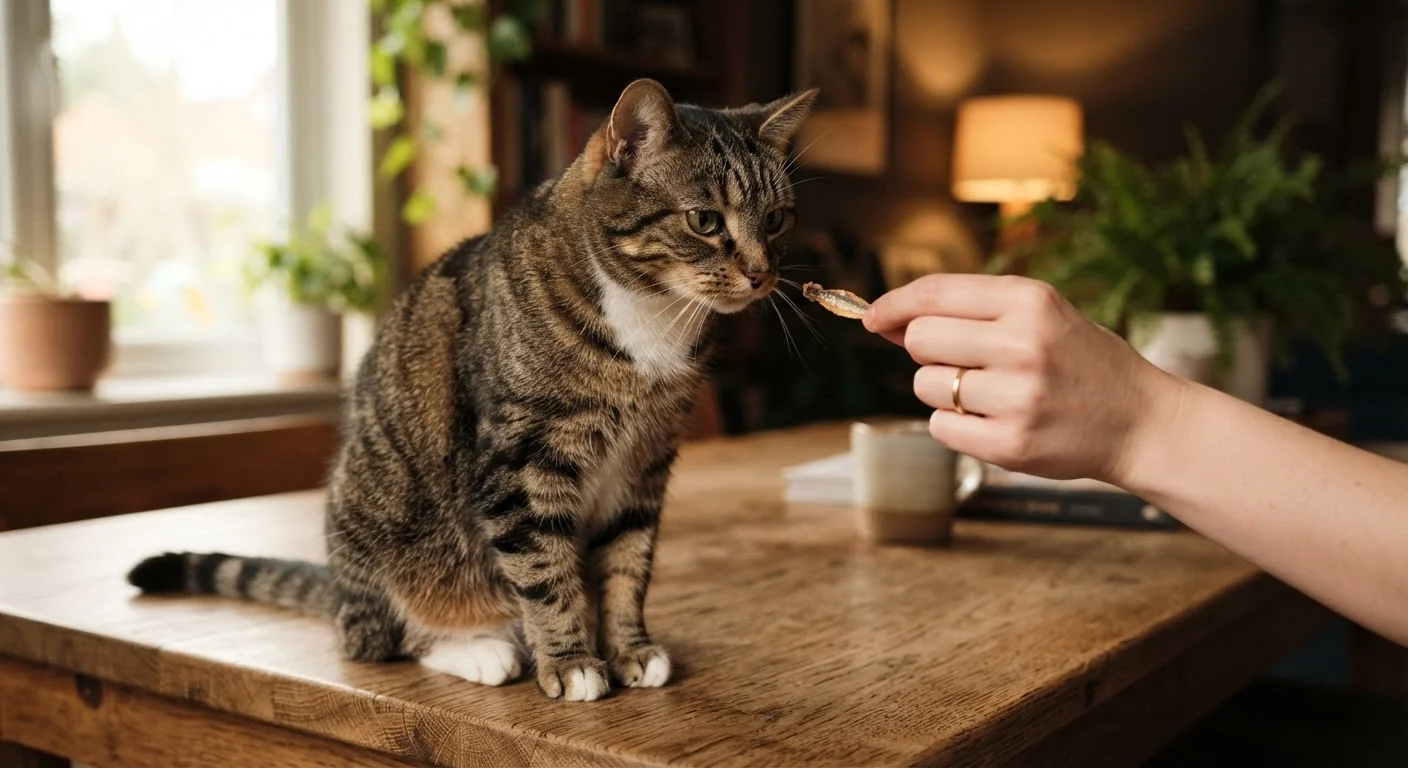
Key Takeaways
- Cats are fully capable of learning cues, behaviors, and routines through positive reinforcement.
- Punishment-based methods are ineffective with cats and can damage your bond with them.
- Short, consistent training sessions work far better than infrequent, lengthy ones.
- Food motivation varies by cat — finding the right reward is key to progress.
- Age is not a barrier; adult and senior cats can learn new behaviors successfully.
Why Cat Training Myths Are So Stubborn
Cats have shared our homes for thousands of years, yet they remain widely misunderstood — especially when it comes to training. Unlike dogs, which were selectively bred over millennia for responsiveness to human direction, cats domesticated themselves largely on their own terms. That history feeds a cultural narrative that cats are aloof, uncooperative, and beyond instruction.
The reality, supported by decades of animal behavior research, is far more nuanced. Cats are curious, motivated learners — they simply respond to a different set of signals than dogs do. When training fails, the culprit is almost always method, not species. Getting past the myths is the first step toward a more cooperative relationship with your cat.
Myth
Cats can't be trained — they're too independent to follow instructions.
Fact
Cats are highly trainable using positive reinforcement; their independence simply means they need a different approach than dogs.
The idea that cats are untrainable is one of the most persistent myths in pet ownership. Cats learn through the same fundamental process as dogs — operant conditioning (the association between a behavior and its consequence). They can reliably learn to sit, come when called, use a scratching post on cue, and even perform complex trick chains. The difference is that cats are less motivated by social approval and more motivated by direct rewards. Once you identify what your individual cat finds rewarding — usually a specific food treat or a play session — training becomes very achievable. If you're new to the terminology, our pet training glossary breaks down concepts like operant conditioning in plain language.
Myth
You have to start training a cat as a kitten, or it's too late.
Fact
Adult and senior cats learn new behaviors just as effectively as kittens when sessions are appropriately structured.
While kittens do have a socialization window that shapes their comfort with new experiences, learning itself is not age-limited. Adult cats can absolutely acquire new cues and change unwanted habits. In some ways, older cats are easier to work with: they're calmer, less easily distracted, and better able to sustain brief focus. The key adjustment is patience — an older cat with established routines may take slightly longer to build new associations, but the learning process works the same way. Consistent, short sessions of two to five minutes remain the most effective format at any age.
Myth
Punishing a cat — like spraying it with water — teaches it what not to do.
Fact
Punishment suppresses behavior in the moment but does not teach the cat what to do instead, and it erodes trust.
When a cat is startled or hurt, it learns to associate you with that unpleasant experience — not the behavior you're trying to stop. The result is often a cat that performs the unwanted behavior when you're not present, or one that becomes anxious or avoidant around you. Positive reinforcement — rewarding the behavior you want — is far more durable. Redirect unwanted behaviors toward acceptable alternatives and reward those instead. For a broader look at how this principle applies from day one, see our training roadmap for new pet owners.
Myth
Cats are only trainable with food, so cats that aren't food-motivated can't be trained.
Fact
Food is the most common reward, but play, petting, and verbal praise can all serve as effective reinforcers for the right cat.
Motivation is individual. While high-value food treats — small, soft, and smelly — work for the majority of cats, some individuals respond more strongly to a brief play session with a wand toy, a chin scratch, or even the sound of a clicker followed by access to a favorite resting spot. The practical step is to experiment. Offer different rewards across multiple short sessions and observe which produces the most enthusiastic response and the fastest re-engagement. That's your primary reinforcer. It's also worth noting that cats trained before meals tend to be more food-motivated than cats trained right after eating.
Myth
If a cat does something wrong after being trained, it's being spiteful or dominant.
Fact
Cats do not act out of spite; regression usually signals a training gap, a health issue, or an environmental stressor.
Attributing human emotions like spite or dominance to cats misrepresents how feline cognition works. When a trained behavior breaks down — for example, a cat that previously used its litter box starts going elsewhere — the causes are almost always practical: a change in litter type, a dirty box, a new stressor in the home, or an underlying medical issue like a urinary tract problem. Before concluding a cat is being defiant, rule out health causes with a veterinary check, then assess what changed in the environment. Behavioral regression is information, not a moral failing. You can also explore how persistent myths about cat health can complicate this kind of problem-solving in our piece on common pet health myths.
What Effective Cat Training Actually Looks Like
Successful cat training relies on a few consistent principles. First, timing matters enormously: the reward must follow the desired behavior within one to two seconds for the cat to form the correct association. Second, sessions should be brief — two to five minutes is typically the sweet spot — and conducted when your cat is alert but calm, not right after waking or during a high-energy play phase.
Third, end every session on a win. Ask for a behavior your cat already knows reliably, reward it, then stop. This keeps the training experience positive and your cat eager to engage next time.
Don't Mistake Disinterest for Inability
If your cat walks away during training, it's a signal — not a personality flaw. Cats have shorter attention spans than dogs and are sensitive to stress, hunger, and environmental distractions. Ending a session before your cat disengages, rather than after, keeps training associated with positive experiences.
Consistency across everyone in the household is equally important. If one person allows a behavior that another discourages, the cat receives conflicting information and learning stalls. Agree on house rules before you begin, and apply them uniformly. For owners managing feeding alongside training, understanding reward timing relative to meals is worth exploring — our article on feeding schedules and portion myths covers the basics of meal structure that can support your training routine.
Punishment Can Backfire Seriously
Spraying cats with water, yelling, or physically correcting them does not teach them what you want — it teaches them to fear you or avoid the situation entirely. Animal behaviorists consistently recommend removing punishment from your training toolkit. A damaged trust relationship is much harder to repair than a bad habit.
Finally, remember that training is not a one-time event. Behaviors that aren't practiced periodically will fade. A few quick reinforcements each week maintain what your cat has learned and keep your communication channels open.