

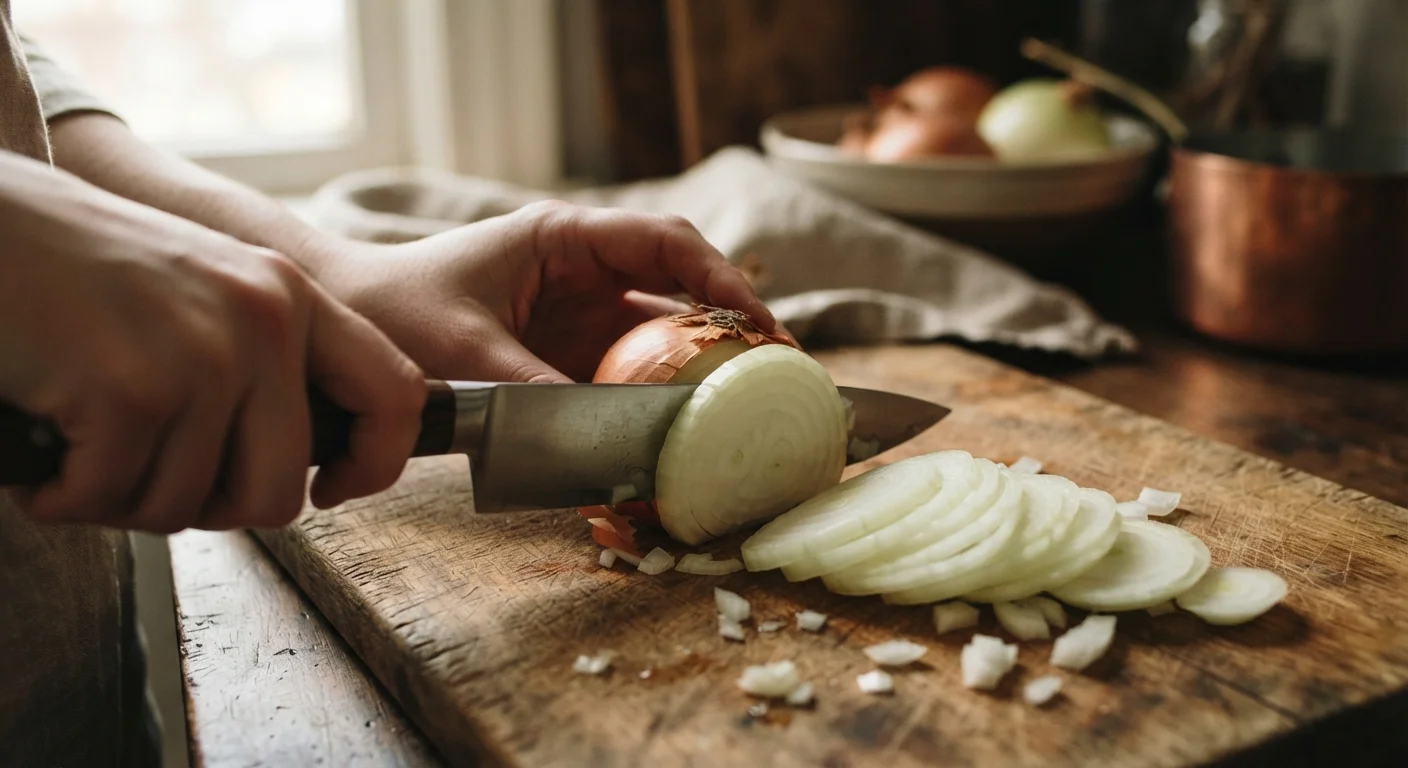
Key Takeaways
- Onions make you cry because cutting them releases a volatile sulfur compound that irritates your eyes.
- Colder onions release less gas — chilling before cutting is one of the most effective reduction methods.
- A sharp knife causes less cell damage and therefore less tear-inducing chemical release.
- The root end of an onion has the highest enzyme concentration — cut it last.
- Ventilation and distance from the cutting board can meaningfully reduce eye irritation.
- Some onion varieties are naturally lower in tear-causing compounds than others.
Lachrymatory Factor (LF)
When you cut an onion, you break open its cells and trigger a chain of chemical reactions that produce a volatile compound called syn-propanethial-S-oxide — commonly called the lachrymatory factor. This gas floats up to your eyes, reacts with moisture on the surface, and forms a mild sulfuric acid that irritates your tear glands. Your eyes then produce tears to flush out the irritant. It's your body working exactly as it should — just at an inconvenient moment.
The lachrymatory factor is produced when the enzyme alliinase acts on sulfur-containing amino acids released by cell damage, generating sulfenic acids that are rapidly converted to the tear-inducing gas by a separate enzyme called lachrymatory-factor synthase.
The Chemistry Happening Inside Your Onion
An onion is essentially a layered chemical storage system. While it grows, it accumulates sulfur-containing compounds as a natural defense against soil pathogens and insects. These compounds are kept separate from the enzymes that would react with them — until a knife comes along and breaks that barrier.
The moment you slice through an onion's cell walls, an enzyme called alliinase is released and immediately begins converting those stored sulfur compounds into unstable sulfenic acids. A second enzyme, lachrymatory-factor synthase, rapidly transforms those acids into the volatile gas syn-propanethial-S-oxide. That gas is lighter than air, rises quickly, and makes a beeline for your eyes.
Once it contacts the moisture on your corneas, it converts into a very dilute sulfuric acid. That's enough to activate your trigeminal nerve and signal your lacrimal glands to produce tears. The intensity depends on how many cells you rupture — which is why rough, crushing cuts cause far more irritation than clean, precise slices.
“The chemistry of the onion is a elegant example of a plant's evolved defense system being inadvertently triggered by the cook's knife. Understanding that mechanism is the first step toward working around it.”
— Harold McGee, Food science writer and author of On Food and Cooking
Why Some Cutting Sessions Are Worse Than Others
If you've noticed that onions don't always make you cry equally, you're not imagining it. Several variables affect how much lachrymatory factor gets released and how quickly it reaches your eyes.
- Knife sharpness: A dull blade crushes and tears cells rather than slicing cleanly through them, rupturing far more cellular structure and releasing more reactive compounds. A sharp chef's knife is one of the most practical tools for reducing irritation.
- Onion temperature: Enzymes work more slowly at lower temperatures. A room-temperature onion off the counter produces more gas than one that's been refrigerating for half an hour.
- Your distance from the board: The gas disperses quickly. Standing even a few inches farther back from your cutting surface — or tilting your head away slightly — can reduce exposure meaningfully.
- Kitchen ventilation: A kitchen exhaust fan or even an open window creates airflow that disperses the gas before it concentrates around your face.
- Onion variety and freshness: Older onions and sharper varieties (like standard yellow or white onions) tend to have higher enzyme concentrations. Freshly harvested sweet onions are typically milder.
The Single Biggest Improvement You Can Make
If you only change one habit, make it knife sharpness. A sharp blade is the most controllable variable in your kitchen — it reduces cell damage, speeds up your prep time, and makes every cutting task safer and more precise. Most home knives benefit from honing before each use and professional sharpening a couple of times a year.
Practical Strategies That Actually Work
You don't need specialty equipment or elaborate rituals to reduce onion-induced tears. A few technique adjustments go a long way.
- Chill the onion first. Place it in the refrigerator for 30 minutes before you begin. This slows enzyme activity at the source without affecting how the onion cooks or tastes.
- Use your sharpest knife. A properly sharpened blade causes minimal cell damage per cut. Honing your knife before prep work is a small habit with a real payoff.
- Cut the root end last. The root stores the highest enzyme concentration. Work from the stem end and remove the root only when necessary.
- Work near ventilation. Turn on your range hood or crack a window. Moving air carries the gas away from your face faster than it can accumulate.
- Work quickly and confidently. The longer you spend cutting, the more gas accumulates. Efficient knife work — not rushed, but deliberate — limits total exposure time.
None of these strategies will eliminate every tear, but combining two or three of them makes a noticeable difference for most cooks. Over time, these adjustments become second nature, and onion prep stops feeling like an ordeal.
~30 min
Refrigeration time to slow enzyme activity
Food science guidance generally suggests 30 minutes of chilling is sufficient to meaningfully reduce lachrymatory factor release during cutting.
2x+
More cell damage from a dull versus sharp knife
Culinary educators note that a blade that crushes rather than slices can rupture significantly more cells per cut, amplifying the chemical reaction.