

| Best for hair penetration | Coconut oil (lauric acid structure allows partial shaft penetration) (Journal of Cosmetic Science) |
| Most skin-type versatile | Jojoba (mimics natural sebum; waxy, non-greasy feel) |
| Fastest to oxidize | Rosehip oil (store in dark, cool conditions; use within 6 months of opening) |
| Typical application method | Apply to damp skin or hair immediately after washing |
| Patch test window | Apply to inner forearm; wait 24 hours before full use |
| Not recommended for acne-prone facial skin | Coconut oil (high comedogenic potential on face) |
What Natural Oils Actually Do
Natural oils have been used in hair and skin care for centuries, but the marketing language around them can make it hard to know what you're actually getting. In plain terms, oils serve a few basic functions: they help lock moisture into the skin or hair shaft, they soften texture, and some have mild anti-inflammatory or antimicrobial properties backed by research.
It helps to understand the difference between two broad categories. Emollient oils smooth and soften the surface by filling gaps between skin cells. Occlusive oils form a physical barrier that slows water loss. Many oils do both to varying degrees. Neither type adds water — they work best applied to damp skin or hair, sealing in the moisture already there.
If you're still figuring out how your skin responds to different ingredients, our guide on understanding your skin type is a useful starting point. And for a broader look at how oils appear alongside other actives on product labels, see our ingredient label reference.
| Best for hair penetration | Coconut oil (lauric acid structure allows partial shaft penetration) (Journal of Cosmetic Science) |
| Most skin-type versatile | Jojoba (mimics natural sebum; waxy, non-greasy feel) |
| Fastest to oxidize | Rosehip oil (store in dark, cool conditions; use within 6 months of opening) |
| Typical application method | Apply to damp skin or hair immediately after washing |
| Patch test window | Apply to inner forearm; wait 24 hours before full use |
| Not recommended for acne-prone facial skin | Coconut oil (high comedogenic potential on face) |
A Breakdown of the Most Common Oils
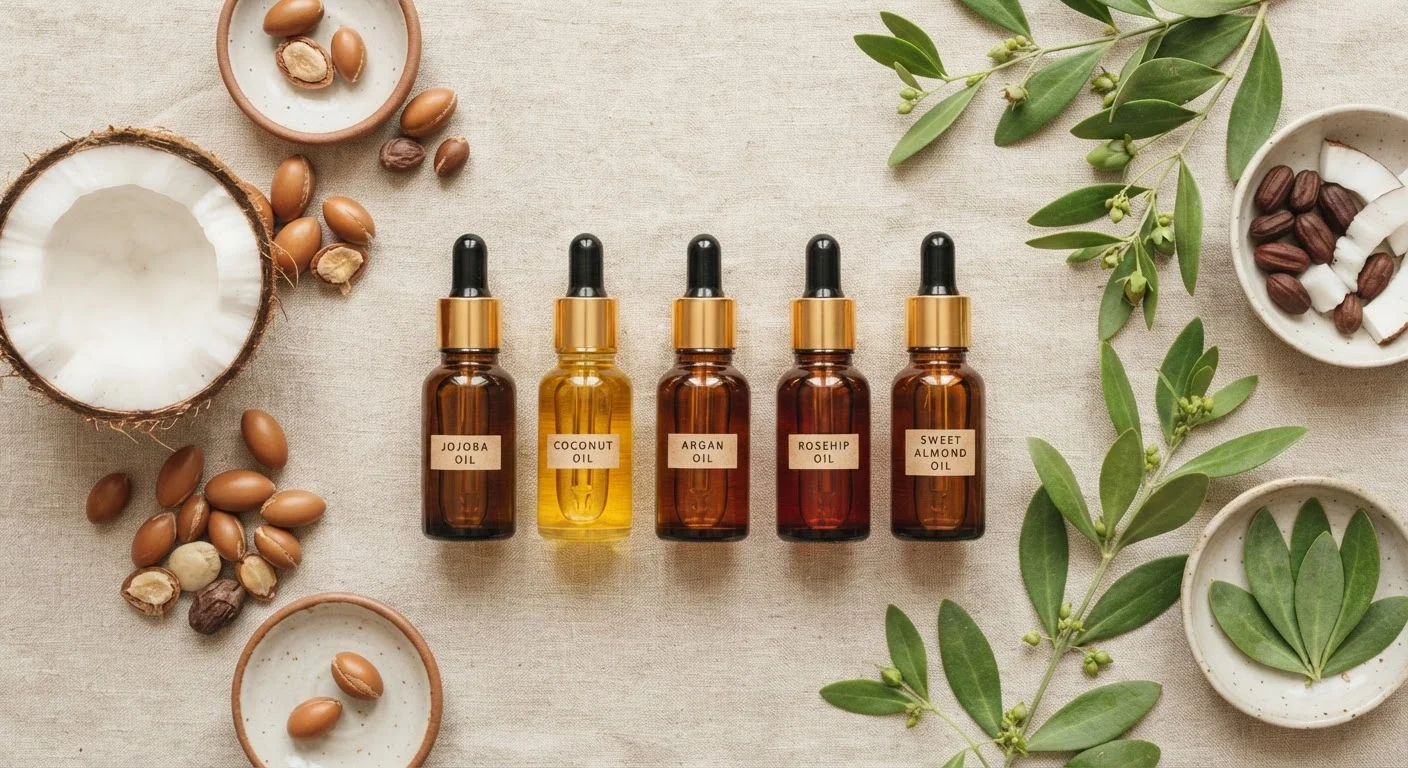
Below is a plain-language look at five oils you'll encounter frequently, along with how each is generally used and what the evidence actually supports.
Emollient
A substance that softens and smooths the skin or hair surface by filling gaps between cells. Emollient oils improve texture and reduce roughness without necessarily forming a physical barrier.
Occlusive
An ingredient that forms a physical layer on the skin to slow transepidermal water loss (TEWL). Occlusives don't add moisture themselves — they prevent existing moisture from evaporating.
Carrier Oil
A base oil used to dilute concentrated substances like essential oils before they are applied to skin. Common examples include jojoba, sweet almond, and fractionated coconut oil.
Oxidation
A chemical reaction that occurs when oil is exposed to air, light, or heat over time. Oxidized oil smells rancid and may irritate skin rather than benefit it.
Linoleic Acid
An omega-6 fatty acid found in many plant oils. Skin cannot produce it on its own, and some research links topical linoleic acid to improved skin barrier function.
Oleic Acid
An omega-9 fatty acid common in oils like argan and sweet almond. It is relatively occlusive and absorbs more slowly than linoleic acid, making it especially useful for drier skin types.
Coconut Oil
One of the most studied plant oils in hair care, coconut oil is rich in lauric acid, a medium-chain fatty acid that can partially penetrate the hair shaft. Research published in the Journal of Cosmetic Science found it reduced protein loss in hair more effectively than mineral oil or sunflower oil in a pre-wash treatment. On skin, it works well as a body moisturizer for most people, though its pore-clogging potential makes it a poor choice for acne-prone facial skin.
Argan Oil
Pressed from the kernels of the argan tree, argan oil is high in oleic and linoleic acids along with vitamin E. It absorbs relatively quickly and is commonly used on both hair (to tame frizz and add shine) and face (as a light moisturizing oil). It's generally well-tolerated across skin types.
Jojoba Oil
Technically a liquid wax rather than a true oil, jojoba closely mimics the skin's own sebum. This makes it one of the more versatile options — it works as a light facial moisturizer, a carrier for other ingredients, and a scalp conditioner. Its waxy structure also gives it a longer shelf life than many other plant oils.
Rosehip Oil
Pressed from the seeds of rosehips, this oil is high in linoleic acid and contains naturally occurring trans-retinoic acid, a form of vitamin A. It's commonly used on the face and is often cited in connection with hyperpigmentation and scar appearance, though results vary and evidence is still developing. It oxidizes faster than some other oils, so storage matters.
Sweet Almond Oil
A lightweight, mild option high in oleic acid and vitamin E. Often used as a body oil or massage oil, it absorbs reasonably well and is generally gentle on sensitive skin. It's also a common carrier oil when diluting essential oils — though essential oils should always be diluted before skin contact.
For readers managing curly or coily hair, oils play a particularly important role in sealing moisture. See our guide on caring for curly and coily hair for context on where oils fit into that routine.
How to Use Natural Oils Practically
A few general principles apply regardless of which oil you choose:
- Apply to damp skin or hair. Oils don't add moisture — they seal it in. Apply immediately after bathing or washing while the surface is still slightly wet.
- Less is usually more. A few drops go a long way, especially on the face or fine hair. Using too much can leave a heavy or greasy residue.
- Patch test first. Even natural oils can trigger reactions in some people. Apply a small amount to the inner forearm and wait 24 hours before widespread use.
- Check for oxidation. Oils can go rancid. A sour or off smell means the oil has oxidized and should be discarded. Store oils in a cool, dark place and pay attention to expiration dates.
- Be cautious with nut-based oils if you have known nut allergies. Speak with a healthcare provider before use.
For a broader understanding of how ingredients like these interact in formulated products, the common skincare ingredients reference is worth reading alongside this guide.
This article is for general informational purposes only and is not a substitute for professional medical or dermatological advice. If you have a skin condition, allergy, or specific health concern, consult a qualified healthcare provider before changing your routine.